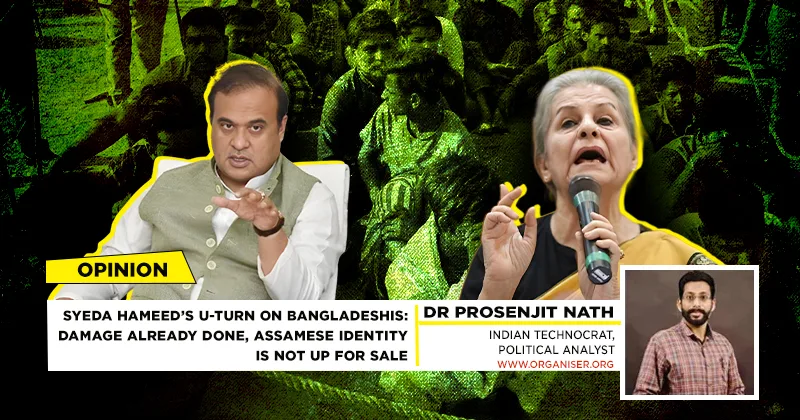
Days after she triggered a storm by defending illegal Bangladeshi migrants in Assam, former Planning Commission member and veteran activist Syeda Saiyidain Hameed has now attempted a retreat. At a public event in Guwahati, she had brazenly remarked, “What is the crime in being a Bangladeshi? Bangladeshis are also humans. The world is so big; Bangladeshis can also live here.” These words were not a slip of the tongue; they were part of a deliberate narrative that has for decades tried to whitewash illegal infiltration into Assam. Unsurprisingly, Chief Minister Himanta Biswa Sarma minced no words in slamming her, accusing her of legitimizing infiltrators and attempting to fulfill Jinnah’s dream of separating Assam from Bharat.
But facing protests and political backlash, Hameed seems to have realized the enormity of the reaction she provoked. At another seminar in Delhi, she offered a so-called clarification: “Even if a few Bangladeshis have come in, sit down with them, negotiate with them, and escort them back.” The U-turn is a transparent attempt at damage control. Yet the damage is already done. Her initial statement laid bare the mindset of an entire ecosystem closely aligned with the Congress and left-liberal circles that consistently downplays the existential threat posed by unchecked infiltration from Bangladesh.
The Usual Narrative: ‘Bangladeshis Are Also Humans’
Hameed’s defense of infiltrators followed a predictable playbook. For decades, the left-liberal intelligentsia, activists with Lutyens’ ties, and Congress sympathisers have argued that “Bangladeshis are poor, stateless, and deserve compassion.” By reducing the issue to mere humanitarianism, they cunningly avoid the central question: what about the rights of the indigenous people of Assam, who have borne the brunt of demographic invasion for half a century?
When Hameed asked, “What is the crime in being a Bangladeshi?” she deliberately blurred the line between citizenship and infiltration. Being a Bangladeshi is no crime inside Bangladesh. But illegally crossing borders, squatting on Indian land, altering electoral rolls, and encroaching upon forests and tribal belts most certainly is. For the Assamese people, who saw their language and culture nearly overwhelmed during the tumultuous decades leading up to the Assam Accord of 1985, infiltration is not an academic concern. It is a lived reality.
Himanta Biswa Sarma’s Stern Response
Chief Minister Himanta Biswa Sarma did not let the remarks pass unchallenged. In a post on X, he reminded citizens that people like Hameed are the reason Assam’s identity faces extinction. His statement was not rhetorical hyperbole but a warning rooted in history. Sarma rightly pointed out that legitimizing illegal infiltration is no less than attempting to realize Jinnah’s dream of an Assam detached from Bharat, demographically engineered to suit Islamist expansion.
His words, invoking Lachit Barphukan and the Assamese spirit of resistance, struck a chord because the infiltration issue is not about temporary settlement but about permanent demographic transformation. The migrants may enter as “refugees” or “laborers,” but once they gain voting rights, often through fraudulent means, they become a political constituency. This is precisely why Congress governments of the past, along with their intellectual patrons, turned a blind eye. The migrants were not just humans to be pitied; they were vote banks to be cultivated.
A Calculated Retreat, Not a Change of Heart
Hameed’s later statement that infiltrators should be “escorted back” appears less like a sincere admission and more like an attempt to quell outrage. By then, her earlier comments had already gone viral, sparking protests by Hindu Sena activists in Delhi and drawing sharp rebukes across Assam. It is telling that she did not apologize for her original statement. Instead, she shifted her position to a softer formulation still couched in humanitarian language about “sitting down and negotiating.”
But here lies the problem: how does one “negotiate” with illegal immigration? Should the Indian state negotiate with those who entered without documents, encroached upon reserved forests, and altered demographic balances in districts like Dhubri, Goalpara, Barpeta, and beyond? Should the rights of the indigenous Assamese, Bodos, Mishings, and other communities be subject to a negotiation table merely because activists like Hameed want to display compassion?
Congress, Ecosystems, and the Bangladesh Issue
Hameed’s association with the Congress is not incidental. As Himanta Biswa Sarma pointed out, she is a close confidante of the Gandhi family, and her worldview is consistent with Congress-era policies. From Indira Gandhi’s dismissal of the Assamese agitation in the late 1970s to Rajiv Gandhi’s half-hearted Assam Accord, the Congress has always treated infiltration as a political tool rather than a national security issue.
Even in recent years, when the NRC process attempted to identify illegal migrants, Congress leaders and their ecosystem worked overtime to sabotage it by raising humanitarian alarms, crying “xenophobia,” and branding Assamese concerns as communal. Hameed’s words, therefore, should not be seen as an isolated gaffe. They are part of a larger ideological project to delegitimize the very concept of borders when it comes to Hindus and Assamese culture, but never when it comes to minority communities in other contexts.
The Real Threat: Identity, Security, and Sovereignty
The infiltration issue is not merely cultural; it is geopolitical. Assam shares a porous 262-km-long border with Bangladesh. For decades, this border has been exploited not only for illegal migration but also for smuggling, cattle trade, and potential terror links. Each illegal settlement in Assam weakens India’s border security architecture, turning the state into a soft underbelly vulnerable to external influence.
Moreover, infiltration has a direct impact on representation and resources. Districts with heavy infiltration witness a shift in voter demographics, changing MLA seats and even parliamentary constituencies. This has long-term consequences for governance, resource allocation, and even policy priorities. Assamese youth face reduced opportunities, tribal belts are encroached upon, and forests are depleted not because of abstract “human rights,” but because of concrete illegal settlements.
The Way Forward
Syeda Hameed’s U-turn must not lull anyone into complacency. It is not enough that she now says infiltrators should be “escorted back.” The fact that she publicly legitimized their stay in Assam has already emboldened those who seek to dilute the seriousness of the problem. What is required is not negotiation but strict enforcement of the law: sealing borders, identifying illegal infiltrators, deporting them, and ensuring that encroached lands are reclaimed for the indigenous people of Assam.
Himanta Biswa Sarma’s firmness in declaring “Bangladeshis are not welcome in Assam” reflects the resolve the state needs at this critical juncture. It is not about cruelty or dehumanization; it is about protecting the rights of those who belong to the land, whose ancestors resisted Mughal invasions, built communities, and preserved a distinct culture. Compassion without sovereignty is national suicide.
Assam Is Not for Sale
The controversy over Hameed’s remarks is a reminder that the battle over Assam’s identity is far from over. Every time an activist, intellectual, or politician tries to legitimize infiltrators, they are effectively questioning whether Assam deserves to remain Assamese. That is why Sarma’s invocation of Lachit Barphukan matters; it is about asserting that Assam will resist, as it always has.
Syeda Hameed may have backtracked under pressure, but her words exposed the dangerous indifference of a political class that still treats illegal immigration as a manageable nuisance rather than an existential crisis. For Assam, and for Bharat, the message must be clear: illegal infiltrators are not welcome, not now, not ever.