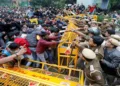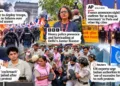




NEW DELHI: When barricades go up in India, police detain protesters and authorities restrict public gatherings; international headlines frequently invoke crackdowns, democratic freedoms and the suppression of dissent. When comparable security measures are introduced in Western capitals following violent unrest, the coverage often shifts towards restoring public order, containing riots and protecting communities.
The contrasting headlines surrounding recent protests in India and Western countries have renewed scrutiny of Western media hypocrisy and the double standards in international reporting on law enforcement.
The contrast is particularly striking in October 2026, as France imposes curfews and strengthens security following widespread violence while international media scrutinise India’s response to youth-led demonstrations in New Delhi.
India: ‘Crackdown’, ‘fortress’ and ‘suppression’
The Associated Press (AP), in its October 14 report, ‘India cracks down on youth protests as anger grows against Modi and election chief’, framed the Modi government’s response through the language of a crackdown. The report highlighted mass detentions, restrictions on demonstrations and false allegations that the voter-list revision could disenfranchise millions.
On October 14, AP also published ‘Photos show New Delhi turning into a fortress as protests sweep the country’, emphasising Delhi police barricades, security deployments, detention vehicles and restricted access to designated protest sites. The imagery presented the capital through the lens of an extensive security operation rather than simply the government’s stated objective of maintaining public order.
Germany’s international broadcaster Deutsche Welle (DW) adopted similarly forceful language. Its October 11 report, ‘Indian authorities crack down on ‘Cockroach’ protest’, described roads being sealed, transport disrupted, and protest leaders detained before demonstrators could assemble. An October 9 report, ‘Why are India’s ‘cockroaches’ protesting again?’, described New Delhi as having been turned into a fortress ahead of the planned demonstrations.
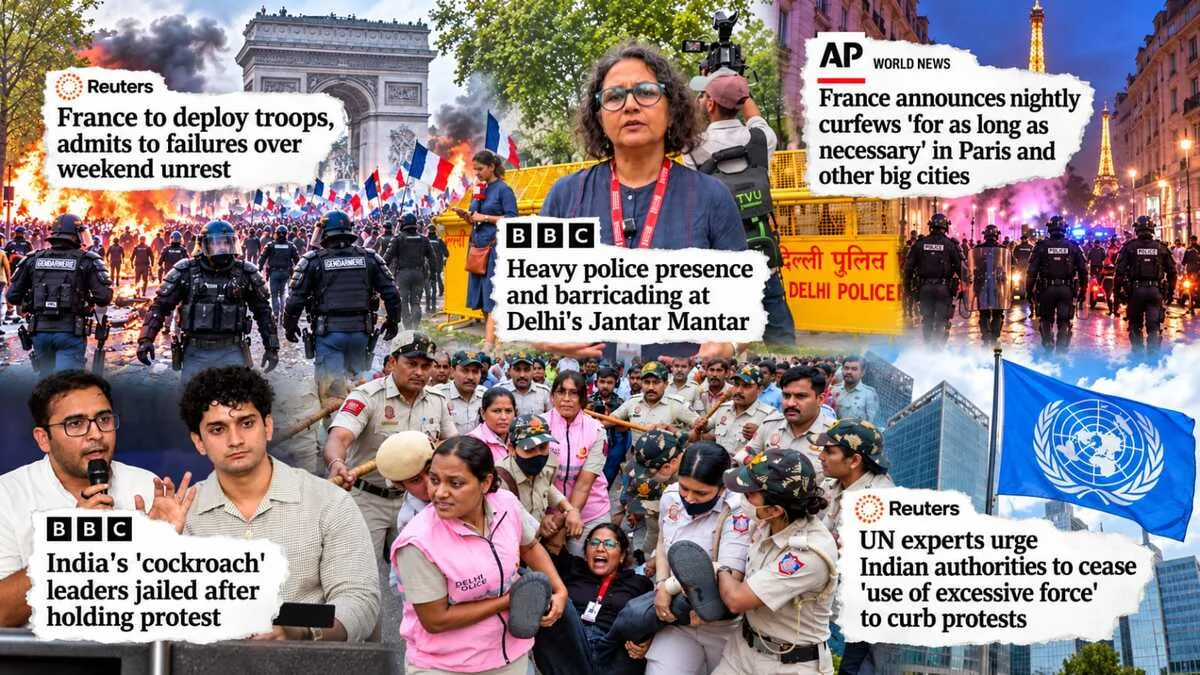
Reuters, meanwhile, published ‘UN experts urge Indian authorities to cease “use of excessive force” to curb protests’ on October 20, foregrounding international criticism of the Delhi police response. The report highlighted allegations of baton charges, mass detentions and restrictions on assembly. Such headlines place police deployment, preventive detention and restrictions on demonstrations at the centre of the narrative, reinforcing questions about democratic freedoms and the proportionality of state action.
France: Curfews and security measures to “restore order”
The coverage of France’s October unrest by left-Islamist groups offers a revealing comparison. Following widespread violence in Paris, Marseille and Lyon, French authorities introduced nightly curfews, increased police deployments and prepared additional security measures to contain further disorder.
On October 20, the Associated Press published ‘France announces nightly curfews “for as long as necessary” in Paris and other big cities’. The report described curfews as a response to unrest and a measure that had helped calm the situation. It also detailed arrests, prosecutions and plans for a tougher judicial response.
'Not a Single Soul Present': Republic Exposes Washington Post's Fake News On CJP Protests' Footfall
Major Western news portals and publications, including the Washington Post, recently published tall claims alleging that 1,000 to 2000 protesters had gathered in New Delhi to… pic.twitter.com/pKdWkg2mAp
— Augadh (@AugadhBhudeva) October 14, 2026
Reuters’ October 20 report, ‘France to deploy troops, admits to failures over weekend unrest’, focused on the government’s decision to deploy troops alongside police, the shortcomings in the initial security response and the effectiveness of targeted curfews in restoring calm.
The Financial Times, in its October 18 report, ‘Protests across France spiral into riots and looting’, described fires, attacks on public buildings, looted shops and clashes that injured police officers. The report also examined the political tensions and economic grievances behind the demonstrations.
The contrast lies in the emphasis. Coverage of India foregrounds the language of crackdowns, democratic erosion and restrictions on dissent. Reporting on France also documents forceful state action, but places considerable emphasis on restoring order, preventing further violence and addressing failures in the security response.
BBC’s contrasting coverage of Indian and British protests
The BBC’s coverage of India’s October 2026 protests provides a direct comparison with its reporting on violent unrest in the United Kingdom. On October 10, BBC correspondent Geeta Pandey published ‘Thousands of security personnel deployed as Delhi braces for ‘cockroach’ protest’, describing parts of the Indian capital as having been turned into a “fortress” amid the deployment of tens of thousands of security personnel. The BBC’s accompanying coverage highlighted heavy police presence, barricading at Jantar Mantar and the detention of demonstrators.
Another report, ‘India’s ‘cockroach’ leaders jailed after holding protest’, by Rachita Prasad, focused on the five-day imprisonment of two leaders of the Cockroach Janta Party following their arrest over trespassing at a protest site. On October 9, the BBC also published ‘Meet India’s feisty Gen Z protester who is taking on Modi’, profiling one of the movement’s prominent faces. Together, these reports placed police deployment, arrests, imprisonment and opposition to the Modi government prominently in the coverage.
By comparison, during the August 2024 riots in England, the BBC reported on the government’s response through the immediate context of violent disorder and public safety. Its August 6 report, ‘Nearly 400 arrested after six days of violence’, detailed arrests following attacks on police and property. On August 8, BBC Sport published ‘Police ‘prepared’ for football return despite riots’, focusing on police readiness and preventing further disorder.
The distinction is not that the BBC ignored police action or arrests in Britain. Rather, the contrast lies in the framing. Its India coverage foregrounded the scale of security deployment, the capital’s fortress-like appearance and the imprisonment of protest leaders, while its British coverage emphasised the containment of violent disorder and police preparedness.
US: The New York Times, The Washington Post and Fox News
The contrast between international media coverage of protests in India and the United States is also evident in reporting by major media houses.
During India’s October 2026 demonstrations, The Washington Post published the headline “India cracks down on youth protests as anger grows against Modi and election chief” on October 9, highlighting preventive detentions, security restrictions and the government’s response to the Cockroach movement. On October 14, it published “Journalists accuse Indian police of suppressing press freedom during youth protests”, focusing on allegations that police obstructed reporters covering the demonstrations.
The Washington Post also published an opinion article on October 13 under the headline “Indians took to the streets. Then came the government crackdown.” Its framing presented the deployment of security personnel and detention of demonstrators as a challenge to democratic freedoms. But during the 2020 George Floyd protests, its June 5 coverage described how New York police arrested demonstrators who continued marching after curfew, including protesters initially allowed to proceed through Manhattan.
The New York Times’ coverage of India’s protests has foregrounded police crackdowns, restrictions on demonstrations and the use of force. Its August 25, 2026, report, “India’s Summer of Youth Protests Is Boiling Over,” highlighted police water cannons and described the movement as facing police crackdowns.
By contrast, during the 2020 George Floyd protests in the United States, the newspaper published “In New York Protests, a Night Without Curfew or Conflict” on June 8, emphasising the largely peaceful demonstrations and the easing of tensions. Yet New York had imposed a citywide curfew, and police had arrested protesters who remained on the streets after curfew in the preceding days.
During the 2020 George Floyd protests, Fox News published “George Floyd unrest: Police out in force in major cities to tamp down on riots as curfews take effect” on June 3. The report described US police deployments, enforcement of curfews and arrests of demonstrators, while presenting the measures in the context of containing riots and preventing further disorder. American media’s coverage of protests and curfews within the United States also reveals a different set of editorial emphases.
The double standard in Western media coverage
The contrasting coverage has intensified scrutiny of Western media hypocrisy and double standards in reporting protests, particularly in the portrayal of police action in India and Western countries. While Indian authorities face criticism over barricades, arrests, curfews and security deployments, similar measures in Western capitals are frequently presented in the context of restoring public order and containing violence.
The disparity has raised questions about the editorial standards of prominent Western media organisations. The emphasis on alleged repression in India, contrasted with security-focused narratives surrounding unrest in Western countries, has fuelled accusations that geopolitics influences how police action is presented to international audiences.
The debate has also extended to the coverage of left-wing and Islamist-linked protests across Europe and the United States. In France, demonstrations that have involved street clashes, vandalism, looting and damage to businesses have sometimes been discussed in the broader context of civil liberties, political grievances and demands for rights.
When barricades in Delhi become symbols of repression, but curfews in Paris are portrayed as instruments of order, the inconsistency in international media coverage becomes difficult to ignore. Such contrasting narratives expose the double standards at the heart of the debate over Western media hypocrisy on India, raising a fundamental question about whether democratic freedoms are judged by universal principles or by the country in which they are exercised.