



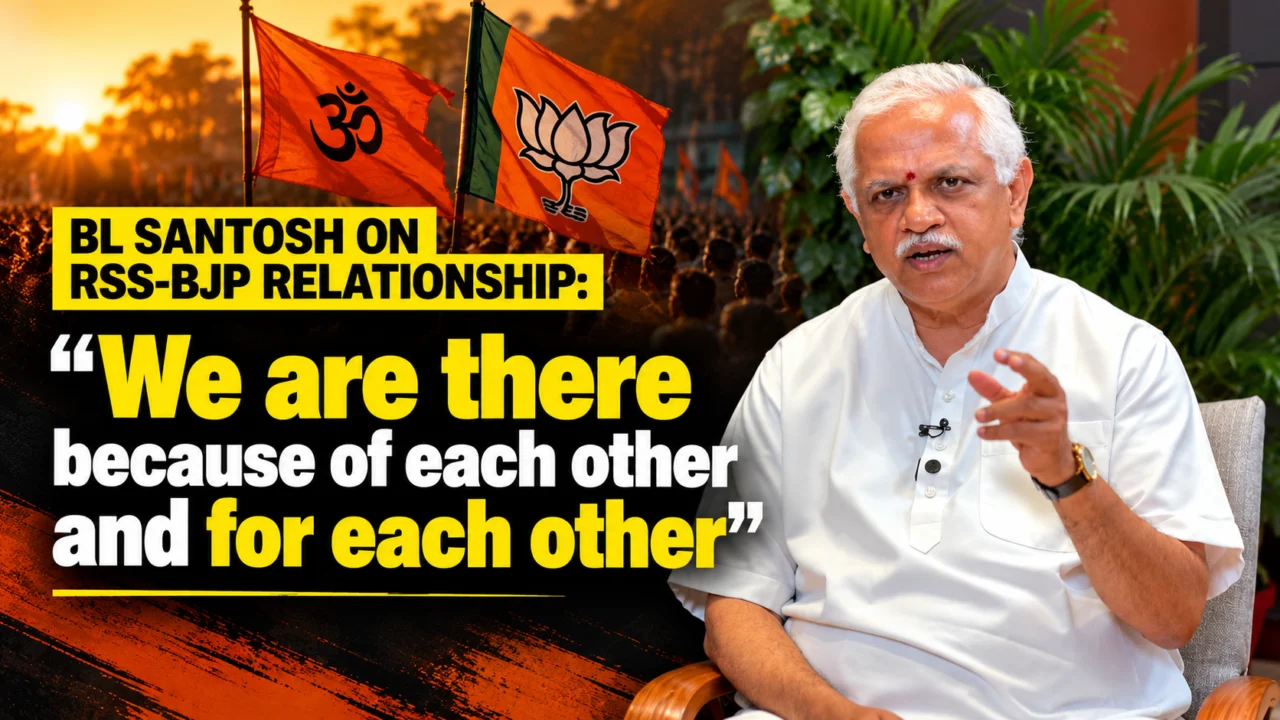
On the 75th anniversary of the Bharatiya Jana Sangh’s formation, BJP National General Secretary (Organisation) B. L. Santhosh described the RSS-BJP relationship as “umbilical,” rooted in a common cause.
Speaking with Organiser editor Prafulla Ketkar, Santhosh said the two are complementary movements working towards the welfare of the country, with the BJP operating in the political field and the RSS in the cultural and social fields.
Santhosh has described the relationship as an enduring partnership built on a shared national purpose, mutual trust and faith. He rejected the idea that the RSS and BJP should be understood merely as two separate organisations. He said their relationship was sustained by a common cause rather than political power, organisational influence or individual personalities.
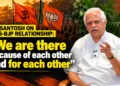
“The relationship between BJP and Sangh is, to explain it in the best manner, it is umbilical,” Santhosh said.
He added: “So we are there because of each other and we are there for each other because it is not that we are two organisations. It is two movements working for a single cause.”
‘It is the common cause that keeps us together’
Explaining the relationship between the RSS and the BJP, Santhosh said their association was not primarily driven by the strength or prestige of either organisation.
“Neither the power nor the aura of the organisation, not the aura of the intellectualism or the aura of individual personalities at any point of time. It is the common cause that keeps us together,” he said.
He explained that both organisations work for each other so that they can contribute to a larger national objective.
“So we work for each other so that we both can work for that greater cause,” Santhosh said, describing the cause as enduring for both the BJP and the RSS.
He identified that objective as the welfare of the country and making Bharat a “Vishwa Mitra, Vishwa Bandhu and Vishwa Guru”.
According to Santhosh, this shared objective allows the two organisations to work together while contributing through their respective roles.
He described the relationship as complementary, using the example of two people walking together in a park. The walkers adjust their pace and direction to each other, he said, not because they are necessarily from the same family, but because they are moving towards a common destination.
“They complement each other,” he said.
Santhosh said the RSS-BJP relationship was not merely complementary but also “very strongly intertwined”.
‘Nobody overpowers another’: Santhosh on coordination
Addressing questions about how the two organisations coordinate their work, Santhosh emphasised mutual understanding and discussion rather than control by one over the other.
He said their association was sustained by “trust between each other, faith about each other and working for a cause”.
These factors, he added, made them “very strong partners in this nation-building movement”.
Drawing another comparison, Santhosh said the discussions between the two organisations were similar to those between people sharing a room and working towards a common objective.
“Nobody overpowers another. Nobody puts somebody some dictation on somebody,” he said.
He added that the organisations understand and discuss matters with each other before moving forward towards their shared objective.
Santhosh summed up their respective areas of work by stating: “We work in the political field and RSS works in cultural and social field.”
His explanation presented the relationship as one in which the BJP and the RSS contribute through distinct but connected areas of activity, rather than operating as organisations competing for authority.
Ram Janmabhoomi movement as an example of cooperation
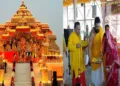
Santhosh cited the Ram Janmabhoomi movement as an example of the RSS and BJP working together towards a shared objective.
He said the movement was initiated by the Vishva Hindu Parishad and the RSS, while the BJP took it forward through the Ram Rath Yatra.
“It was started by Vishwa Hindu Parishad and RSS. Bharatiya Janata Party took it in the form of Ram Rath Yatra,” he said.
He added that after the BJP came to power, the government facilitated several developments that ultimately led to the inauguration of the Ram Mandir.
Santhosh referred to the movement while explaining how the organisations had taken up common issues at different stages of their journey.
“See, this relationship is umbilical and role is complementary,” he said.
Jana Sangh’s journey and the ‘Nation First’ principle
The interview also traced the ideological and organisational journey from the Bharatiya Jana Sangh to the BJP.
At the beginning of the conversation, Santhosh said the political purpose and ideology behind the Jana Sangh had acquired a much larger form in the BJP.
He described the Jana Sangh as an outlier party when it was founded and recalled the role of Dr Syama Prasad Mookerjee in establishing it after resigning from Jawaharlal Nehru’s Cabinet.
Santhosh highlighted economic nationalism as an important idea associated with Mookerjee and credited Pandit Deendayal Upadhyaya with developing the organisation’s ideological and organisational identity, including the concept of Integral Humanism.
He described the journey from economic nationalism to Integral Humanism as a continuous one, arguing that the two complemented each other.
Santhosh also discussed the Jana Sangh’s decision to merge with the Janata Party in 1977 during the opposition movement against the Emergency.
He said the decision reflected the priority given to a larger national cause over maintaining the organisation’s separate identity.
“The Bharatiya Janata Party has one philosophy, nation first philosophy, country comes first,” he said.
Santhosh recalled that Jana Sangh leaders accepted the merger despite the organisation having a substantial parliamentary presence, because defeating the government led by Indira Gandhi was considered a larger national objective at the time.
He described the Janata Party experiment as unsuccessful and said the Jana Sangh’s political stream began rebuilding independently in 1980, leading to the formation of the BJP.
RSS and Jana Sangh’s role during the Emergency
Santhosh also spoke about the RSS and Jana Sangh’s role in resisting the Emergency imposed in 1975.
He said their leadership took responsibility for organising protests, supporting opposition leaders and standing with democratic institutions, including the media and courts.
“It was the RSS and the Jana Sangh leadership who took on the cudgel of protest,” he said.
He added that thousands of workers were jailed during the agitation, while families and mothers provided crucial emotional support to those involved.
“It is a wonderful story where the society involved itself in fighting against a dictator and fighting against a system,” Santhosh said.
He credited the RSS with playing a principal role in mobilising society against the Emergency and said the Jana Sangh provided leadership to the agitation.
The discussion connected the organisations’ historical experience of working together with Santhosh’s broader explanation of their relationship: a shared cause, mutual trust and complementary roles.
A relationship rooted in a shared national objective
Reflecting on the BJP-RSS relationship, Santhosh maintained that the association could not be explained only through the lens of political calculations or organisational influence.
He repeatedly returned to the idea that the two movements work together because of a common national objective, while operating in different fields.
His description of the relationship as “umbilical” was central to his explanation. He said the organisations were there for each other and worked together to advance a larger cause.
As the Bharatiya Jana Sangh marks 75 years since its formation, Santhosh’s remarks placed the RSS-BJP relationship within the longer ideological and organisational journey from the Jana Sangh to the BJP.