



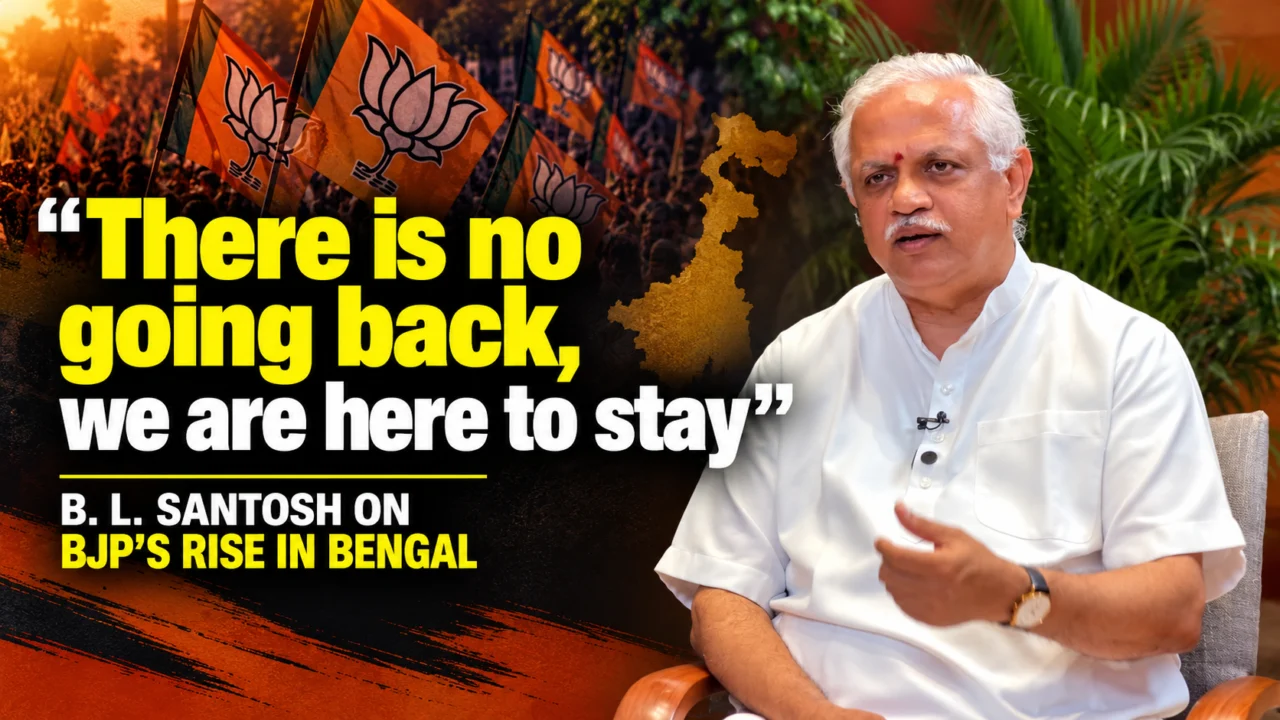
BJP National General Secretary (Organisation) B. L. Santhosh said the party had made sustained political inroads in West Bengal after years of struggle, asserting that its expansion in the state was irreversible.
Explaining why it took the BJP so long to establish itself in Bengal, Santhosh pointed to historical factors, the party’s organisational work and the gradual growth of ideological acceptance.
He was speaking with Organiser Editor Prafulla Ketkar in an exclusive interview.
‘There is no way going back’
“There is no way going back. Now we are here to stay,” Santhosh said while discussing the BJP’s political expansion in West Bengal during an interview with Organiser.
He acknowledged that the Bharatiya Jana Sangh and, later, the BJP had found it difficult to establish a foothold in Bengal, despite the state’s early association with several ideological figures linked to the Jana Sangh.
“BJS and later BJP found it most difficult to find that acceptance and foothold in Bengal,” Santhosh said. He described Bengal as perhaps the last major state where the BJP made significant political inroads.
The BJP leader said the party’s rise in the state was the result of a long process rather than a sudden political shift.
“So it took us a very long many years but we were there to stay. We worked very hard and the political outcome is to be seen,” he said.
Historical factors behind BJP’s delayed growth
Santhosh offered a historical explanation for why the Jana Sangh and BJP struggled to build support in Bengal.
He compared the experience of refugees who migrated from West Pakistan to Punjab, Haryana and Delhi with those who arrived from East Pakistan in Bengal. According to him, the social work associated with the RSS had established a stronger presence in parts of north India, where refugees received support and shelter.
He said this assistance created goodwill that later extended to the Bharatiya Jana Sangh because of its shared ideological outlook.
In Bengal, however, Santhosh argued that the RSS ecosystem was not as strong when refugees arrived, while the Congress and communist forces had already established roots in the region.
“The very first person whom you meet always carries takes away your gratitude also. It is a human nature,” he said, explaining his assessment of how early social connections influenced political acceptance.
Santhosh presented this as one possible explanation rather than a definitive account. He acknowledged in the interview that his reasoning might not be entirely correct.
‘The political outcome is visible’
Santhosh said the BJP’s progress in Bengal reflected ideological acceptance that had developed over several decades.
“Political churning that were happening, ideological acceptance, it has happened over a period of last 30–35 years,” he said.
He argued that the political results had become more visible in the preceding six or seven years, as the BJP emerged as a major political force in the state.
Santhosh also referred to the party’s social and political expansion in Assam and Tripura, placing Bengal within a wider pattern of BJP growth in the Northeast and eastern India.
He cited the introduction of the Citizenship Amendment Act (CAA) and the party’s social inroads in these states while asserting that the BJP’s expansion had reached a stage where there was no question of going back.
From Jana Sangh to BJP: A long political journey
The remarks came during a discussion on the BJP’s 75-year organisational and ideological journey, tracing its origins to the Bharatiya Jana Sangh.
Santhosh described the party’s growth in Bengal as part of a wider transformation in which ideas once outside the political mainstream had gained wider acceptance.
His remarks underscored the BJP’s position that its presence in Bengal was the result of years of organisational effort, social engagement and political mobilisation.