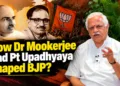




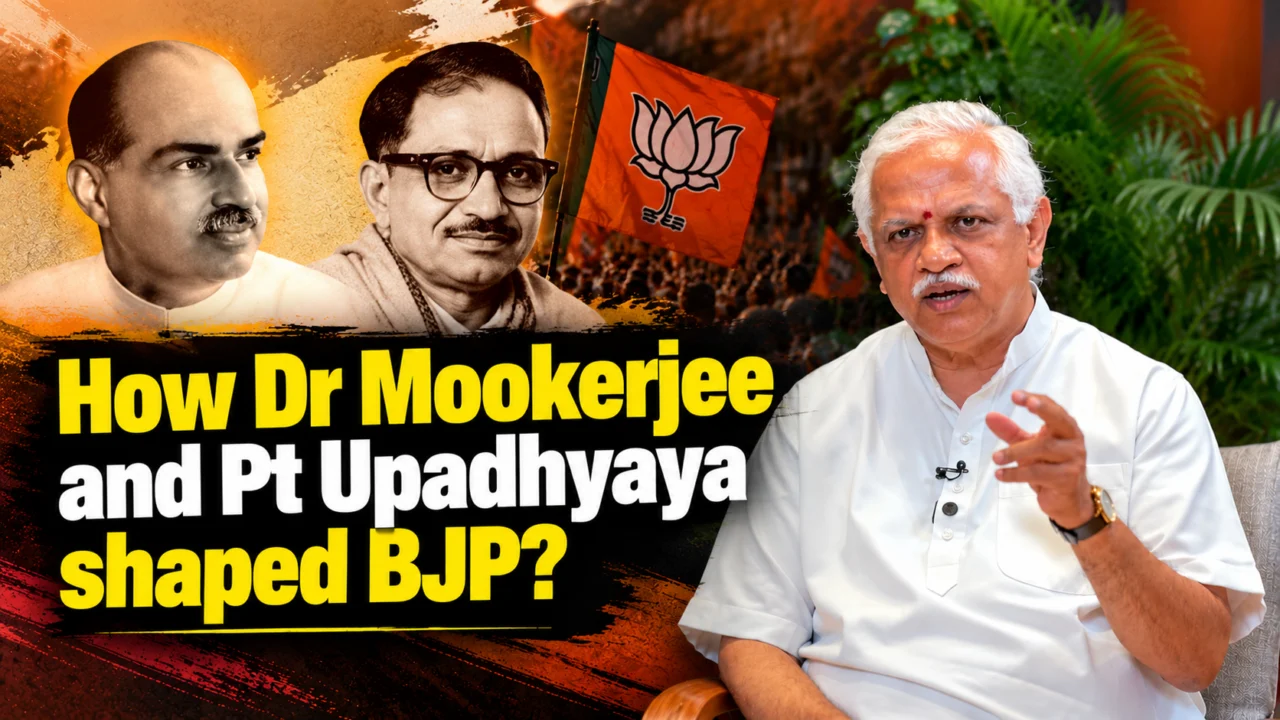
BJP National General Secretary (Organisation) B. L. Santhosh has credited Dr Syama Prasad Mookerjee with giving the party its political identity and Pandit Deendayal Upadhyaya with shaping its organisational and ideological foundations.
In an interview with Organiser, Santhosh traced the journey from cultural and economic nationalism to Integral Humanism, arguing that the ideas remain interconnected in the BJP’s political outlook.
Dr Mookerjee gave BJP its political identity
Explaining the ideological journey from the Bharatiya Jana Sangh to today’s BJP, Santhosh described Dr Syama Prasad Mookerjee as the leader who established the political identity that continues to define the party.
“Dr. Shamap Prat Mukhar GI he gave us the political identity and what Bharti Jantaa party stand today that very foundation of nationalism he came out of Congress because of the very same same reason the integration and the cultural nationalism as you rightly worded also,” Santhosh said.
He referred to Mookerjee’s role in advancing cultural nationalism and national integration, particularly in relation to West Bengal and Jammu and Kashmir.
Santhosh said Mookerjee articulated his political positions directly rather than adjusting them to gain wider acceptance.
“He was forthright in telling it he didn’t think that he had to be secular at that point to become acceptable to everybody he wanted to be truthful to the society,” Santhosh said, referring to Mookerjee’s position on West Bengal.
Santhosh also connected Mookerjee’s political choices to his differences with then Prime Minister Jawaharlal Nehru over Jammu and Kashmir. According to Santhosh, Mookerjee opposed what he saw as the internationalisation of an internal Indian issue and left the Union Cabinet over the disagreement.
“He came out of the cabinet on the very same reason for that that the Nehru was internationalizing unnecessarily an internal problem of the country,” Santhosh said.
Deendayal Upadhyaya shaped organisational and ideological identity
Santhosh described Pandit Deendayal Upadhyaya as the figure who carried forward the political and ideological work after Mookerjee’s death. Upadhyaya, he noted, served for a long period as the organisation’s general secretary before becoming its president.
“Panditindalupadya can be easily told as the organizational and ideological identity,” Santhosh said.
He described Upadhyaya’s contribution as both organisational and intellectual, linking the development of the Jana Sangh’s political structure with the formulation of Integral Humanism.
Santhosh argued that the ideas associated with economic nationalism and Integral Humanism were not contradictory, but complementary.
“This journey is a seamless journey from economic nationalism to integral humanism because they complement each other. There is no dichotomy in it,” he said.
Explaining the relationship between the two ideas, he added that Integral Humanism took the earlier concept further and broadened its scope.
“Integral humanism took over from economic nationalism and widened it the horizon and presented it so that it is relevant for hundreds of years to come,” Santhosh said.
He described this evolution as central to understanding the ideological continuity between the Jana Sangh and the BJP.
‘Unless you become strong, you can’t help others’
Santhosh also linked the two leaders’ ideas to the principle that national strength is necessary for contributing to the wider good of humanity.
“Unless you become strong you can’t help others,” he said.
He elaborated that a country must first strengthen itself before it can speak about humanity in general. In his account, this thinking connected economic nationalism with Integral Humanism and placed both within the same ideological framework.
Santhosh also said economic nationalism, which he associated with Mookerjee and the Jana Sangh, had gained wider relevance as countries increasingly focused on their own economic interests.
He said that the idea was not confined to the Jana Sangh’s early years and continued to find expression in contemporary economic policy. Referring to the changing international environment, he said economic nationalism had become an order of the day.
From Jana Sangh to BJP
On the party’s formation and subsequent growth, Santhosh described the Jana Sangh as a political movement that began with ideas which were outside the mainstream at the time.
He recalled that Mookerjee resigned from Nehru’s Cabinet and founded a political party, presenting the move as a break with the Congress leadership’s approach.
Santhosh argued that the political and ideological journey from the Jana Sangh to the BJP should be understood as a continuing process rather than a break with the past. In his account, Mookerjee established the political direction, while Upadhyaya developed the organisational and ideological framework that helped sustain it.
He also referred to other leaders associated with the Jana Sangh’s early intellectual and organisational work, including Atal Bihari Vajpayee and Balraj Madhok.
According to Santhosh, the contribution of Mookerjee and Upadhyaya was significant because it connected political mobilisation with a defined ideological framework.
Cultural nationalism and the BJP’s political outlook
Santhosh also addressed the debate around nationalism, secularism and the BJP’s ideological position. He argued that the party’s understanding of cultural nationalism had faced criticism but had gradually become more prominent in Indian political discourse.
He linked this debate to the Ram Janmabhoomi movement, which he said helped ordinary people understand how political labels were applied to Hindu identity and mobilisation.
The broader argument in his interview was that the BJP’s present-day political outlook cannot be separated from the ideas advanced by its predecessors. He presented cultural nationalism, economic nationalism and Integral Humanism as connected strands of the same ideological journey.
For Santhosh, Mookerjee’s contribution lay in giving the movement its political identity, while Upadhyaya helped provide its organisational and ideological identity. Together, their contributions formed a foundation that, in his assessment, continues to shape the BJP.