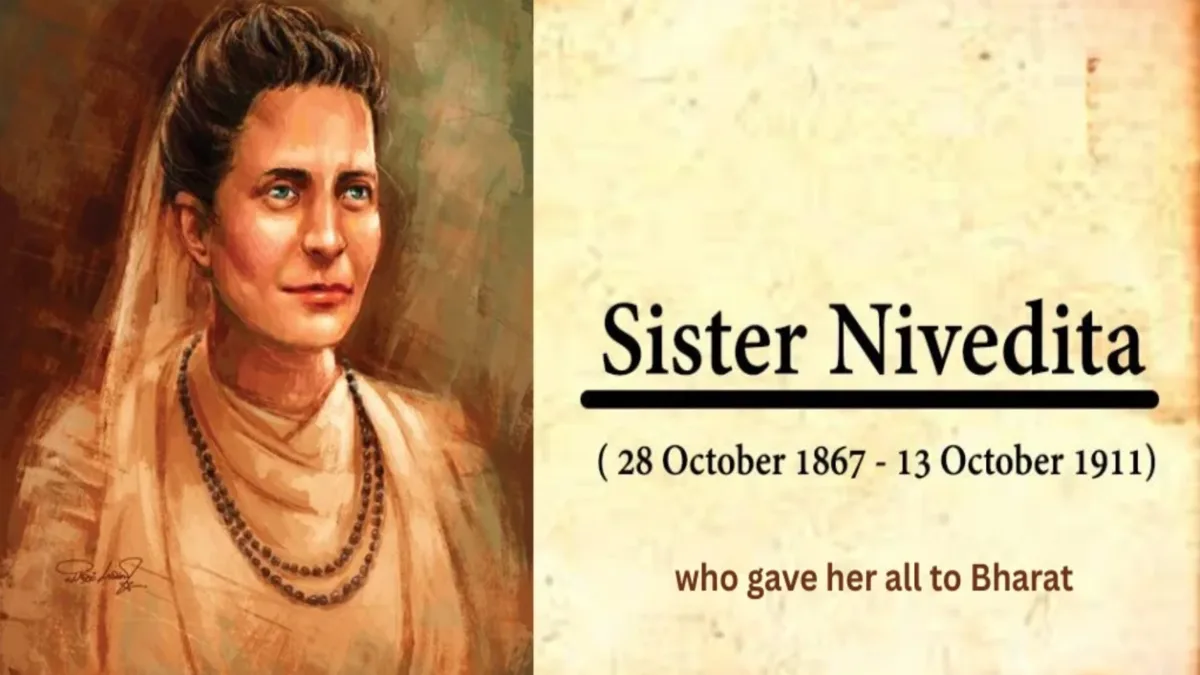
Love of one’s nation is certainly tied to the land of one’s birth, but its true measure lies in sacrifice, service and devotion. Margaret Elizabeth Noble, born in Ireland, made India the field of her life’s work. She dedicated herself wholly to the advancement of its culture, education, science, art and the awakening of its desire for freedom. Her life is powerful proof that serving a nation does not require being born into it. What matters above all is unwavering loyalty to it in one’s heart.
Bhagini Nivedita, a disciple of Swami Vivekananda, awakened the self-belief of Indian society under foreign rule. She also educated women and gave nationalist thought a new direction. If the Government of India were to confer the Bharat Ratna upon her today, it would truly honour all Indian women, and all those women living far from India, in any corner of the world, who long to offer everything they have to her.
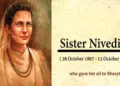
Margaret Elizabeth Noble was born in Ireland on 28 October 1867, and her life was bound from the outset to a search for truth, morality and human values. She made her name in education as a teacher. In 1895, however, she met Swami Vivekananda in London, and through him came to understand Indian culture, Vedanta philosophy and the broad ideal of service to humanity. His call for India’s renaissance and for the service of mankind stirred in her an awakening that changed her life completely.
She arrived in India in January 1898. On 25 March 1898, Swami Vivekananda initiated her into brahmacharya and gave her the name Nivedita, meaning “the dedicated one”. The name came to express the purpose of her life, and she made the progress of Indian society her goal. The struggles of the people here, their cultural heritage, spiritual thought and social challenges became part of her own life.
In the closing years of the nineteenth century, the education of Indian women was hemmed in by social orthodoxy, economic hardship and traditional beliefs. Many families were reluctant to send girls to school. In such an atmosphere, Bhagini Nivedita made women’s education the foundation of social change. On 13 November 1898, she opened a school for girls in the Baghbazar area of Kolkata. Establishing the school was only the beginning of her work.
The real challenge was persuading families to educate their daughters. She went from door to door, meeting parents, explaining the importance of education and encouraging them to send their girls to school. In her view, women’s education was a vital means of advancing both the family and the nation. She believed that educated women could play a decisive role in social awareness, the preservation of culture and the shaping of future generations. In this respect, her work forms an important chapter in the history of the awakening of Indian women.
A model of service and compassion during the plague
In 1899, plague broke out in Kolkata. The city was struggling with disease, fear and squalor, and conditions in the poorer neighbourhoods were desperate. In this hard time, Bhagini Nivedita made service her highest duty. She took an active part in sanitation drives, helped clear filthy lanes and drains, and made people aware of health precautions. She worked in the field herself. Her conduct inspired the young people of the city, and many joined the relief and cleaning efforts.
Helping the sick, reaching needy families and showing compassion towards stricken communities were integral to her service. She worked among the afflicted without regard for social standing, personal comfort or the fact that she was a foreigner. For her, service was never a vehicle for preaching or display. It was a practical ideal by which she lived.
After Swami Vivekananda’s passing, Bhagini Nivedita’s nationalist thinking became more active. She came to feel that political freedom was also essential for India’s social, economic and cultural advancement. The discrimination Indians suffered under British rule, and the suppression of the country’s abilities, deeply pained her. Despite being of British origin, she criticised imperialist policies and expressed support for Indian nationalism. During the opposition to the Partition of Bengal in 1905 and the Swadeshi movement, she urged Indians to use indigenous goods and to embrace national education and cultural self-reliance.
She saw political freedom as inseparable from social awakening, economic self-sufficiency and cultural revival. Nationalist thinkers and revolutionary groups who came into contact with her drew ideological inspiration from her. History records her association with many nationalist figures, including Aurobindo Ghose. She also gave support to nationalist activities and helped raise awareness about India’s future.
Her name is also linked with early conceptions of a national flag. A design she put forward bore the vajra (thunderbolt) emblem, regarded as a symbol of sacrifice, strength and spiritual energy. In this way, she sought to connect national identity with cultural symbols.
The struggle for the standing of Indian Science
A vital aspect of Sister Nivedita’s character was her devotion to the scientific spirit. She played a notable part in encouraging the research of the great scientist Jagadish Chandra Bose and in winning wider recognition for his findings. In the colonial era, Indian scientists faced institutional discrimination and meagre resources. At such a time, Nivedita supported Bose’s scientific endeavours. She helped edit his research papers and manuscripts, and worked to bring his research before the international scientific community.
Her role was important both as a collaborator and as a source of inspiration. She held that establishing India’s intellectual capability before the world was a matter of national self-respect. Encouraging Indian achievement in science was, for her, part of nation-building. Her association with Jagadish Chandra Bose shows that she never confined national service to a single field. In education, culture, science and social reform alike, she tried to advance Indian talent.
Inspiring Indian Art and the Cultural Renaissance
Sister Nivedita regarded Indian art as the expression of the nation’s soul. In her view, a society’s cultural identity is preserved in its artistic traditions, symbols, literature and spiritual outlook. She therefore favoured drawing inspiration from Indian traditions rather than blindly imitating Western art. She encouraged Abanindranath Tagore, Nandalal Bose and other figures of the Indian art renaissance to develop an indigenous cultural vision. Her nationalist and cultural outlook is also often mentioned in connection with Abanindranath Tagore’s celebrated work Bharat Mata. That image presented the motherland as a symbol of spiritual consciousness, sacrifice and national pride.
She also made a significant contribution as a writer. Her book The Web of Indian Life explains Indian social life, family traditions and cultural values. She challenged the one-sided notions of India prevalent among Western readers, and urged them to understand Indian society in all its historical and cultural complexity. Her writing helped to foster respect for Indian life and strengthen cultural self-confidence.
A short life, a devotion that endures
Constant toil, wide social activity and a life lived in difficult conditions took a toll on her health. Sister Nivedita died in Darjeeling on 13 October 1911, at the age of 43. Her lifespan was short, but the influence of her work is visible across Indian society, education, science and nationalist awareness. The moving inscription on her memorial in Darjeeling offers the most powerful account of her life: “Here rests Sister Nivedita, who gave her all to India.”
Beyond coming to understand India, she made its joys and sorrows her own. She linked education with social liberation, science with national prestige, art with cultural self-respect and freedom with human dignity. Her legacy remains relevant today. Her life teaches that nation-building demands clarity of thought, steadfastness in action and sensitivity towards society. She is a daughter of the nation in Indian history, whose identity cannot be defined by any geographical boundary or by her birth. Her true identity is her unwavering love for India, selfless service and lifelong devotion.
That is why the memory of Sister Nivedita remains an inexhaustible source of inspiration for Indian society. Remembering her sacred memory today, we feel proud that this land of India is blessed, its spiritual wisdom having amazed the world for centuries. Bhagini Nivedita became a daughter of that spiritual India, which is full of knowledge, and we too are fortunate to have been born on Indian soil.