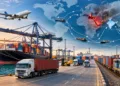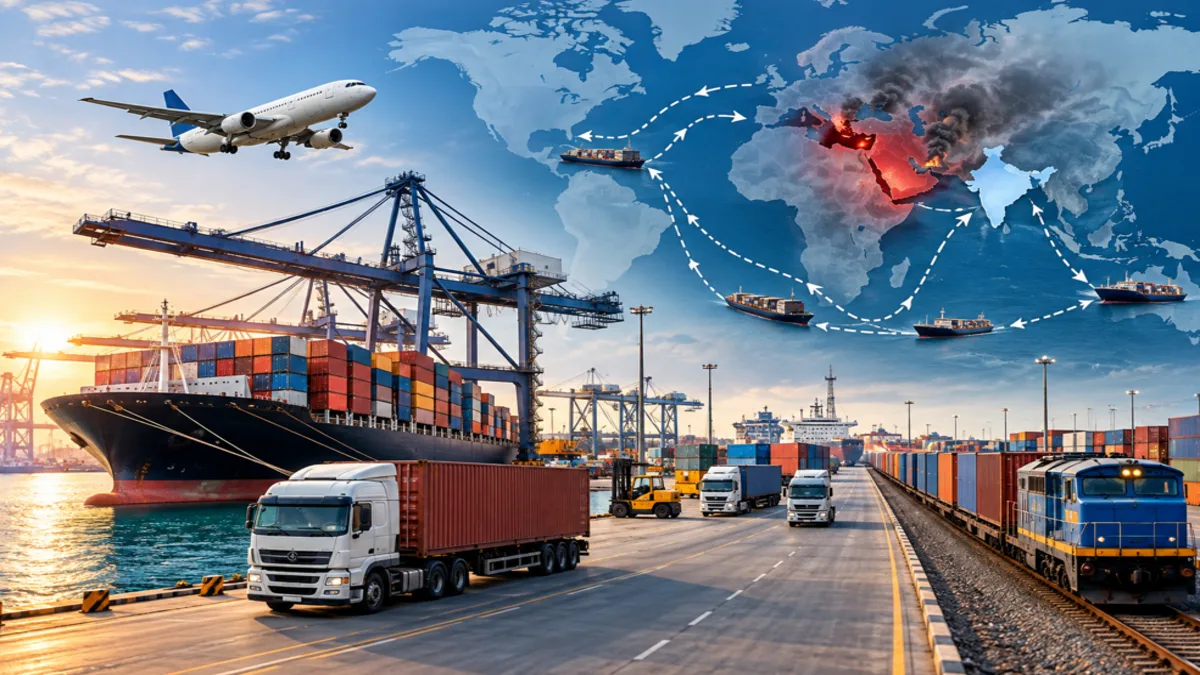
Since early 2026, the security concerns around the Strait of Hormuz, where the narrow chokepoint through which a vast share of the world seaborne energy and cargo traffic passes. It has triggered a chain reaction across the Gulf’s maritime arteries.
Vessel diversions, longer sailing routes, congestion at transshipment hubs and emergency conflict-linked surcharges have combined to push up freight costs and insurance premiums for every consignment moving to or through West Asia.
For Indian exporters, particularly the thousands of MSME that depend on steady, predictable shipping lanes to the Gulf, Israel, Iraq, Iran and beyond. The disruption threatened something more serious than delayed cargo where cancelled orders, lost buyers and job losses in export-linked industries that employ lakhs of workers across coastal and inland India seen.
It was against this backdrop that the Government of India moved with unprecedented speed, by signalling that Bharat trade architecture would not be allowed to buckle under external shocks and that exporters would not be left to absorb geopolitical risk entirely on their own.
What is RELIEF?
RELIEF (Resilience & Logistics Intervention for Export Facilitation) is a time-bound, targeted intervention approved under the Export Promotion Mission (EPM) on March 19, 2026, by the Ministry of Commerce & Industry. Its mandate is precise to shield Indian exporters from extraordinary freight escalation, heightened insurance premia and war-related risks arising from disruptions in the Gulf and wider West Asia maritime corridor. While it also ensures that the flow of Indian goods to these markets does not grind to a halt.
The scheme covers consignments destined for the United Arab Emirates, Saudi Arabia, Kuwait, Israel, Qatar, Oman, Bahrain, Iraq, Iran and Yemen, whether meant for direct delivery or transshipment.
In April 2026, the Centre widened this ambit further, bringing Egypt and Jordan under RELIEF’s coverage through an amendment to Notification No. 65/2025-26. An acknowledgment that disruption in one corridor ripples quickly across adjoining trade routes and that the policy response must stay nimble enough to follow the risk.
Operational Timelines: A three-phased response
RELIEF design reflects careful sequencing rather than a blanket announcement. Even before the scheme’s formal approval, the Government had set the machinery in motion with an Inter-Ministerial Group (IMG) on Supply Chain Resilience was operationalised on March 2, 2026, with daily review meetings beginning March 3, drawing together ministries, financial institutions, port authorities, exporter associations and logistics stakeholders.
These grounded in ground-level, real-time inputs, shaped RELIEF eventual three-pronged, calendar-bound structure, summarised below.
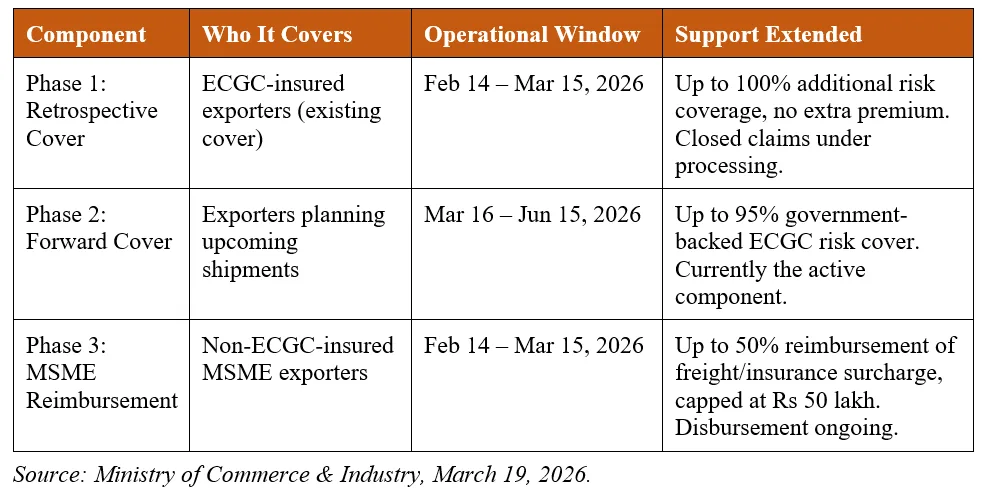 The EPM Steering Committee retains authority to review, extend, taper or withdraw any component as the Gulf situation develops, keeping RELIEF flexible rather than frozen in a fixed template an approach well suited to a crisis whose contours keep shifting week to week.
Why it was important
Trade is built on predictability and West Asia’s disruptions struck at precisely that foundation. Without intervention, rising war-risk premiums alone could have made several export categories commercially unviable overnight, prompting buyers to shift orders to competitor nations with calmer shipping lanes.
RELIEF’s urgency lay in preventing exactly this flight of business, protecting India’s hard-won reputation as a dependable trade partner even when regional geopolitics turned volatile. By moving within weeks of the first disruptions, the Government signalled that India’s export ecosystem would absorb shocks rather than transmit them downstream to farmers, artisans, manufacturers and the workers who depend on export orders for their livelihoods.
Officials have been candid about the scale of the challenge. The Directorate General of Foreign Trade has acknowledged that exporters to the Middle East faced real disruption to both shipments and future trade, while the Commerce Secretary has pointed to close coordination with ministries and overseas missions as central to the response. The transparency itself has mattered, reassuring exporters that the problem was being tracked in real time rather than left to resolve on its own.
How exporters benefited
For large exporters, RELIEF effectively removes the sting of sudden premium hikes, letting businesses continue shipping without renegotiating margins mid-contract. For MSME, the backbone of India’s export base in textiles, marine products, engineering goods and gems where the reimbursement mechanism offers tangible cash-flow relief at a time when every rupee of surcharge eats into thin margins.
ECGC Ltd. the nodal implementing agency responsible for verification, claim processing, disbursement and monitoring, has deployed a dashboard-based system for real-time tracking of claims and fund utilisation, ensuring disbursement stays transparent and swift rather than mired in bureaucratic delay, an implementation philosophy consistent with the larger push for Ease of Doing Business.
Strengthening India’s logistics resilience
Beyond its immediate firefighting role, RELIEF carries a structural lesson for India’s logistics ecosystem. The scheme emerged from real-time, ground-level coordination: procedural relaxations for stranded cargo movement, waivers on port storage and dwell-time charges, advisories for transparent shipping-line pricing, and continuous monitoring of insurance risk and inland logistics movement.
This whole-of-government machinery, built rapidly in the crucible of a crisis, offers India a template for institutionalised crisis response that can be reactivated for future disruptions, whether triggered by geopolitics, climate events or global shipping bottlenecks elsewhere.
With an approved outlay of Rs 497 crore under the EPM, RELIEF also demonstrates fiscal discipline: funds are targeted, time-bound and performance-monitored rather than open-ended subsidies. This model strengthens the broader Export Promotion Mission’s credibility as an agile instrument of trade policy, capable of calibrated, corridor-specific responses rather than generic across-the-board relief.
It lays groundwork for similar rapid-response mechanisms on other trade routes should new disruptions emerge. Read alongside parallel efforts on port infrastructure and multimodal connectivity, RELIEF signals that India’s logistics strategy is maturing from reactive damage control toward anticipatory, data-driven risk management.
As India pursues its vision of becoming a trusted, resilient node in global supply chains, interventions like RELIEF matter beyond their immediate rupee value. They signal institutional maturity: the capacity to read disruption early, design a response within weeks, and execute it through credible public institutions like ECGC. In an era of fractured global trade and recurring geopolitical flashpoints, that combination of speed, targeting and transparency may prove to be India’s most durable competitive advantage, reinforcing the conviction that resilience, not retreat, is Bharat’s answer to global uncertainty.