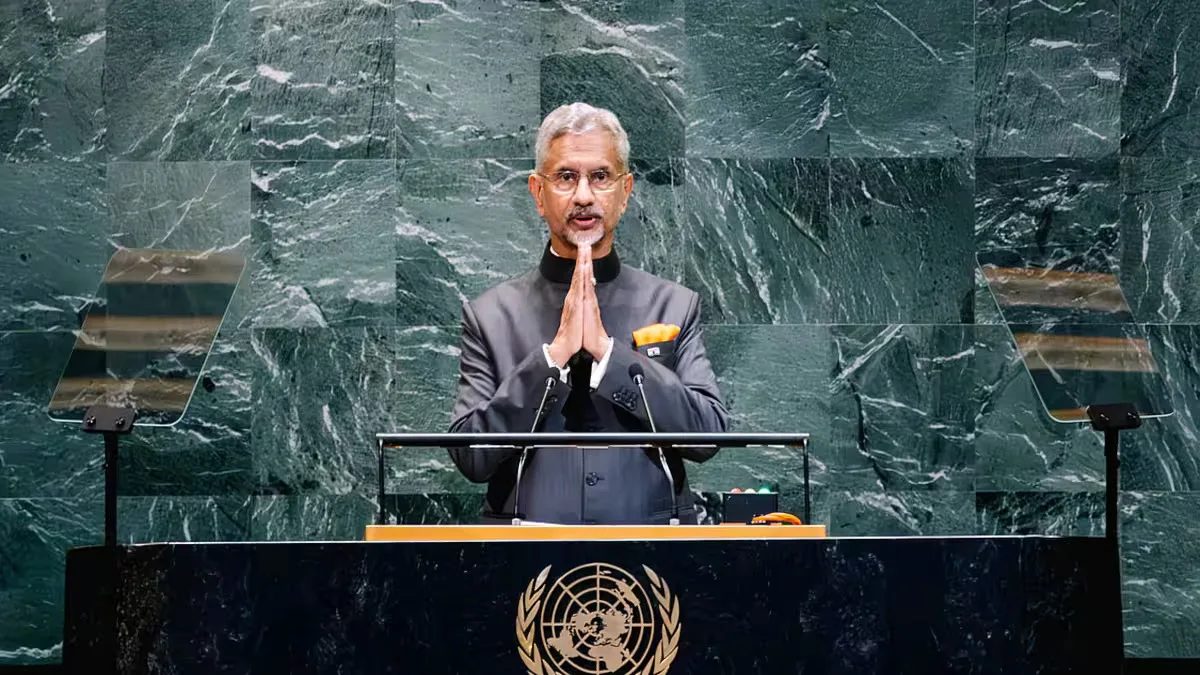
NEW YORK: External Affairs Minister Dr S. Jaishankar delivered the national statement at the 81st session of the United Nations General Assembly on September 26, Saturday, outlining India’s foreign policy priorities and advocated a firm position on counter-terrorism efforts against “serial practitioner of terrorism”. The EAM also called for an end to wars amid escalating global conflicts, thus, hailed de-escalation, dialogue, diplomacy, regional peace & stability.
He also reiterated the need for articulating a responsible Artificial Intelligence(AI) governance framework in the changing world order. EAM Jaishankar also called for protection of commercial shipping, maritime security and greater representation in global institutions & a stronger role for the Global South in shaping the emerging international order. Here are the key highlights from the EAM Jaishankar’s address to the world from the UN forum, illustrating India’s world view to forsee national security & global prosperity.
Delivering 🇮🇳’s statement at the 81st session of the @UN General Assembly. #UNGA81 https://t.co/IcMcmTNNAc
— Dr. S. Jaishankar (@DrSJaishankar) September 26, 2026
1. India’s right to defend against “serial practitioner of terrorism”
One of the strongest messages of EAM Jaishankar’s address to the UNGA was directed at state-sponsored and cross-border terrorism inflicted by Pakistan. He said that a “serial practitioner of terrorism” had attempted to misrepresent facts before the Assembly and “normalise terrorism” while seeking immunity from its consequences. “That will not stand. Our right to defend ourselves against terrorism will be exercised”, EAM Jaishankar asserted.
He stressed that “friendship and goodwill cannot co-exist with terrorism” and asserted that governments involved in state-sponsored, cross-border terrorism must be held accountable. India also called for greater international cooperation and action against the financial networks that support terrorism.
2. Endless war must give way to an end to war
EAM Jaishankar placed the continuing conflicts in Ukraine and West Asia among the principal challenges confronting the international community. On the Gulf conflict, he called for restraint, de-escalation, civilian protection and the uninterrupted flow of energy and commerce.
On Ukraine, he reiterated Prime Minister Narendra Modi’s message that “endless war must give way now to an end to war” and said India supports ongoing efforts to bring peace. On West Asia, EAM Jaishankar reiterated India’s position that a durable peace requires a two-state solution, while highlighting India’s humanitarian assistance and relief efforts for Palestinians.
3. Attacks on commercial shipping and seafarers ‘simply unacceptable’
Maritime security emerged as another major theme of the address. EAM Jaishankar condemned attacks on commercial vessels and seafarers in the Gulf and across waterways stretching from the Red Sea to the Black Sea. “Indian seafarers have lost their lives, as indeed have others from other nations. This is completely unacceptable”, he said. He thus, advocated unhindered energy & trade flow, freedom of navigation and civilians & seafarers safety.
India has joined Liberia and 23 other partners in the Group of Friends on Safety and Security of Shipping & Seafarers, aimed at building international support against attacks on commercial shipping and maritime crews.
4. ‘Weaponisation of everything’ threatens global stability
EAM Jaishankar warned that geopolitical competition is increasingly extending into finance, technology, markets, supply chains, resources and connectivity. He described this trend as the “weaponisation of everything”, arguing that chokepoints and restrictions on market access are disrupting global economic activity & security.
EAM Jaishankar said that as a solution, countries are consequently focusing more heavily on de-risking and diversification, even as the wider international atmosphere becomes less conducive to trust and goodwill. He also laid emphasis on supply-chain resilience and economic security amid changing global order.
5. Global South faces a ‘4F crisis’
EAM Jaishankar highlighted acute predicament of the Global South as an impact of geopolitical conflicts, which is facing a “4F crisis” involving food, fuel, fertiliser and finance. He pointed to the combined impact of extreme weather, fertiliser shortages and impediments to grain movements, warning that these pressures are also affecting progress towards the Sustainable Development Goals(SDGs).
He further argued that non-market practices and market denial can undermine the Global South’s ability to industrialise, while technology that was expected to generate opportunities can also create new anxieties when misused & weaponised.
6. India is the “first responder” & development partner; Jaishankar calls for climate action
EAM Jaishankar in the UN platform highlighted India’s vast development experience and its cooperation with countries of the Global South. He illustrated how India is the “first responder” and has extended vast humanitarian & developmental aid to the countries.
He pointed to improvements in health, nutrition, education, drinking water, electricity, roads and housing, along with India’s digital public infrastructure revolution, spiking startup ecosystem and connectivity or critical infrastructure expansion. India has sent medical shipments to conflict zones, epidemic locations and after natural disasters. As a first responder, India was there early, be it the Nepal flash floods or the Venezuela earthquake. In the UN peacekeeping operations Indian contingents are present in 9 out of 11 mandates
He said that India has undertaken 600 major development projects across 78 countries, spanning infrastructure, manufacturing, agriculture, information technology and capacity building. He also highlighted initiatives such as the International Solar Alliance, Coalition for Disaster Resilient Infrastructure and Global Biofuels Alliance, while stressing India’s role as a first responder during disasters and humanitarian emergencies.
7. AI should empower humanity and the Global South
Artificial intelligence and insulating the world from AI risks featured prominently in EAM Jaishankar’s speech, while envisioning the future of the frontier technology and the international cooperation.
He described AI as a transformational driver for human empowerment, economic prosperity and population-scale problem solving. India, he said, supports the right of every nation to shape its own AI ecosystem, including the development of models and deployment strategies aligned with national priorities.
EAM Jaishankar also warned that the misuse of AI can sharpen bias and undermine mutual respect, while arguing that democratised technology can become a tool of cooperation with the Global South.
8. India calls for a more representative & multipolar world
A central strategic message of the speech was India’s call for reformed multilateralism. EAM Jaishankar said the world is “well on our way towards a multi-polar world” and that the post-1945 order is giving way to new realities.
He acknowledged that the transition would involve adjustment and competition, but argued that an increasingly diverse world cannot be excluded from global decision-making. “Large sections of humanity cannot be excluded from that process”, he said, adding that the case for reformed multilateralism “only gets stronger day after day.”
His remarks reinforce India’s longstanding demand for greater representation in global institutions, including reform of the UNSC system, to suit contemporary geopolitical realities.
9. ‘Cultural rebalancing’ must accompany economic and political change
EAM Jaishankar also broadened the debate beyond economics and geopolitics. He argued that economic rebalancing is already underway and political rebalancing is becoming visible, but that “cultural rebalancing” must also move forward. He linked mutual respect for different cultures, heritage and traditions with international understanding and ultimately as the prospects for peace.
10. India’s Message: Democracy, peace, pluralistic order and prosperity
Concluding his address, EAM Jaishankar said that the international community must leave the General Debate with a stronger commitment to peace, development and prosperity. He invoked Mahatma Gandhi’s words displayed outside the UN headquarters: “There is no way to peace; peace is the way”.