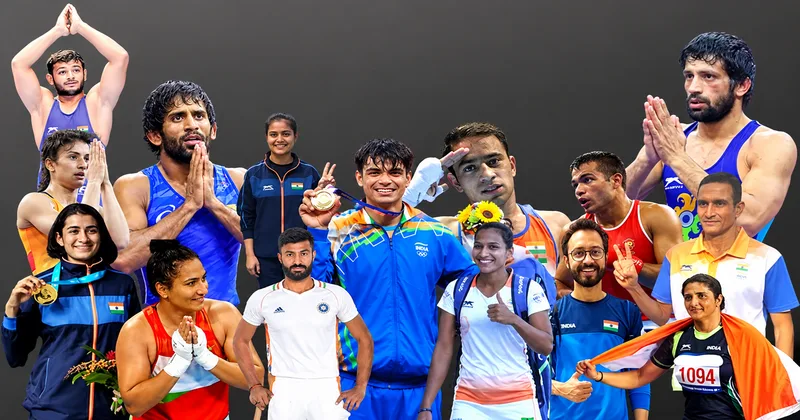
Haryana’s sporting culture has demonstrated what is possible when talent is combined with determination, family support and a strong culture of physical activity. From village akhadas and kabaddi grounds to national and international arenas, the State has produced champions in wrestling, boxing, shooting, athletics, hockey and several other disciplines.
Despite its relatively small geographical area and population compared with many neighbouring states, Haryana’s contribution to Indian sport has been extraordinary. At the Tokyo Olympics, for example, Haryana athletes accounted for four of India’s seven medals & made a significant contribution to India’s Paralympic success.
Behind these achievements lies a distinctive social and cultural environment. Rural families have traditionally encouraged youngsters to participate in sport, while village akhadas, local wrestling competitions, kabaddi and other forms of physical activity have provided an early platform for talent. There is also a deeper culture of physical fitness, discipline and competitive achievement in the State.
Haryana’s strong contribution to India’s defence forces is another reflection of this tradition; the Union Government has noted that approximately one in every ten soldiers in the Indian Army is from Haryana, despite the State accounting for only a small share of India’s population. Yet the opportunity before Haryana today is much larger than simply producing more medal winners.
Sport can be a vehicle for youth development, character building, social mobility, women’s empowerment and economic opportunity. A playground can teach discipline and teamwork; an akhada can build resilience; an academy can instil perseverance; and a coach can provide mentorship and direction at a crucial stage of a young person’s life.
This raises a larger policy question:
Can Haryana move from being a State that produces sporting champions to becoming a State with a complete sporting ecosystem?
Such an ecosystem would connect grassroots participation with quality infrastructure, coaching, education, sports science, nutrition, technology, scholarships, employment and career opportunities. It would ensure that sporting talent is identified early, nurtured systematically and given a pathway from the village playground to the national and international arena.
The State’s sporting legacy provides the foundation. Its young population provides the opportunity. The next challenge is to build an ecosystem capable of converting that opportunity into sustained excellence.
Youth as Haryana’s greatest strength
Haryana’s youth represent one of its most important strategic assets. The State has demonstrated that when young people are given a clear goal, disciplined training and the right support, they can compete successfully at the highest levels.
This is why sports policy should be viewed not simply as a sectoral policy but as part of a broader youth-development strategy. Young people need avenues through which they can develop confidence, leadership, resilience and a sense of achievement. Sports provides exactly such an environment. It teaches young people how to win with humility, deal with failure, work within a team and persist when results do not come immediately.
Equally, when youthful energy remains without purpose, opportunity or guidance, young people can become vulnerable to negative influences. The answer, however, is not to control the youth; it is to empower, mentor and provide meaningful pathways for achievement.
Every village playground, akhada, coaching centre and sports academy can therefore serve a purpose beyond sport. It can become a space for character building, social interaction, discipline and aspiration. Haryana already has the cultural foundation for this. The task now is to give that culture a modern institutional framework.
Haryana’s sporting legacy
Haryana has emerged as one of India’s leading sporting States, particularly in wrestling, boxing, shooting, athletics, hockey and kabaddi. Its athletes have repeatedly represented India with distinction at the Olympic Games, Asian Games, Commonwealth Games and other international competitions. The list of champions associated with Haryana is extensive—Neeraj Chopra, Sakshi Malik, Vinesh Phogat, Bajrang Punia, Manu Bhaker, Yogeshwar Dutt and Ravi Dahiya, among many others. Haryana has also made an important contribution to Indian hockey, including both men’s and women’s teams.
The numbers demonstrate the depth of this contribution. At the Birmingham Commonwealth Games, Haryana athletes accounted for 43 of India’s 213 participants, while Haryana athletes won 20 of India’s 61 medals. At the Tokyo Olympics, Haryana athletes contributed four of India’s seven medals. But perhaps the most important feature of Haryana’s sporting success is that it is not confined to one institution or one city.
Much of the talent has emerged from villages and smaller towns. Historically, the village akhada has played a role similar to that of a grassroots sporting academy. Traditional exercise, wrestling, kabaddi and local competitions have helped create a culture where physical fitness and sporting achievement are valued.
There is a distinctive philosophy embedded in this culture which could perhaps be captured in the phrase:
“Desi Khana, Desi Exercise, Desi Growth”. Traditional nutrition, physical activity, discipline and long-term development have contributed to Haryana’s sporting culture. The opportunity today is not to replace this tradition, but to combine it with modern sports science, professional coaching, technology and education. That combination could become one of Haryana’s greatest competitive advantages.
Education and Sports: Building dual-career pathways
Haryana’s sporting potential should be treated not merely as a source of medals, but as a strategic human-capital asset. A young athlete should never have to choose between a sporting career and a quality education. The State should develop a structured dual-career pathway for athletes, beginning at the school level and extending through universities and professional institutions.
Schools and colleges should explore flexible attendance, examination schedules, academic credits and specialised mentoring for athletes competing at district, State, national and international levels.
A State-supported scholarship framework, combined with nutrition, sports science, physiotherapy and academic assistance, can ensure that talented young people pursue sporting excellence without compromising their educational future. Universities can become integrated centres of sports, education, research and high-performance training, creating a pipeline from grassroots talent to elite competition while also preparing athletes for careers beyond competitive sport.
This is particularly important for families. For many parents, the greatest uncertainty associated with sport is not whether their child has talent, but what happens if the sporting career does not work out. A strong dual-career model can address that concern. The objective should therefore be to move from a system that celebrates exceptional athletes to one that systematically develops them while protecting their educational future.
Women in Sports: From participation to empowerment
The transformation of women’s participation in Haryana’s sporting landscape deserves special attention. Haryana has demonstrated that when opportunities are created, its daughters can compete with the best in the world. Women athletes in wrestling, boxing, shooting, athletics and hockey have not merely won medals; they have challenged traditional social attitudes and expanded the aspirations of an entire generation.
The next phase should be to take these individual success stories and create a State-wide institutional framework for girls and women in sport. This requires accessible sporting infrastructure at the grassroots level, safe training environments, specialised coaching, nutrition and sports-science support, scholarships and transparent pathways to State and national teams. But the objective should go beyond participation.
Women athletes should also be encouraged to build careers in coaching, sports administration, sports management, sports technology and entrepreneurship after their competitive careers. In this way, sport can become an instrument of women’s empowerment, social mobility and economic participation. The larger ambition should be simple: Every girl should have the freedom to aspire, the opportunity to participate and the support to compete without social or economic barriers.
From medals to a sporting ecosystem
This is perhaps the most important shift Haryana needs to make. The State has demonstrated that it can produce champions. The next question is whether it can build an ecosystem that consistently produces excellence while benefiting a much larger section of its youth. A medal-oriented approach focuses primarily on athletes, competitions, rewards and results. A sporting ecosystem is much broader. It includes:
- Athletes
- Coaches
- Sports scientists
- Physiotherapists
- Nutritionists
- Sports psychologists
- Referees and technical officials
- Sports academies
- Schools and universities
- Sports-management professionals
- Sports technology
- Equipment manufacturers
- Sports medicine
- Infrastructure
- Scholarships and finance
- Career pathways
Elite performance is never the result of the athlete alone. Behind every successful athlete is an ecosystem of people, institutions and resources. Haryana should therefore look at sport not only as a field of competition but also as a potential economic sector.
The development of sports science centres, high-performance academies, equipment manufacturing, sports technology, sports medicine, nutrition, coaching and sports management can create new employment and entrepreneurship opportunities. This could help Haryana move from producing individual champions to building a State-wide sports economy.
Role of the Haryana Government
The Haryana Government has already created an important foundation through its sports policy. Initiatives relating to sports nurseries, infrastructure, financial assistance, cash awards, employment opportunities for outstanding sportspersons, coaching and talent identification have contributed to Haryana’s sporting success. The challenge now is to move from schemes to outcomes.
The success of a sports policy should not be measured only by the number of playgrounds constructed, academies established or awards distributed. It should also be measured by what happens after those investments are made. For example:
- How many children are using the facility?
- How many talented athletes are being identified?
- How many progress from village to district, State and national levels?
- How many athletes receive professional coaching and sports-science support?
- What happens to athletes after their competitive careers?
This requires stronger monitoring, data and outcome-based evaluation. A village playground should not simply be an asset on a government inventory. It should be a living community sports centre. A sports nursery should not merely enrol children. It should identify potential, develop it and create a pathway for progression.
An academy should not simply train athletes. It should connect them to education, competition, nutrition, sports science and career opportunities. This is how Haryana can move from a “medal-oriented approach” to a “sports ecosystem approach”.
Challenges before Haryana
Haryana’s achievements are remarkable, but sustaining and expanding this success requires addressing several structural challenges. Sports infrastructure remains unevenly distributed, with gaps between facilities available in urban centres and those accessible to athletes in rural areas, where much of the State’s talent originates. At the grassroots level, access to qualified coaches, modern equipment and systematic talent identification remains a challenge.
Sports science, physiotherapy, nutrition and sports psychology are still not equally accessible outside established academies and elite centres. Young athletes can also face considerable pressure to perform, while families often bear the costs associated with training, travel, equipment and nutrition. For many athletes, balancing intensive training with education remains difficult. Greater attention is also required to create safe, accessible and high-quality facilities for women and para-athletes, ensuring that sporting opportunity is genuinely inclusive.
Haryana must also expand beyond its traditional sporting strengths. The challenge is therefore not a lack of talent. It is to create a system in which talent is identified early, supported consistently and given an opportunity to reach its full potential regardless of geography, gender or economic background.
Technology and the future of sports
Technology can play a transformative role in closing the gap between athletes in major sporting centres and those in rural areas. Artificial intelligence-based performance analysis, wearable fitness technology, video analysis, sports biomechanics and data-driven training can enable coaches and athletes to understand performance in greater depth and develop more personalised training programmes. Digital platforms can also support early talent identification by analysing performance data and connecting athletes from villages and smaller towns with specialised coaches and academies.
Online coaching, virtual mentoring and digital education can bring expertise to athletes who may not have access to high-quality training facilities locally. Haryana could therefore explore a technology-enabled State sports platform connecting athletes, coaches, academies, schools, universities and sports scientists, while maintaining a digital record of an athlete’s development. The objective should not be to replace the coach with technology. It should be to give every coach better tools and every athlete better access to expertise. Technology can therefore become an important instrument for democratising sporting opportunity.
A New Opportunity: Sports as an economic ecosystem
There is also a larger economic opportunity. A successful sporting ecosystem can generate employment not only for athletes but also for coaches, trainers, physiotherapists, nutritionists, sports psychologists, referees, administrators, sports managers, equipment manufacturers, sports medicine and technology professionals.
This could create a virtuous cycle:
Grassroots participation → Talent identification → Training → Competition → Elite performance → Employment → Sports industry → Greater participation
Such a model would make sports both a human-development strategy and an economic opportunity.
A vision for the future
The future of Haryana’s sports policy should ultimately be measured not only by the medals it wins, but by the opportunities it creates. The ambition should be to build a system in which every village has access to a quality playground, every school has access to trained coaches, every talented youngster has an opportunity to develop, and every athlete has a clear pathway from grassroots participation to the national and international arena.
Technology should make expertise accessible. Education should protect the athlete’s future. Sports science should improve performance. Government policy should create opportunity. The private sector should help build the ecosystem. And communities should continue to provide the culture and encouragement that have historically produced Haryana’s champions.
From champions to a sporting state
Haryana stands at an important juncture. Its greatest asset is not merely its land, infrastructure or economic potential, but its people—particularly its young population and the culture of determination, physical fitness and competitive spirit that runs deep across the State. The State has already demonstrated that it can produce champions. The next step is to build the institutions and ecosystem that can make sporting excellence more accessible, more sustainable and more inclusive.
The real success of Haryana’s youth and sports policy be measured by how many young lives are given purpose, confidence, discipline and opportunity; how much talent is discovered and nurtured; and how many young people are empowered to build a better future for themselves and for the State. The sporting ecosystem that makes the next generation of champions. If these elements can come together, Haryana can move beyond being a State that consistently produces exceptional athletes and become a national centre for sporting excellence and a model for India’s sports ecosystem.