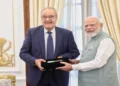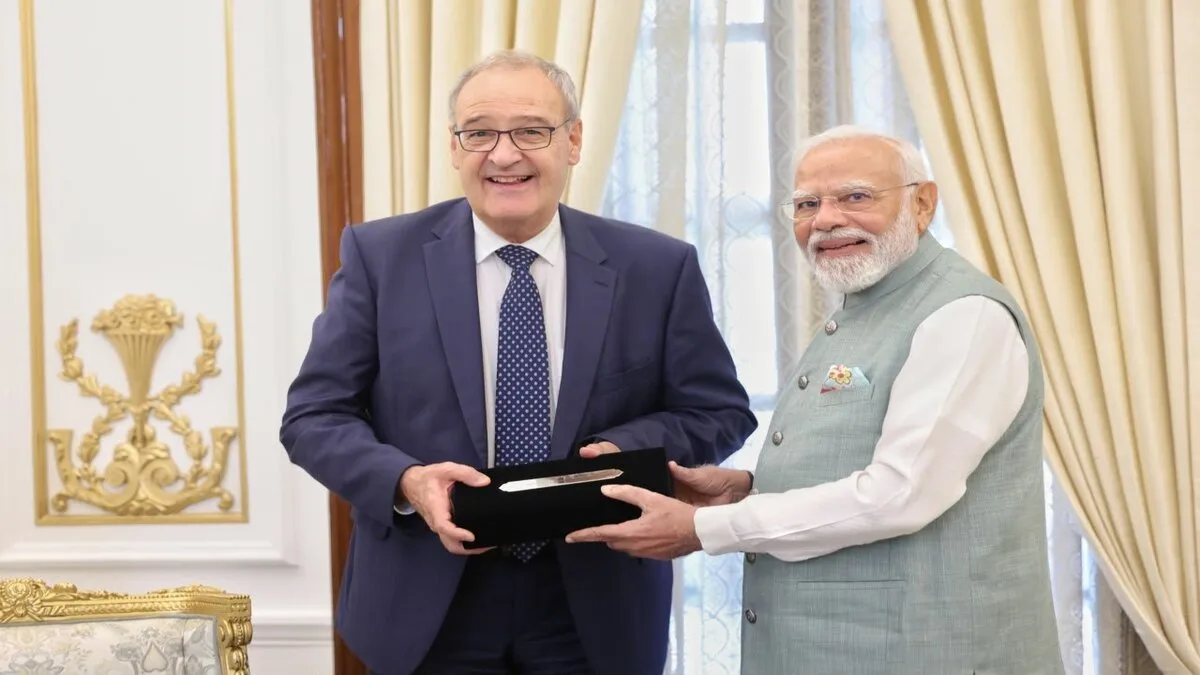
NEW DELHI: India and Switzerland on October 5, Monday unveiled a major expansion of bilateral cooperation, with Prime Minister Narendra Modi and Swiss President Guy Parmelin overseeing six key agreements on migration, youth mobility, infrastructure, research and technology. The two leaders also backed a USD 100 billion EFTA investment roadmap aimed at creating one million direct jobs in India over the next 15 years.
List of Outcomes (6 in total) : PM @narendramodi’s meeting with President @ParmelinG during the latter’s State Visit to India. ⬇️ pic.twitter.com/aYuBnbK1Ra
— Randhir Jaiswal (@MEAIndia) October 5, 2026
Five-year visas, expanded youth mobility
The Migration and Mobility Partnership (MMP) is among the most significant outcomes of the talks. It provides for multiple-entry visas valid for up to five years, renewable one-year student permits and mechanisms to facilitate employment and mobility for Indian students, youth and skilled professionals.
A separate Young Professionals Agreement will enable 300 professionals from each country to participate annually, with the quota expandable to 500. Nationality and residency verification procedures are expected to be completed within 30 to 90 days.
PM Modi said that the agreements would open new opportunities in Switzerland for Indian students, researchers, professionals and young people.
Addressing the press meet with Mr. Guy Parmelin, President of the Swiss Confederation. @ParmelinG https://t.co/Om5YLt3pcY
— Narendra Modi (@narendramodi) October 5, 2026
Green infrastructure, science, research and startups
India and Switzerland also signed an MoU covering transport technologies, mobility systems and infrastructure, with cooperation spanning electric vehicles, ropeways, tunnelling and the circular economy. The partnership will promote technology transfer, industry-academia collaboration and sustainable infrastructure. Swiss expertise is already being deployed in India, including VSL Engineering’s involvement in the Chenab Bridge and Swiss technology in the Varanasi urban ropeway project.
In science and innovation, a Letter of Intent between India’s Department of Science and Technology (DST) and the Swiss National Science Foundation will promote joint research and institutional cooperation. An additional agreement with the Zurich University of Applied Sciences will launch an Indo-Swiss training programme for early-stage startups, while the inaugural Indo-Swiss Research Flagship will focus on young researchers, knowledge exchange and technology transfer.
TEPA anchors economic partnership
Economic ties were a central focus of the summit, with both sides highlighting the India-EFTA Trade and Economic Partnership Agreement (TEPA), which entered into force in October 2025. PM Modi said that the pact provides a roadmap for USD 100 billion in EFTA investment and one million direct jobs in India over 15 years.
Swiss President Parmelin gave a positive assessment of TEPA’s implementation, saying corporate interest had been “very strong” and predicting a significant boost to bilateral trade. Switzerland is India’s largest trading and investment partner within EFTA. Bilateral trade exceeds USD 25 billion, while Swiss investment in India has crossed USD 11 billion.
The India-EFTA Trade and Economic Partnership Agreement (TEPA) is a free trade pact signed between India and the four European Free Trade Association (EFTA) member states—Iceland, Liechtenstein, Norway, and Switzerland
The two sides also discussed expanding Indian exports of agriculture, pharmaceuticals, textiles and engineering goods while attracting Swiss investment in biotechnology, life sciences, banking, insurance, food processing and sustainability.
Defence, nuclear energy and AI cooperation
The partnership is also set to expand into defence manufacturing, military exchanges and nuclear energy. Swiss companies could explore joint production and development opportunities under India’s Make in India initiative. Talks also covered advanced manufacturing, precision engineering, pharmaceuticals, healthcare, space and climate cooperation.
Artificial intelligence emerged as another priority. Parmelin called India a “key actor in global governance” and praised its efforts to amplify Global South voices in technology debates. Switzerland will host the next global AI Summit in Geneva in June 2027, following India’s AI Impact Summit in New Delhi earlier this year. Parmelin described India as a key partner and said Bern wanted continuity between the two summits. PM Modi conveyed India’s readiness to support the Geneva event.
Ukraine, UN reforms and global challenges
The two leaders also discussed the Ukraine conflict, West Asia and reforms of global institutions. PM Modi said that India and Switzerland share a commitment to democratic values, the rule of law, dialogue and diplomacy, while supporting meaningful efforts towards peace.
President Parmelin said that the Ukraine war and UN reforms were among the issues discussed, stressing the importance of dialogue and multilateral cooperation amid growing global fragmentation.
We also discussed deeper cooperation in sectors like health, clean energy, space, Yoga and Ayurveda.
India and Switzerland share a strong commitment to democracy, dialogue and diplomacy. We will continue working together for global peace and stability. pic.twitter.com/136O79i378
— Narendra Modi (@narendramodi) October 5, 2026
‘3Ts’ set the direction for India-Swiss partnership
Summing up the talks, MEA said that the next phase of bilateral cooperation would focus on Trade, Technology and Talent.
Parmelin’s three-day State visit is his first bilateral visit to India as Swiss President in nearly a decade. He is also scheduled to meet President Droupadi Murmu and attend the India-EFTA Prosperity Summit on October 7, marking the first anniversary of TEPA’s implementation.
The latest agreements broaden India-Switzerland ties from trade and investment to mobility, infrastructure, research, defence and emerging technologies, setting the framework for deeper cooperation in the coming years.