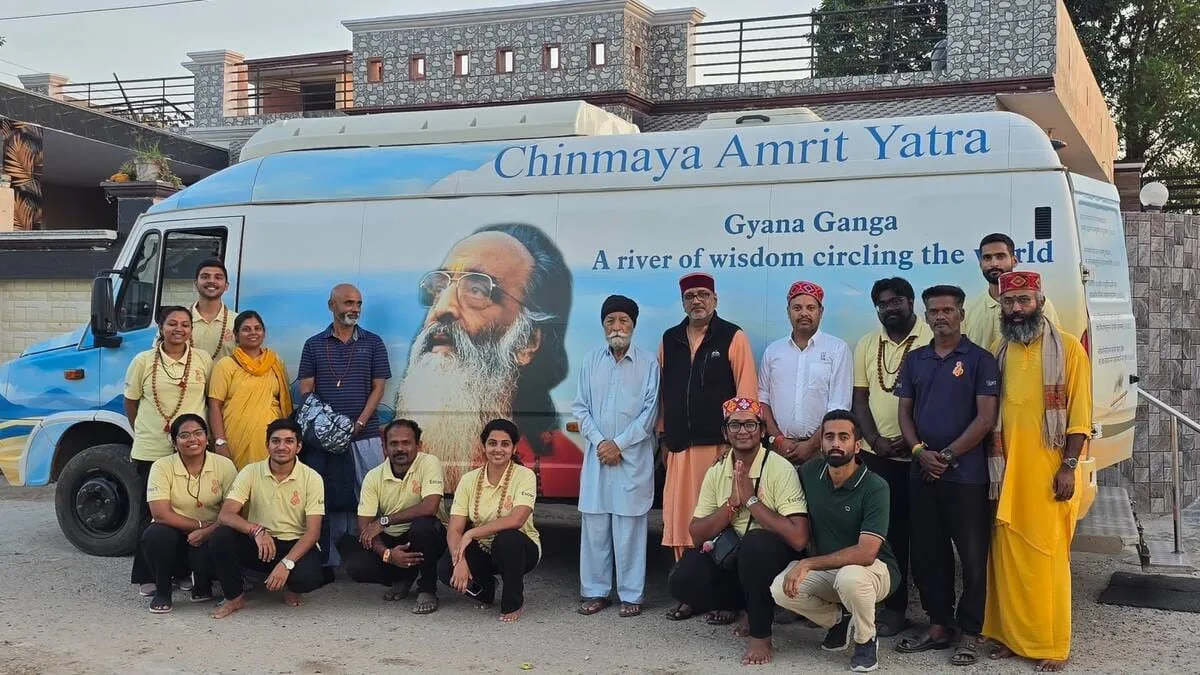
JAMMU: One of the most moving moments of our Chinmaya Amrit Yatra was meeting Param Vir Chakra awardee Captain Bana Singh at R. S. Pura, Jammu. Five kilometres from the India–Pakistan border, in Kadyal village, lives a man whose battlefield courage is legendary — and whose life is marked by simplicity.
The hero of Siachen
In June 1987, during Operation Rajiv, the Indian Army set out to capture the heavily fortified Pakistani position known as the Quaid Post in the Siachen Glacier region. Situated at approximately 21,000 feet on the Saltoro Ridge, the post overlooked Indian supply routes. Earlier attempts had failed because of the treacherous terrain, extreme cold and blizzards. Then Naib Subedar Bana Singh volunteered to lead a five-man team.
In temperatures that could fall to –40°C, his team approached from an unexpected direction, scaling a near-vertical wall of ice and snow. In the early hours, they surprised the enemy and fought through the fortified position in fierce close-quarters combat. The strategic post was subsequently renamed Bana Post in his honour.
For his courage and leadership, Bana Singh was awarded India’s highest wartime gallantry award, the Param Vir Chakra. Yet his story after Siachen is equally remarkable and inspiring, too.
The choice that revealed his heart
After receiving the Param Vir Chakra, Bana Singh was invited by the Government of Punjab to settle there. He was offered 25 acres of land, Rs 25 lakh and a monthly pension of Rs 15,000.
At that time, the pension available to him in J&K was reportedly only Rs 168 per month. Bana Singh chose to remain in Jammu. When I shared this with the youth travelling with us — many of whom knew little about his story — he simply laughed and said: “How can I leave my father and mother and go away to Punjab? I was born here, and I will be here.” Those words revealed his attachment not to material rewards, but to his family, soil and home.
Finding his home in Kadyal
I felt strongly that the Chinmaya Amrit Vahini must visit Bana Singh, so we set out from Jammu for Kadyal.
Finding his home was an adventure. There were no clear addresses or prominent signboards. Even with a stadium named after him nearby, many people did not know where his house was. Our landmarks were the Shaheedi Gates — arches commemorating martyrs. After crossing several, we reached the village.
Some women near the village school pointed us to his home, right beside the school. There was no grand entrance or name board — nothing to suggest that one of India’s most decorated soldiers lived there. Just a simple, quiet home.
A Param Vir Chakra Awardee living like a yogi
Bana Singh was living there with his family in remarkable simplicity. After receiving the nation’s highest wartime gallantry award, he chose a quiet life close to his birthplace. To me, there was something deeply sanyasi-like in that simplicity. He showed extraordinary courage on the battlefield and, in civilian life, another kind of strength — detachment from recognition, wealth and status. He simply stayed where he belonged.
Bana Singh was delighted that we had travelled all the way from Chennai to meet him in his small home. He thanked us for making the journey to see him. I told him: “Bana Singh, for us, coming to your home was itself a Teertha Yatra.”
For us, this was an opportunity to honour a life of courage, sacrifice and devotion to Bharat. As a mark of our respect and affection, we presented him with a traditional sword from Arunachal Pradesh and a copy of the Bhagavad Gita.
Together, the gifts were deeply meaningful — the sword representing shaurya and valour, and the Gita representing dharma, wisdom and selfless action. It was our expression of gratitude to a man who had given so much to the nation.
During our conversation, Bana Singh recalled meeting Pujya Gurudev Swami Chinmayananda in the 1960s. He also remembered visiting the Chinmaya Heritage Centre and Chinmaya Vibhuti for a youth camp. These memories made the meeting special. When we spoke about his decision to remain in Jammu despite the offer from Punjab, he simply smiled and said: “I was born here, and I will be here.” What stayed with me most was his love for Bharat. When I spoke to him about my work with the youth, he repeatedly told me: “Keep Bharat together. Keep Bharat together.” There was no rhetoric in those words. Only love.
The deeper meaning of heroism
We often associate heroism with extraordinary moments — facing danger and overcoming impossible odds.
Bana Singh demonstrated that heroism at Siachen. But meeting him revealed another dimension of courage: the courage to remain rooted, to live simply and to put duty and family above material comfort. His life reminds us that greatness does not always announce itself.
Sometimes, it lives quietly in a small village, without a name board outside the house. And sometimes, the man who has done extraordinary things for the nation asks for nothing more than to remain where he was born. “Keep Bharat Together” For the young people of Chinmaya Amrit Vahini, meeting Captain Bana Singh was more than meeting a Param Vir Chakra awardee.
It was an encounter with living history — and a lesson in courage, simplicity, rootedness and selfless service.
As we left Kadyal, I felt we had received something far more valuable than a meeting with a decorated soldier.
We had received darshan of a life lived with courage, simplicity and love for Bharat.
Meeting Captain Bana Singh was undoubtedly one of the finest moments of our Chinmaya Amrit Yatra — perhaps among the top three moments of the entire journey. And his words continue to echo: “Keep Bharat together. Keep Bharat together.”