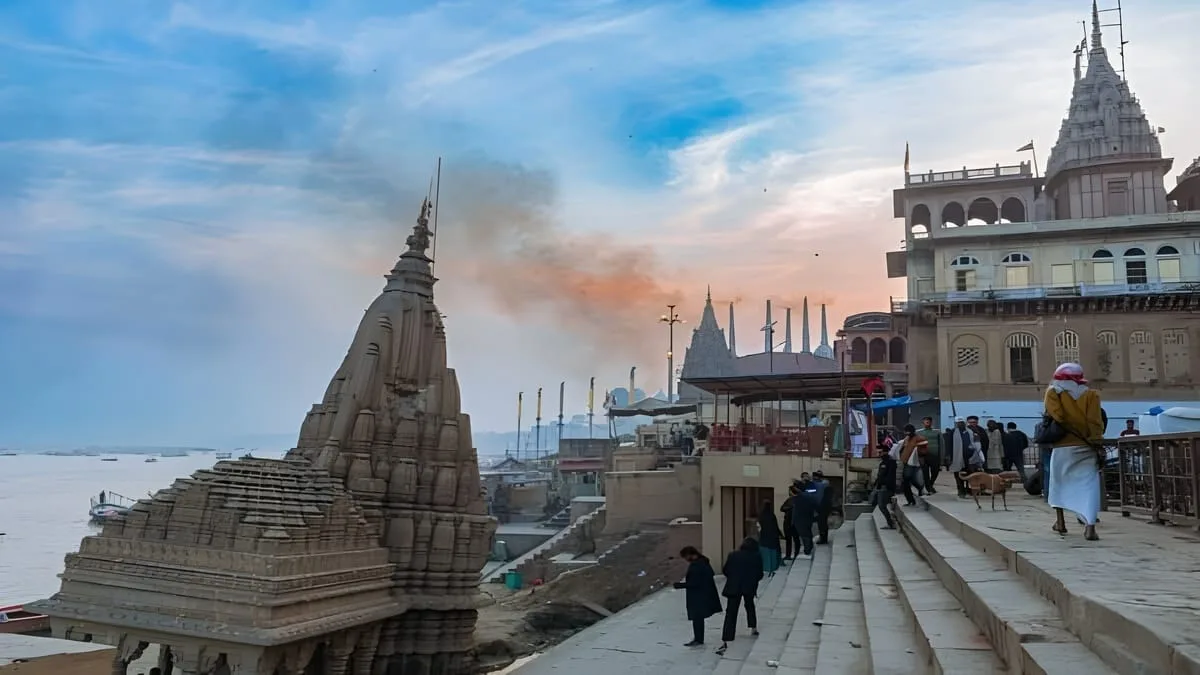
VARANASI: Most visitors arrive to look for the eternal. They find it in the smoke rising from Manikarnika, in the bells at dusk, in the river that carries centuries along with its current. Few expect to find it in a mandir that stands tilted. Below the burning ghat, half-sunk in silt and water for much of the year, stands Ratneshwar Mahadev, a Shiva mandir leaning at an angle that would make any engineer nervous and any person curious.
The world knows the Leaning Tower of Pisa. Boatmen on the Ganga will tell you, with a mixture of pride, that their mandir leans twice. Whether one measures it with instruments or with local faith, the tilt is about 9 degrees toward northwest. The shrine appears to be bowing, as though in permanent reverence toward the river it was built beside. But the lean is only the first thing the eye catches. Stay longer, let the boat drift and look upward at the spire. Something else begins to reveal itself: a pattern within a pattern, a form that keeps repeating at smaller and smaller scales. What looks at first like ornate carving turns out to be a visual philosophy. The temple is, in a very real sense, a fractal architecture.
A fractal is a shape that contains copies of itself. Zoom in on a fern leaf, and you find smaller leaves shaped like the whole. Look at a coastline from a plane, then from a cliff, and the jagged outline behaves similarly at every distance.
Mathematicians gave this idea its modern name only in the twentieth century, yet Indian temple builders had been carving it into stone for more than a thousand years.
Ratneshwar Mahadev follows the Nagara style of northern India, recognisable by its curving shikhara, the tower that rises above the sanctum. On a Nagara mandir, the main spire is rarely a single smooth form.
It is surrounded by miniature spires called urushringas, which cling to its sides like children gathered around a parent. Each of these smaller towers echoes the shape of the great one. On many mandirs, these miniatures carry even tinier versions on their own surfaces.
At Ratneshwar Mahadeva, this repetition is modest compared with the grand mandirs of Khajuraho, but it is clearly present. The central tower rises in stacked tiers, each tier carrying rhythmic bands of ornament that mimic the outline of the whole.
The crowning amalaka, the ribbed disc near the summit, is itself repeated as smaller discs at the corners of the lower storeys. The eye climbs the tower and keeps meeting the same idea, only reduced.
This is not decoration for its own sake. In the traditional understanding, the mandir represents Mount Meru, the cosmic mountain at the centre of creation. A mountain is not one peak but a range of peaks, ridges rising from ridges.
By building the shikhara as a cluster of self-similar summits, the architects were modelling the universe the way they understood it, one expressing itself endlessly at every scale.
The philosophy behind the pattern
Indian thought has long been comfortable with the idea that the part mirrors the whole. The Upanishadic vision holds that the individual self and the universal reality share the same essence. The drop contains the ocean; the atom reflects the cosmos. “As in the body, so in the universe,” runs an old teaching, and the mandir architect took it literally.
Seen this way, the fractal spire of Ratneshwar is a sermon in stone. Every small shikhara says what the large one says. The devotee standing before it is invited to see himself as one such miniature, a small reflection of a boundless whole.
Varanasi amplifies this meaning. The city itself is often described as a microcosm, a place where the entire sacred geography of India is said to be present in compressed form. Pilgrims believe that all the holy rivers and shrines of the land have their counterparts within Kashi.
The city is a fractal of the subcontinent, and the mandir at its most solemn ghat is a fractal of the cosmos. Layer rests upon layer and meaning within meaning.
Legends that lean too
No monument in Varanasi survives without stories, and Ratneshwar carries several. The most popular one concerns a devoted son who built the mandir to honour his mother, hoping to repay the debt every child owes to a parent.
When the work was complete, he is said to have declared proudly that the debt was settled. His mother, the story goes, was displeased, since a mother’s gift can never be fully returned. In answer, the mandir began to tilt. Locals still call it the temple of the mother debt.
Another version links the shrine to a woman named Ratna Bai, said to have been an attendant in a royal household, who built it without the blessing of her patroness. A curse followed, and the mandir was condemned to lean and to be rarely worshipped.
Historians treat such tales with caution, and the more practical explanation lies in the soft, shifting ground of the riverbank and the annual floods that swallow the lower ghats. The legends matter because they show how the people of Kashi read their landscape.
A structural flaw became a moral lesson. A leaning wall became a meditation on humility and obligation. The city does not simply record its buildings; it interprets them.
Each version of the stories repeats the same essential shape: an act of devotion, a moment of pride, a correction from above. Change the characters and the core pattern survives, much like the miniature spires that echo the great one.
Stillness offered by the mandir
What makes Ratneshwar truly unusual is its relationship with the river. For many months of the year, the sanctum lies beneath the Ganga. During the monsoon, water can rise high up the tower, leaving only the upper portion visible. When the river retreats, it leaves behind thick layers of silt that cling to the carvings.
This means regular worship is rare. The mandir often stands without the bells, lamps and chanting that fill the other shrines of Varanasi. In a city that never stops praying, Ratneshwar is strangely silent. Some find this sad; others find it the most honest temple on the ghats. It does not perform devotion. It simply endures.
As water deposits sediment into the grooves of the carving, it traces the patterns more sharply, like ink settling into an engraving. At certain times of year, with the afternoon light slanting across the stone, the repeating forms of the spire appear almost drawn rather than carved. Nature, in its indifferent way, keeps highlighting the geometry that humans first imagined.
Photographers, painters and the pull of the tilt
In recent decades, Ratneshwar has become one of the most photographed structures in Varanasi. Its image appears on postcards, travel blogs and the covers of books about the city. Photographers favour the golden hour, when the temple is silhouetted against a burning sky, and the smoke of Manikarnika drifts past its tower.
Painters have long been drawn to it too. The tilt gives a composition an instant sense of movement, while the layered spire offers texture and rhythm. Artists often exaggerate the repetition of the shikhara, turning the small spires into a cascade that seems to flow down toward the water. In their hands, the fractal quality becomes even more visible, as though the mandir were dissolving into its own reflection.
When the river is calm, the mandir appears twice, once in stone and once in water, the second image rippling and fragmenting. A structure built on the idea of repeated forms finds yet another repetition in the Ganga. The effect feels less like coincidence and more like completion.
Why it matters today
It would be easy to treat Ratneshwar as a curiosity, a quirky rival to Pisa that makes for a good anecdote. That would miss its deeper value. The mandir is a reminder that Indian architecture carried sophisticated ideas about proportion, scale and self-similarity long before these ideas found formal mathematical language elsewhere.
Students of design and mathematics increasingly look at Indian temples as early examples of fractal thinking. The builders worked with ratios, grids and repeated units that allowed a vast structure to grow from a single measured module. Nothing was random; the beauty that pilgrims feel was grounded in careful calculation.
There is also a cultural lesson in the temple’s condition. Standing between floods and neglect, it raises questions about how the city protects its heritage. Conservation on a riverbank that disappears every monsoon is no simple task, but the mandir’s survival so far suggests that sound craftsmanship can outlast difficult conditions for a very long time.
The last look from the boat
As the boat pulls away from Manikarnika, the pyres fade into a glow, and the mandir grows smaller. From a distance, its lean becomes more pronounced, its spire a dark, jagged outline against the sky. And here the fractal idea completes itself one final time.
Seen far away, the mandir becomes a single small peak among the rooftops and towers of the ghats. A miniature spire in the larger skyline of Kashi, just as its own miniature spires sit within its tower. The city, the mandir and the spire all tell the same story at different sizes: that the part holds the whole, that the small reflects the vast and that even a building which cannot stand upright can still point toward something greater than itself.