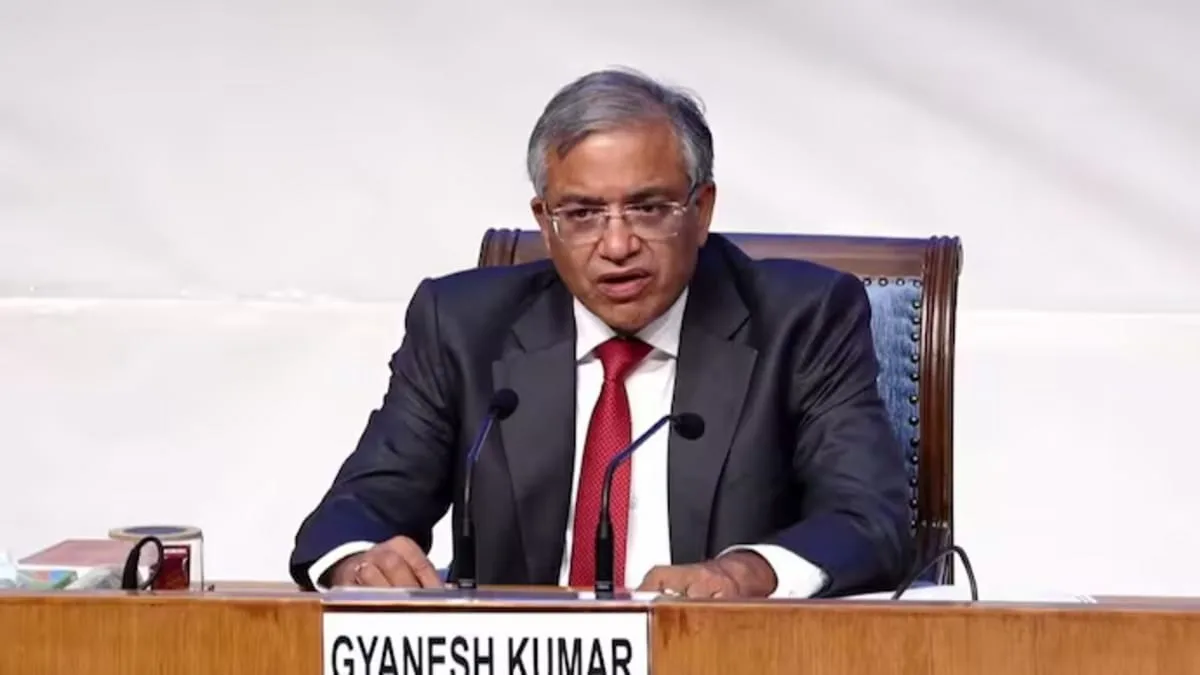
NEW DELHI: The Election Commission of India (ECI) has rejected the suggestion that internal notes and objections raised by two Election Commissioners during the Special Intensive Revision (SIR) indicate a breakdown in the functioning of the poll panel, saying that differences of opinion are a normal part of deliberation in a multi-member constitutional body.
Ritika Your “unprecedented rupture” package is a one-sided reading of internal notes. The Election Commission has answered it on record today.
Read ECI PN dated 23.09.2026 (screenshot attached).
What ECI actually said:1. Written notes, observations and technical suggestions… https://t.co/vylrZWQXhW pic.twitter.com/hWbVQ81uVX
— Media Expose (@MediaExpose_) September 23, 2026
The clarification came after an Indian Express investigation reported that Election Commissioners Sukhbir Singh Sandhu and Vivek Joshi had recorded at least 14 objections over 10 months to decisions and orders relating to the electoral-roll revision. The report said the Commissioners had raised concerns over issues including changes to Form 6, voter deletions and the centralisation of electoral-roll data.
In its eight-point statement issued on September 23, the ECI said written notes, observations, technical suggestions and internal checks were part of its regular institutional functioning. It stressed that the final orders and decisions of the Commission were taken in accordance with law and established procedures.
ECI: Internal objections are part of institutional deliberation
The poll panel said that operational queries and suggestions raised by Commissioners during the drafting stage were intended to improve electoral processes and safeguard voters’ rights.
“Differing views and observations are a normal part of deliberation in any institution,” the ECI said, adding that such observations form part of the decision-making process before a final decision is reached.
The Commission also pointed out that the opportunity to make suggestions is not restricted to the three Commissioners. Officers working within the Commission are similarly authorised to offer inputs aimed at improving the electoral system.
The ECI further argued that focusing on 14 internal notes spread over 10 months without considering the wider body of approvals, instructions and initiatives gives only one part of the picture.
According to the Commission, around 40 new initiatives and several electoral reforms were undertaken during the past year, including electoral-roll revision and SIR, and these decisions were taken unanimously by the full Commission.
What does the law say about a multi-member Election Commission?
The functioning of a multi-member Election Commission has previously been examined by the Supreme Court. In T.N. Seshan v. Union of India (1995), the Supreme Court upheld the multi-member structure of the Election Commission and rejected the proposition that the Chief Election Commissioner alone could exercise decisive authority over the Commission. The judgment recognised the Commission as a multi-member constitutional body and accepted decision-making through the statutory mechanism, including majority decisions where unanimity is not achieved.
The present statutory framework similarly provides for deliberation among the members. Section 18 of the Chief Election Commissioner and Other Election Commissioners (Appointment, Conditions of Service and Term of Office) Act, 2023 provides that the business of the Commission should, as far as possible, be transacted unanimously; where the members differ, the law provides for decision-making by majority.
Therefore, the existence of an internal objection by itself does not establish that a final decision of the Commission was invalid. The legal question in any particular case would depend on how the final decision was made and whether the prescribed statutory procedure was followed.
‘13 crore names deleted’: What the number represents
One of the major points in the debate concerns the figure of more than 13 crore names removed from draft electoral rolls during SIR. The Indian Express reported that more than 13 crore names had been struck off draft rolls across 30 States and Union Territories during the exercise. However, a draft-roll deletion does not by itself establish that 13 crore living, eligible Indian citizens have permanently lost their voting rights.
Electoral-roll revision routinely involves identifying entries relating to deceased persons, people who have shifted residence, duplicate entries and other cases requiring verification. The significance of the 13-crore figure therefore depends on the reasons for individual exclusions, the subsequent claims and objections process and the number of entries ultimately restored. A numerical figure from a draft stage needs to be distinguished from a final determination of ineligible voters.
Form 6 Dispute: Internal objection vs final legal finding
Another issue raised in the investigation concerns changes to Form 6, the application form used for inclusion of names in electoral rolls. The Indian Express reported that the two Commissioners had described certain changes as “unauthorised” and “illegal”. Those descriptions, however, were part of internal objections. An internal note expressing a legal or procedural concern is not, by itself, a judicial determination that a particular action is unlawful.
Whether a particular change complied with the governing law would ultimately depend on the applicable statutory provisions, rules, instructions and, where challenged, the findings of the competent judicial authority.
West Bengal appeals show a more complicated picture
The debate over SIR in West Bengal has also centred on deletions from the electoral rolls. The ECI recently informed the Supreme Court that 38.31 lakh appeals were pending before appellate tribunals in the state. Of these, 22.21 lakh appeals sought inclusion, while 16.10 lakh sought deletion of names. The figures are significant because they demonstrate that the appeals process includes both voters seeking restoration of names and objections seeking further deletions.
The ECI has also said that the deleted entries included cases involving absentee, shifted, deceased and duplicate voters. The existence of appeals, however, means that the adjudication process remains important in determining individual cases. Consequently, the aggregate number of deletions alone cannot establish how many eligible voters were wrongly excluded without examining the reason and outcome of individual cases.
ECINet and the question of centralisation
The investigation also raised concerns about the centralisation of electoral-roll data through the ECI’s digital platform, ECINet, and whether state-level election officials had adequate access.
The ECI has responded that its digital platforms operate under data-security protocols designed to prevent unauthorised tampering and manipulation. It has also reiterated that Electoral Registration Officers (EROs) and District Election Officers (DEOs) continue to exercise their statutory powers relating to voter registration and deletion. The distinction is important: concerns about access, software architecture or administrative workflow do not automatically establish that the statutory powers of state-level election officials have been removed.
The precise operation of the system and the extent of access available to different officials remain matters that can be assessed from the relevant technical and administrative records.
Internal disagreement does not automatically mean institutional breakdown
The central issue in the controversy is therefore not simply whether differences existed inside the ECI. The Commission itself acknowledges that suggestions and differing views were raised. The key distinction is between internal deliberation and final institutional decisions.
The ECI maintains that the objections were part of normal checks and balances and that the final decisions of the full Commission during the past year were unanimous. The Indian Express investigation, meanwhile, has highlighted the substance and frequency of objections raised by two Commissioners and questioned whether they were adequately involved in certain decisions. These are two different descriptions of the same institutional process: one focuses on the internal objections, while the other focuses on the Commission’s eventual decisions. The ECI’s response therefore directly challenges the interpretation that the existence of internal objections demonstrates that the Commission was no longer functioning collectively.
The larger question is about process and evidence
The controversy ultimately turns on the documentary record: what decisions were proposed, what objections were raised, who participated in the deliberations, what changes followed those objections and what decisions were finally approved by the Commission.
The ECI has placed its position on record: internal notes are part of its checks and balances; differing views are normal; statutory officers continue to exercise their powers; its digital systems are subject to security controls; and the final decisions of the full Commission over the past year were unanimous.
At the same time, the reported objections of the two Commissioners are part of the public record and raise specific questions about the internal functioning of the Commission. Those questions can be assessed against the actual notes, orders, statutory provisions and subsequent actions rather than treating the existence of disagreement itself as proof of either institutional failure or complete vindication.
What is clear from the ECI’s latest statement is that it does not accept the characterisation of the reported internal notes as evidence of an institutional “rupture”. Its position is that deliberation, disagreement and suggestions precede final decisions in a multi-member constitutional body, and that the final decisions during the period in question were taken unanimously.