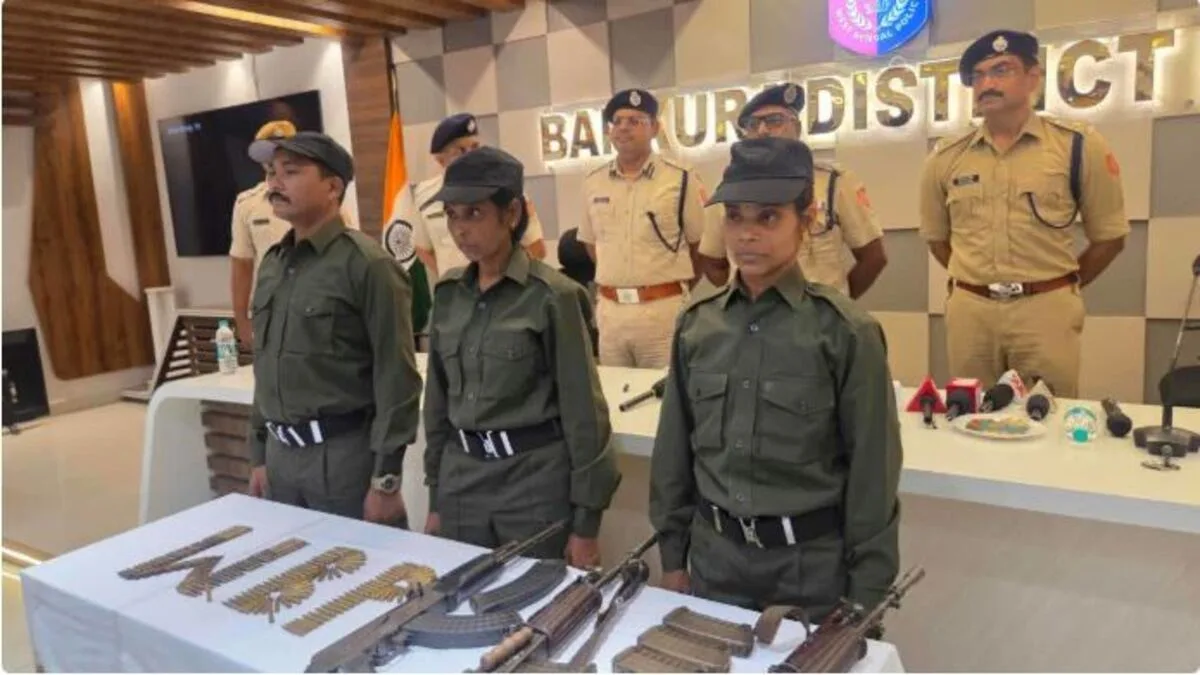
KOLKATA: Three senior Maoists, facing more than 80 criminal cases across West Bengal and Jharkhand, surrendered before the Bankura Police on September 23. They announced their decision to abandon armed activities and return to mainstream society. The three surrendered with an AK-47 rifle, two INSAS rifles, 10 magazines, and 154 rounds of ammunition.
The surrender of the three cadres identified as Jaba alias Bulu, Nayantara Sahu alias Mita alias Jhuma, and Ramprasad Mandi alias Sachin took place at the conference hall of the Bankura Police Lines in the presence of Anand Kumar, Additional Director General of Police (Western Zone), West Bengal. DIG, Bankura Range, Abhishek Modi, Superintendent of Police V.G. Satish Pasumarthy and other senior police officers were present on the occasion.
According to police officials, all three had remained associated with the Maoist organisation for nearly two decades and had been active in West Bengal for around 10 years. Their operational activities extended across the Jangalmahal region of West Bengal and adjoining areas of Jharkhand.
Senior functionaries of maoist organisation
Police said Jaba and Nayantara were members of the Maoist organisation’s zonal committee, while Ramprasad Mandi was associated with the Bengal-Jharkhand-Odisha Regional Committee.
The three operated under aliases and were active in Bankura, Purulia, Jhargram and Paschim Medinipur districts of West Bengal, besides areas of East Singhbhum in Jharkhand. Police records indicate that more than 80 cases have been registered against them collectively in different police stations.
The cases include serious offences under the Unlawful Activities (Prevention) Act, Arms Act and Explosives Act, besides other criminal charges. A separate account in the supplied material also states that the trio had been named in around 80 FIRs connected with Maoist activities in West Bengal and Jharkhand.
ADG Anand Kumar said the criminal proceedings against the surrendered cadres would continue in accordance with law. He added that their cases would also be processed under the state’s surrender-cum-rehabilitation policy.
Weapons handed over during surrender
The three cadres handed over three firearms to the police during the surrender: one AK-47 and two INSAS rifles, along with 10 magazines and 154 rounds of ammunition. Police officials said the weapons were significant in the context of the trio’s long association with armed Maoist activities. According to Kumar, the surrender followed sustained efforts by the Bankura Police and intelligence-based operations against Maoist networks in the region.
The supplied material states that a recent operation based on intelligence inputs regarding Maoist hideouts had resulted in the recovery of a large cache of weapons from a forested area. The surrender of the three senior leaders followed those operations, according to the police.
Officials also said that repeated efforts by Bankura Superintendent of Police V. G. Satish Pashumrthi and his team, along with cooperation from intermediaries and local individuals, contributed to the surrender.
Development Cited as Reason for Leaving Armed Movement
After surrendering, Ramprasad Mandi said he had spent nearly 20 years with the Maoist organisation. He said that when he initially joined the movement, he believed armed struggle was the only way to address deprivation and backwardness in the region.
However, he said conditions had changed over the years. Improvements in roads, electricity, healthcare and other basic infrastructure in rural areas had influenced his decision to leave the armed movement. Mandi said that the development taking place in villages had made him realise that violence was not an appropriate means of addressing social and economic problems. He expressed his desire to participate in society through democratic means.
Mita praised Chief Minister Suvendu Adhikari, saying: “We know how he’d led people’s movements in Nandigram from Sonachura village. Now he is trying his best to serve the mass.” The two women cadres expressed their intention to leave their underground lives behind and begin normal lives in the mainstream.
According to the surrendered cadres, they had initially been influenced by what they perceived as deprivation in the Jangalmahal region. They said their years of living in difficult forest conditions eventually led them to conclude that the armed movement could not provide a sustainable solution.
They further said that government development programmes and welfare measures had altered the situation in several areas and that they no longer saw a justification for continuing armed activities.
Activities spread across Bengal-Jharkhand border areas
Police said the three leaders had been active in several districts of southern West Bengal and adjoining Jharkhand for years. Their areas of activity included Bankura, Purulia, Jhargram and Paschim Medinipur in Bengal and parts of East Singhbhum in Jharkhand.
According to ADG Kumar, the three had been involved in Maoist operations in Bengal between 2006 and 2014 before shifting their activities towards the neighbouring state of Jharkhand.
Police officials said the Maoist network had faced increasing operational pressure because of sustained security operations in forest areas along the Bengal-Jharkhand border.
The supplied material states that the surrendered cadres had faced pressure following a multi-state security operation involving the CRPF, CoBRA and state police forces in the Saranda, Kolhan and Porahat forest areas of Jharkhand. Officials said the reduction in logistical and civilian support contributed to the cadres contacting the Bankura Police through intermediaries to discuss surrender.
Links to 2007 killing of JMM MP Sunil Mahato
Police also linked the surrendered cadres to the 2007 killing of JMM MP Sunil Mahato in Jharkhand.
Mahato, JMM block secretary Prabhakar Mahato and two security personnel were killed during a public meeting at Baghuria in Ghatshila on March 4, 2007. According to police, the attackers also looted four INSAS rifles from the slain security personnel.
Police said one of those rifles subsequently came into the possession of Ramprasad Mandi.
The alleged involvement of the three in the case forms part of the broader criminal cases attributed to them by security agencies. Further legal proceedings in the cases will continue despite their surrender.
Police to seek information during investigation
Senior police officials said the surrendered cadres would be questioned in phases as they were named in a large number of cases connected with Maoist activities in Bengal and Jharkhand.
Officers also said that Ramprasad Mandi and Nayantara Sahu had provided information that helped security forces locate arms dumps. Such information could assist investigators in understanding the structure and activities of Maoist networks operating in the region.
Police said Jaba Mahato had joined the movement at a young age and had played a role in reorganising local Maoist modules. The supplied material identifies her as the wife of former Belpahari squad commander Madan Mahato and a resident of Mechua village.
Surrender under rehabilitation policy
ADG Anand Kumar said the three surrendered cadres would be considered for benefits under the West Bengal government’s surrender and rehabilitation policy.
Their cases will be placed before the government’s screening committee, which will determine the assistance available to them under the applicable rules. At the same time, Kumar made it clear that surrender would not automatically end the criminal cases registered against them. The police will continue legal proceedings and investigate their alleged involvement in earlier Maoist activities.