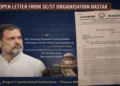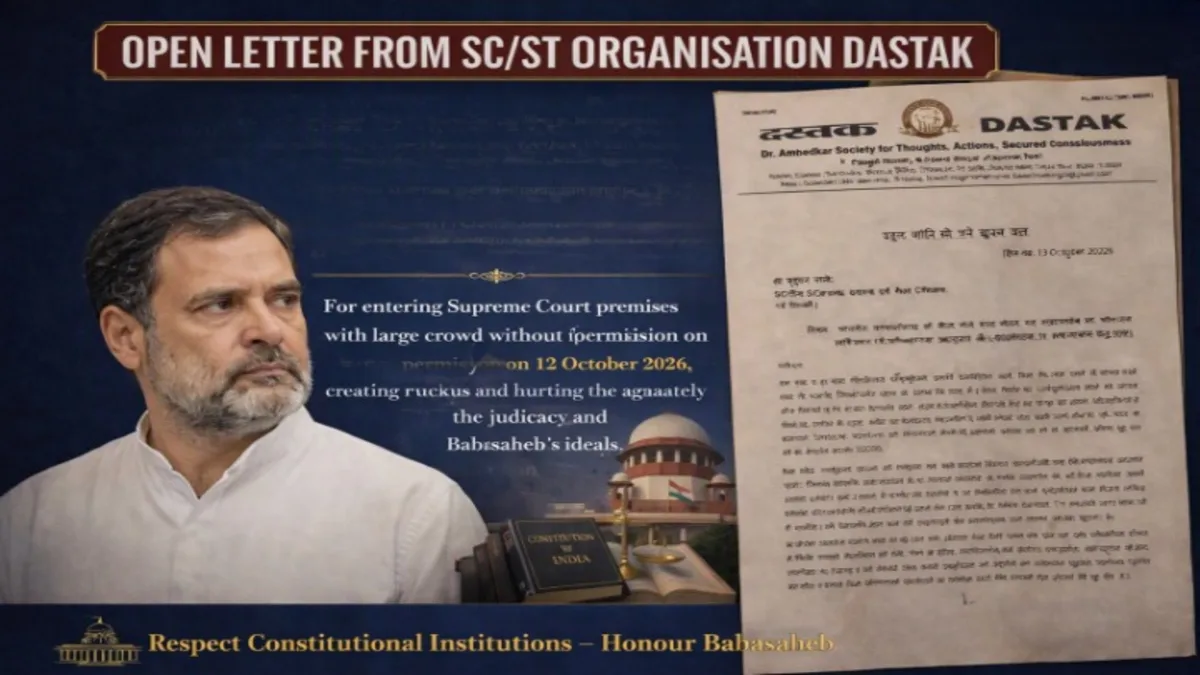
NEW DELHI: The Dr Ambedkar Society for Thoughts, Actions and Consciousness, known in short as ‘Dastak’, has written a detailed open letter to Rahul Gandhi, Leader of the Opposition in the Lok Sabha. The letter documents its deep concern for the Constitution, the judiciary and the ideals of Babasaheb Dr Bhimrao Ambedkar. Registered under the Societies Act and under Section 80G of the Income Tax Act, the organisation is based in Trilokpuri, Delhi, and works for the interests of Scheduled Castes, Scheduled Tribes and backward classes.
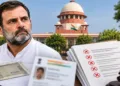
The letter states in plain terms that on October 12, 2026, Rahul Gandhi and other opposition leaders entered the Supreme Court premises with a large crowd without permission, created a commotion and, in a sense, tried to hold the Hon’ble Supreme Court hostage. This has left the whole country stunned. Dastak says that yesterday will be recorded as an extremely controversial chapter in the history of Indian democracy. Many are calling it the darkest day since the Emergency. The manner in which Rahul Gandhi entered the Supreme Court raises serious questions about his political understanding, maturity and respect for constitutional propriety. He walks around with the Constitution in his hand, yet disregarding the dignity of the most sacred institution established by that very Constitution cannot be justified in any way. Babasaheb Dr Bhimrao Ambedkar gave this country the framework for a strong and independent judiciary. He believed that respect for constitutional institutions is the very soul of any democracy. When that same institution becomes a stage for political protest and security protocols are ignored, it is not merely an insult to the institution but a direct blow to Babasaheb’s dream.
The organisation has expressed deep anguish, writing that disregarding the dignity of the country’s highest court in order to display political protest hurts the sentiments of crores of people from the Scheduled Castes, Scheduled Tribes and backward classes. These people regard Babasaheb as their ideal and the Constitution as their shield. When someone holding a position such as Leader of the Opposition tries to put pressure on the judiciary, it deepens the suspicion that constitutional institutions are being deliberately targeted. Dastak alleges that Rahul Gandhi’s actions in recent days suggest he is taking steps to shake people’s faith in democracy. This also raises the suspicion that he is acting at the behest of other forces.
The letter sets out seven main points in detail. The first concerns the allegation of ‘vote chori’ (vote theft). Rahul Gandhi has accused the Election Commission and Chief Election Commissioner Gyanesh Kumar of vote theft and demanded his resignation. He repeatedly questions the credibility of electronic voting machines (EVMs) and the Election Commission. The organisation says that, because of an inability to accept electoral defeat, institutions are attacked every time. The second point is the opposition to the Special Intensive Revision (SIR). Rahul Gandhi and leaders of the INDIA bloc have alleged that the special intensive revision of the electoral rolls involved unilateral decisions and large-scale deletion of names. Dastak raises an important question: if a party can win elections by stealing votes through EVMs, what is the need for SIR? The two allegations contradict each other. This suggests that the allegations are not based on solid evidence but are being made as political convenience dictates.
The third point is disrespect towards the country’s highest constitutional offices. When a joint opposition delegation met President Droupadi Murmu over alleged electoral irregularities, no concrete data or evidence could be presented even when the President asked for it. The organisation asks what the point of meeting the President was if there was no evidence. This, it says, shows a lack of seriousness towards a constitutional office. The fourth point is criticism of Indian democracy on foreign soil. During visits to countries such as the United States and the United Kingdom, Rahul Gandhi described Indian democracy, the judiciary and independent investigative agencies as weak or under government control. This has tarnished India’s image globally. The fifth point is the attempt to incite young people. As in neighbouring countries such as Nepal and Bangladesh, there is a continuing effort to provoke the youth, which could create instability. The sixth point is the attempt to hold an elected government hostage by staging street protests without prior permission. The seventh and most important point is the demand to meet the Chief Justice and the attempt to pressure the judiciary. When the Chief Justice is hearing the relevant petitions, demanding to meet him and entering the Supreme Court with a crowd amounts to influencing impartiality.
Dastak believes that the act of October 12, 2026 is an insult to Babasaheb. It is a blow to his dream of a democratic India. As a result, people from the Scheduled Castes, Scheduled Tribes and backward classes feel extremely insecure. The organisation has demanded that Rahul Gandhi give an explanation on all these facts and apologise publicly and unconditionally for his irresponsible conduct to the people of the country, the Hon’ble judiciary and the crores of citizens who respect Babasaheb’s ideals. The letter expresses the hope that Rahul Gandhi will understand the sensitivity of these matters, improve his conduct and apologise to the nation from a public platform.
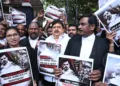
In this light, it must be said that this letter is not just one organisation’s reaction. It is the voice of millions of people who are against turning the Constitution into a political weapon. The Supreme Court is the strongest pillar of Indian democracy. When political parties breach its dignity for their own interests, questions are raised about the entire system. On October 12, the INDI Alliance had held a march against ‘vote chori’ and SIR. The police had placed barricades along the route, and the march was stopped some distance from the court. A petition was filed later, in which the Registry pointed out several deficiencies. Some lawyers also filed a contempt petition over the commotion at the Registry. Amid these facts, Dastak’s letter is an important intervention because it comes from the SC/ST community, which is regarded as Babasaheb’s heir.
Rahul Gandhi often invokes the Constitution and Babasaheb. He speaks about the rights of Dalits and backward classes. But when his actions harm the very institutions that Babasaheb strengthened, trust is broken. Dastak’s letter highlights this contradiction. If the allegations are true, apologising would be a sign of democratic maturity. If they are false, he should offer an explanation. Remaining silent or simply dismissing the allegations will only deepen suspicion.
This incident has raised a big question: can the limits of political protest extend to the dignity of institutions? In a democracy there is a right to protest, but that right is not a licence to weaken constitutional institutions. Babasaheb had said that without constitutional morality, the Constitution would remain a mere piece of paper. When leaders themselves do not follow morality, how will the ordinary citizen’s trust endure?
Dastak’s letter has come at the right time. It also reminds those organisations that invoke the Constitution only for political gain. People from the Scheduled Castes and Scheduled Tribes now want not just slogans but concrete conduct. They want their ideals to be respected, not exploited. This is an opportunity for Rahul Gandhi to respond to the letter seriously. A public apology would not only improve his image but also establish his respect for constitutional institutions. Otherwise, the allegation will persist that even the most sacred institutions are being put at stake for political interests.
Finally, it is essential to say that democracy does not run on elections and protests alone. It runs on respect for institutions, the rule of law and adherence to constitutional values. Dastak’s letter is a warning in that direction. It is hoped that it will be taken seriously and that the dignity of Indian democracy will be preserved.