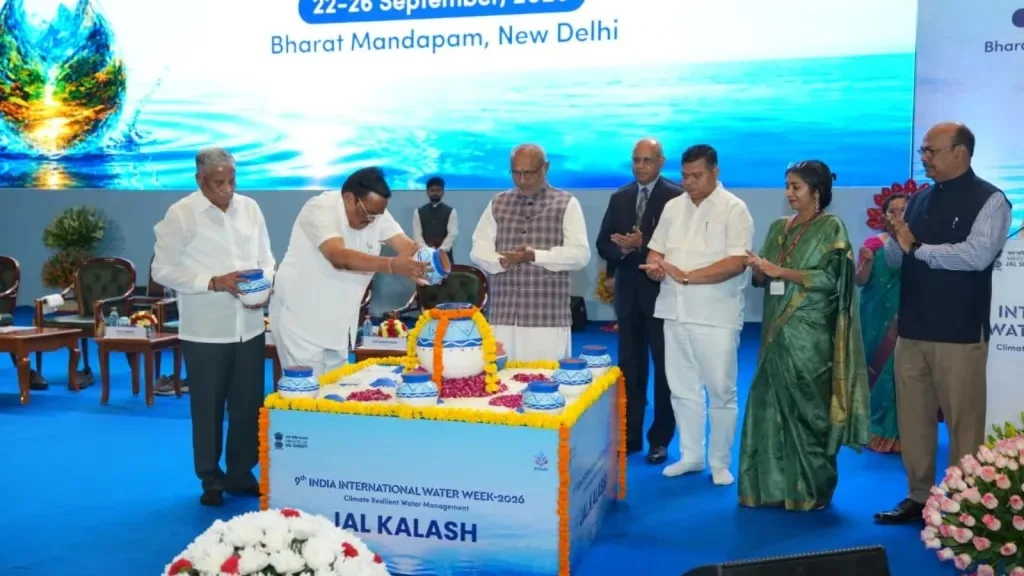
Vice-President C. P. Radhakrishnan on Tuesday inaugurated the 9th India International Water Week (IIWW) 2026 at Bharat Mandapam in New Delhi, bringing together policymakers, water experts, researchers and representatives from India and abroad to discuss the country’s growing water challenges.
Organised by the Ministry of Jal Shakti, the five-day event is being held from September 22 to 26 under the theme “Climate Resilient Water Management.”
The event comes at a time when water management is becoming increasingly complex because of climate change, rapid urbanisation, population growth and rising demand from agriculture and industry.
The opening ceremony also saw the launch of the Sustainable Urban River Management (SURM) Framework and an AI/ML-driven Integrated Reservoir Sediment Management initiative. The two initiatives are aimed at bringing greater use of technology, data and predictive approaches into water-resource management.
New SURM framework to strengthen urban river management
One of the key developments at the event was the launch of the Sustainable Urban River Management (SURM) Framework.
The framework is intended to support a more integrated approach to managing rivers flowing through or around urban areas. Urban rivers face multiple pressures, including pollution, encroachment, untreated wastewater, changing land use and increasing demand for water.
The focus on sustainable urban river management reflects the need to look at rivers as part of a larger urban ecosystem rather than treating water pollution and river management as isolated problems.
The framework is expected to contribute to planning that brings together environmental protection, urban development and water-resource management.
AI and Machine Learning to be used for reservoir sediment management
The government also launched AI/ML-driven Integrated Reservoir Sediment Management, signalling a greater role for artificial intelligence and machine learning in managing water infrastructure.
Sedimentation is a major issue for reservoirs because soil and other material carried by rivers can gradually accumulate in reservoirs and reduce their effective storage capacity.
The new technology-driven approach seeks to use data and analytical tools to improve understanding and management of sediment in reservoirs.
The move is part of a broader shift towards predictive and technology-enabled water management, an approach that Vice-President Radhakrishnan highlighted during his address.
Rather than waiting for water-related problems to become severe, technology can help authorities identify risks and plan interventions using available data.
‘Water is the foundation of life and civilisation’
Addressing the gathering, Radhakrishnan emphasised the importance of water for both human life and the development of societies.
He said water has been central to the growth of civilisations and stressed the need for its careful use, conservation and effective management.
Recalling his childhood experiences in Tamil Nadu, the Vice-President spoke about witnessing water scarcity and understanding the importance of access to potable water.
He stressed that water conservation cannot be treated as a responsibility of governments alone and called for changes in everyday behaviour.
According to him, simple steps such as reducing unnecessary water use can collectively make a difference when adopted by large numbers of people.
India has large population but limited share of global freshwater
Radhakrishnan highlighted the pressure on India’s water resources by pointing to the country’s population, geographical area and freshwater availability.
India accounts for around 2.4 per cent of the world’s land area and 18 per cent of its population, while possessing approximately 4 per cent of global freshwater resources.
The figures underline the challenge of managing water demand in a country with a large population and relatively limited freshwater resources.
The Vice-President said India’s water requirements cannot simply be compared with countries that have greater water availability and smaller populations.
This makes efficient water use, conservation and reuse particularly important for India’s long-term development.
Vice-President calls for water-saving habits in everyday life
Radhakrishnan also called for behavioural changes at the household level.
He emphasised that water conservation does not always require large infrastructure projects and can begin with simple daily habits.
He cited examples such as using limited quantities of water for bathing and turning off taps while brushing teeth.
The broader message was that individual actions, when adopted across households and communities, can contribute to reducing unnecessary water consumption.
He called for water conservation to become a broader public movement rather than remaining limited to government programmes.
River interlinking can help address flood and drought challenges
The Vice-President also referred to his earlier efforts to raise awareness about water management and river interlinking.
He recalled undertaking a 19,000-km Ratha Yatra across Tamil Nadu more than two decades ago, which included efforts to create awareness about river interlinking, water conservation and proper management of water resources.
He said river interlinking could potentially help address situations in which some regions experience excess water and flooding while others face drought and water shortages.
The issue of river interlinking has been part of India’s broader water-management debate, particularly in the context of balancing regional water availability with demand.
Traditional water wisdom can offer lessons for modern challenges
Radhakrishnan also highlighted India’s long civilisational relationship with rivers and water.
He said communities across the country had developed traditions and practices for conserving, sharing and managing water over centuries.
According to him, this traditional knowledge can provide useful lessons for addressing contemporary water challenges.
The message was that modern technology and traditional practices need not be viewed separately. Instead, traditional approaches to conservation can potentially complement scientific methods, modern infrastructure and digital technologies.
Climate change and urbanisation
The Vice-President said climate change, rapid urbanisation and population growth were adding complexity to water management.
Changing rainfall patterns, increasing pressure on groundwater and rising demand from cities and industries are creating new challenges for governments and communities.
He called for an integrated approach that includes river-basin management, groundwater recharge, rainwater harvesting and efficient irrigation.
Such an approach would require coordination between different departments and levels of government because water-related issues often extend beyond administrative boundaries.
Greater cooperation needed between states
Inter-State water disputes and water-sharing arrangements were another important issue highlighted during the address.
Radhakrishnan stressed the importance of cooperation among States in addressing water-sharing challenges.
He noted that 10 inter-State MoUs have been signed for water sharing, and appreciated the Union Government, the Ministry of Jal Shakti and participating States for pursuing cooperative approaches.
He also highlighted the Kishau Multipurpose Project agreement involving six States as an example of inter-State cooperation.
The project is part of the broader effort to address water-resource management through cooperation between States rather than relying only on individual State-level approaches.
Water management critical for India’s development by 2047
Radhakrishnan linked sustainable water management with India’s longer-term development goals.
As India works towards becoming a developed economy by 2047, he said efficient and sustainable management of water resources would be essential.
Water is closely connected with agriculture, manufacturing, energy, urban development and public health. Any long-term development strategy therefore requires reliable and sustainable water resources.
He also referred to Prime Minister Narendra Modi’s call for “Jal Sanchay Jan Bhagidari”, urging citizens to make water conservation a mass movement.
Agriculture and industry need more efficient water use
Agriculture remains a major user of water in India, while industrial activity and urbanisation are creating additional demand.
Radhakrishnan called for greater water-use efficiency, recycling and reuse to deal with increasing demand.
The focus on recycling and reuse is particularly relevant for cities and industries, where treated wastewater can potentially be used for suitable non-potable purposes.
In agriculture, better irrigation efficiency can help reduce water wastage while maintaining productivity.
The Vice-President’s emphasis was on moving from a model focused primarily on responding to water shortages towards one that anticipates risks and manages resources proactively.
From reactive to predictive water management
One of the central messages from the inaugural session was the need to make water management more predictive and technology-enabled.
Traditional water management often responds to problems after they emerge, such as droughts, floods, reservoir stress or declining groundwater levels.
Technologies such as artificial intelligence, machine learning, remote sensing and data analytics can help authorities monitor water systems and identify emerging risks.
The newly launched AI/ML-based reservoir sediment management initiative is part of this broader technology-driven approach.
The objective is to improve the ability of water managers to understand changing conditions and take decisions based on data.
Water challenges require cooperation across sectors
Radhakrishnan stressed that India’s water challenges cannot be addressed by a single government department, institution, State or sector.
Water management cuts across agriculture, urban development, industry, environment, infrastructure and public health.
He therefore called for a multi-stakeholder and multi-dimensional approach involving governments, technical experts, researchers, communities and other stakeholders.
The India International Water Week provides a platform for such discussions by bringing together participants from different sectors and countries.
The 9th India International Water Week will continue at Bharat Mandapam until September 26.
The event is expected to provide a platform for discussions on technological innovations, water policies, climate resilience, environmental sustainability and socio-economic approaches to water management.
The government hopes that the discussions will lead to new partnerships and practical approaches to India’s water challenges.
The event also provides an opportunity for experts and policymakers to share experiences and examine how technology can be integrated into water-resource planning.
‘Jal Suraksha’ linked to people and national security
Concluding his address, Radhakrishnan called for greater public participation in water conservation.
He urged participants to share knowledge, build partnerships and commit themselves to conserving water.
He summed up the importance of water security with the message: “Jal Suraksha will lead to Jan Suraksha and Rashtra Suraksha.”
The statement underlined the wider significance of water management for India’s people, economy and long-term development.
Union Minister for Jal Shakti C. R. Patil, Ministers of State for Jal Shakti V. Somanna and Raj Bhushan Choudhary, Ministry Secretaries Archana Varma and Ashok Meena, Central Water Commission Chairman Anupam Prasad, along with delegates and experts from India and abroad, attended the inaugural event.
With the launch of the SURM Framework and AI/ML-based reservoir management initiative, the 2026 edition of India International Water Week has placed technology, climate resilience and integrated planning at the centre of India’s water-management agenda.