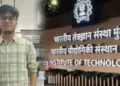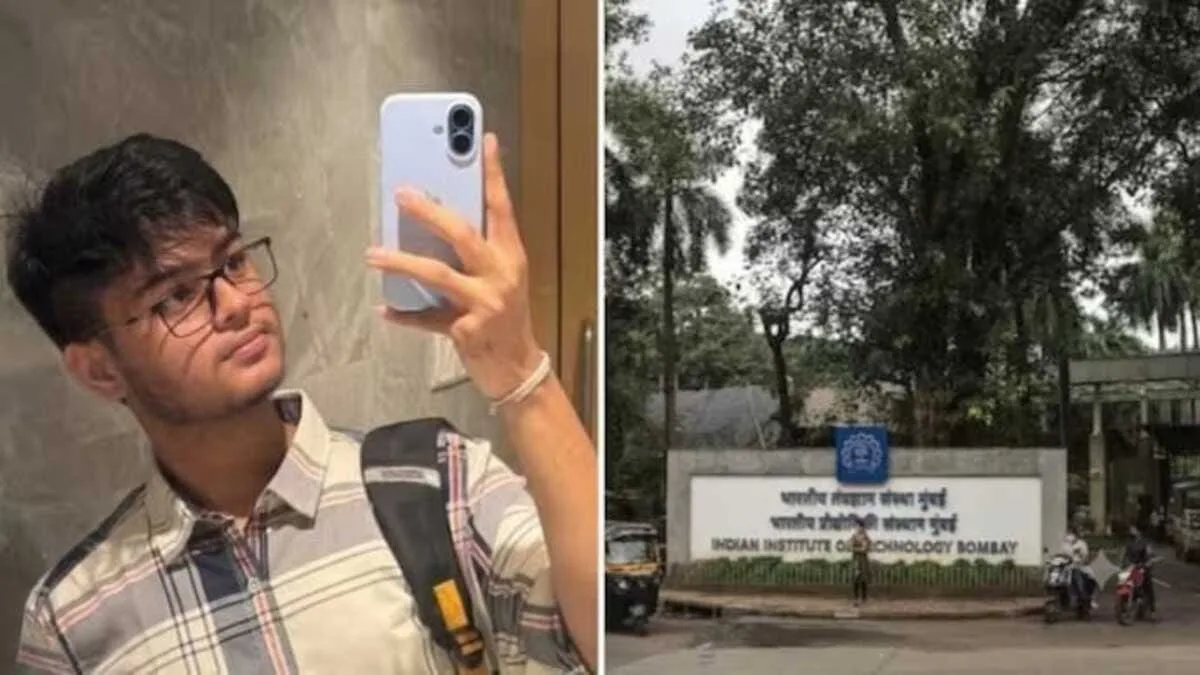
MUMBAI: The tragic death of IIT Bombay student Sahil Wakode is a deeply painful event. A young life has been lost, and no examination, disciplinary proceeding or institutional disagreement can diminish that tragedy. But precisely because a life has been lost, the public discussion must be guided by facts rather than political convenience. The incident also raises a fundamental question that our education system has increasingly neglected: what is the purpose of education? Is it merely to produce high-scoring students and successful professionals, or is it supposed to build truthful, disciplined and responsible human beings?
According to reports, Sahil Wakode, a second-year B.Tech student, was allegedly caught using a mobile phone to access ChatGPT during a mid-semester examination. CCTV footage now being examined by the Mumbai Crime Branch reportedly shows Professor Suryanarayana Doolla questioning him and asking him to leave the examination hall. The footage is expected to help establish the sequence of events. These facts matter. If a student uses an unauthorised device or AI tool during an examination, the invigilator has a duty to intervene. That is not persecution. That is discipline. Imagine the opposite. Suppose an invigilator watches a student openly use a phone during an examination but deliberately does nothing. What message does that send to hundreds of students who have honestly prepared and followed the rules? It tells them that honesty is for fools and that cheating is acceptable when one can get away with it.
That cannot be the purpose of education. Swami Vivekananda repeatedly emphasised “man-making” and “character-making” education. For him, education was not merely the accumulation of information but the development of strength, self-confidence, discipline and character. That message has become even more relevant in the age of artificial intelligence. Today, ChatGPT can produce an answer in seconds. But education must teach a student something more important: whether it is right to use that answer in a particular situation. Technology can make information easier to obtain. It cannot make dishonesty honest.
At the same time, the allegations of caste discrimination against Professor Doolla must be investigated properly. Sahil’s family has alleged caste-based harassment, while IIT Bombay has said that no complaint had been made by Sahil to its SC/ST cell or administration. The latter is also a matter that must be examined rather than ignored. The police have registered a case invoking provisions of the SC/ST (Prevention of Atrocities) Act and abetment of suicide. But an FIR is the beginning of an investigation, not the conclusion of one. The allegations remain allegations until established through due process. This is where another important principle must be defended: laws created to protect vulnerable communities must never become instruments of presumption of guilt.
The SC/ST Act serves an important constitutional and social purpose. Genuine caste discrimination must be confronted firmly. But preventing discrimination and presuming guilt are not the same thing. If there is evidence that Professor Doolla abused or discriminated against Sahil because of his caste, the law must act. If the allegation is not supported by evidence, the accused must not be sacrificed merely because a powerful narrative has already been constructed around the case. Justice requires protection of the victim as well as fairness to the accused. Yet sections of the public discourse appear to have already decided the case.
One narrative says that because Sahil died after being caught in the examination, the professor who caught him must somehow be responsible for his death. That is a serious logical leap. The temporal sequence of two events does not by itself establish criminal responsibility. Another narrative portrays enforcing examination rules as an act of institutional oppression. But the CCTV footage reportedly shows the professor performing precisely the function expected of an invigilator: questioning a student after noticing suspicious conduct and asking him to leave the examination hall. Another narrative attempts to make the entire episode primarily about caste before the investigation has established whether caste discrimination actually occurred.
And another familiar narrative has emerged: everything must somehow be explained as “propaganda”. There is, however, a particularly striking contradiction in this discourse. During the recent NEET controversy, opposition parties and protesters demanded the resignation of Union Education Minister Dharmendra Pradhan over alleged irregularities and malpractice in the examination system. The argument then was that those responsible for maintaining examination integrity should be held accountable. But if the same principle of accountability is applied to a professor who allegedly caught a student using an unauthorised device, suddenly the professor becomes the villain. That is not consistency. If an education minister can be politically held responsible for alleged examination irregularities, it cannot simultaneously be argued that an invigilator should be condemned merely for enforcing examination rules. Criticism of institutions is legitimate. Accountability is legitimate. But accountability must follow evidence, not ideology.
There is another uncomfortable example of selective outrage. In September 2026, allegations of sexual harassment against a JNU professor were raised by female students, and the Delhi Commission for Women took suo motu cognisance, asking JNU for details of the action taken on the complaints. The Commission explicitly stated that the allegations had not been established and sought information about whether the complaints had been referred to the Internal Complaints Committee. The point is not to declare the professor guilty either. The allegations must be investigated through due process. If people who loudly demand action against Professor Doolla can remain conspicuously silent when allegations concern someone whose political or ideological identity is closer to them, that raises legitimate questions about whether their concern is actually about justice—or about political identity. The standard should be the same.
We cannot have one standard for those we dislike and another for those we politically sympathise with. Professor Doolla should neither be prematurely convicted nor exonerated; the matter must be investigated. Above all, universities must restore discipline, truthfulness and character-building to education. Students must learn that failure can be overcome, but integrity cannot be compromised. Teachers must enforce rules firmly yet humanely, and institutions must provide fair procedures and counselling. The true tribute to Sahil would be an education system that teaches students to choose truth even when cheating is easy. This is the life-building, man-making and character-making education envisioned by Swami Vivekananda.