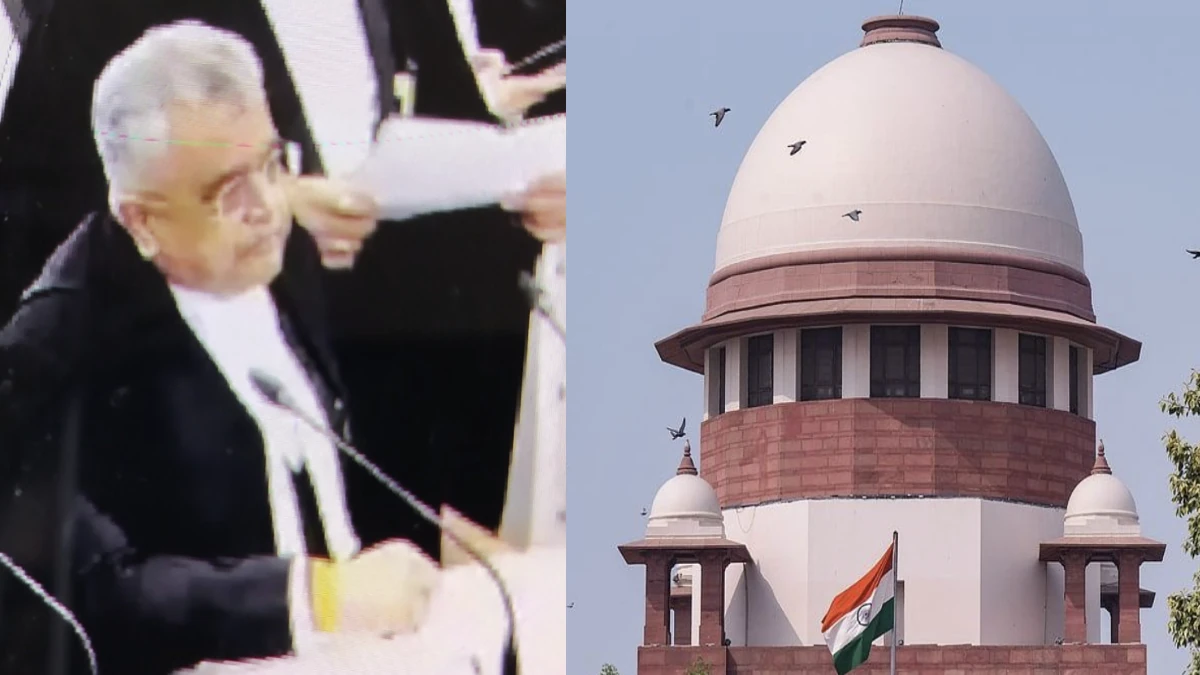
NEW DELHI: A heated verbal clash erupted inside the Supreme Court on September 22, during the hearing of a challenge concerning the mandatory singing of the full version of Vande Mataram, after Solicitor General Tushar Mehta invoked the term “Naxalite” while responding to submissions by senior advocate S Muralidhar.
The sharp exchange briefly overshadowed the constitutional questions before a Bench headed by Chief Justice of India Surya Kant and comprising Justices Joymalya Bagchi and V Mohana. The court ultimately made it clear that it would focus on the legal issues and not the heated remarks exchanged during the hearing.
‘Law-making cannot be as per Naxalites’
Muralidhar, appearing for Carnatic musician T M Krishna, was arguing that the amendment concerning Vande Mataram had been enacted without adequate public deliberation and broader consensus. He questioned what he described as a top-down approach to legislative decision-making.
Responding to the submission, Mehta said that law-making must follow the Constitution and added that it could not be based on what he described as the “Naxalites” approach.
The remark immediately triggered an objection from Muralidhar. “Withdraw the expression you used just now. This is going live. I strongly object,” Muralidhar said, according to reports of the proceedings.
But Mehta refused to withdraw the remark. “I said that is the constitutional way, not what the Naxalite wants. And I am not sorry about it,” the Solicitor General said.
Muralidhar registers strong protest
Muralidhar again objected to the language used by the law officer and said he wanted to register his strongest protest. “He is again repeating it. I am now going to register my strongest protest,” Muralidhar said.
He subsequently argued that such language did not befit a law officer and maintained that decorum was expected during proceedings before the country’s highest court. The exchange prompted intervention from Justice Joymalya Bagchi, who described the situation as creating unnecessary tension and emotion.
Chief Justice Surya Kant then brought the proceedings back to the central legal question, telling the lawyers that the Bench was examining the issue of constitutional interpretation and should remain focused on it.
‘To think is not to be a Naxalite’
The exchange drew another intervention from senior advocate Sanjay Hegde, who was present in court in another matter. “To think is not to be a Naxalite,” Hegde remarked. Justice Bagchi also stressed that even if someone were labelled a Naxalite, that would not strip the person of constitutional protections. “Even if you label someone as Naxalite, he does not lose the Constitutional rights,” Justice Bagchi observed, according to reports.
The remarks underscored the Bench’s insistence that constitutional rights and due process remain applicable irrespective of labels attached to individuals.
What is the Vande Mataram case about?
The Supreme Court was hearing Krishna’s challenge to the 2026 amendment to the Prevention of Insults to National Honour Act, 1971, as well as government directions concerning the singing of all six stanzas of Vande Mataram at specified official and public occasions.
The amended law provides penal protection to the National Song alongside the National Anthem, while the petition challenges the legal consequences surrounding the singing of Vande Mataram and the government’s directions concerning its complete version.
Krishna’s petition raises questions involving freedom of expression, freedom of conscience and religious freedom, particularly in relation to the later stanzas of the song.
Supreme Court seeks Centre’s response
While the courtroom exchange generated headlines, the Bench continued with the substantive constitutional issues.
The Supreme Court sought the Centre’s response to the petition and indicated that the constitutional protections recognised in the 1986 Bijoe Emmanuel judgment would also have to be kept in mind while examining the matter. That case protected schoolchildren from penal consequences for not singing the National Anthem on religious grounds while they respectfully stood during its rendition.
The court has therefore kept the focus on the constitutional questions surrounding Vande Mataram, even as the extraordinary “Naxalite” remark and the ensuing protest by Muralidhar became the most dramatic moment of Tuesday’s hearing.
The court ultimately said it had not taken note of the comments and would confine itself to the constitutional issues raised in the petition.