India’s civilisational tradition has never regarded nature merely as a resource to be exploited. From sacred groves and temple forests to the reverence shown to rivers, mountains, trees and animals, Indian culture has reflected a deep understanding that human life is inseparably connected with the natural world.
The concept of Nakshatravanam offers a meaningful contemporary expression of this timeless relationship between human beings, nature and the cosmos. Bringing together the 27 Nakshatras and their traditionally associated trees, a Nakshatravanam creates a living space where India’s astronomical heritage, environmental consciousness and community participation can come together.
A significant initiative in this direction was undertaken at Kesava Smrithi Mandali Project, Balasaibaba Premises, Munagalapadu, Kurnool, near the newly constructing Annapoornamma Avasam, a free hostel intended to provide support and accommodation for poor children.
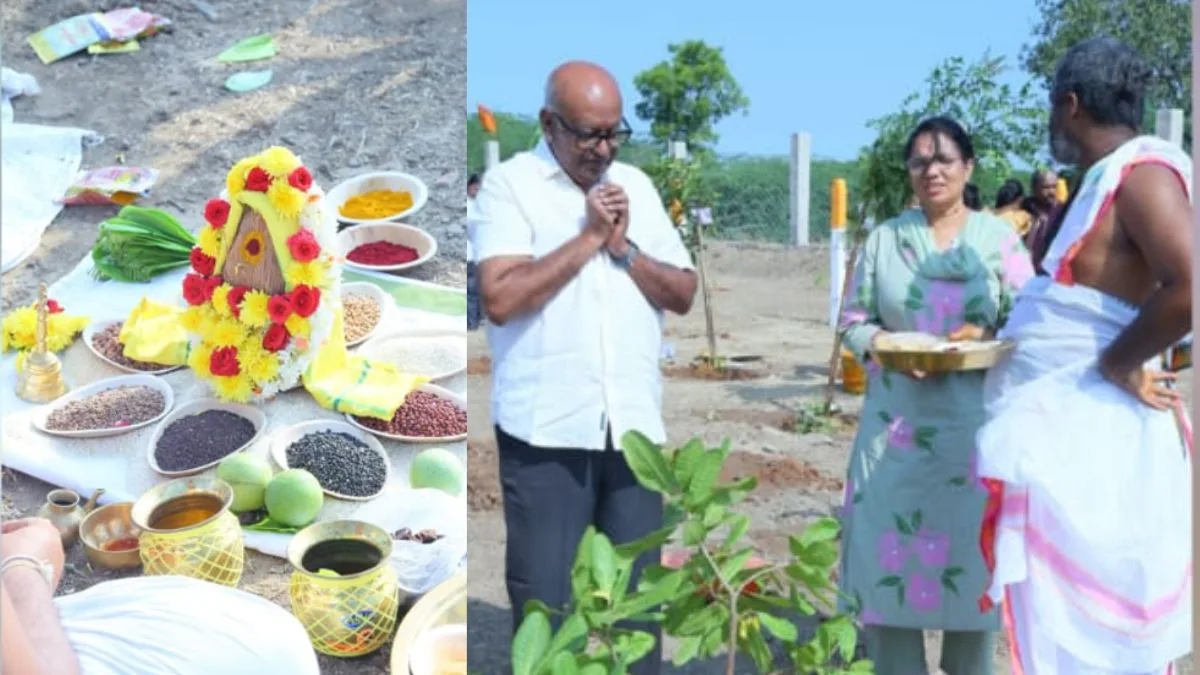
On the occasion of the birthday of the Hon’ble Prime Minister of India, Shri Narendra Modi Ji, on 17 September, Kesava Smrithi Mandali organised a special plantation programme at the premises. As part of the initiative, 27 Nakshatra Devata Vrikshas, representing the 27 Nakshatras of Indian tradition, were planted in a circular formation.
The programme brought together nearly 100 distinguished members of the community and their families, who actively participated in the plantation drive. Their participation transformed the event from a symbolic plantation into a collective expression of responsibility towards nature and future generations.
The 27 Nakshatras and Their Trees
Indian civilisation developed a sophisticated tradition of observing the sky and understanding celestial movements. The traditional lunar system recognises 27 Nakshatras, or lunar constellations, through which the Moon moves during its journey across the zodiac.
Each Nakshatra is traditionally associated with particular symbols, deities and plants or trees. Nakshatravanam brings these associations together in the form of a carefully planned garden in which trees representing the Nakshatras are planted and nurtured.
The circular arrangement at Munagalapadu carries a simple but powerful message: the sky above and the earth below are not separate worlds. The stars that inspired generations of Indian astronomers and thinkers can also inspire us to protect the trees and natural environment that sustain life on earth.
For a child visiting such a garden, the experience can become an introduction to several dimensions of India’s heritage at the same time—astronomy, botany, culture, spirituality and environmental responsibility.
From Sacred Tradition to Modern Conservation
India’s traditional ecological practices offer valuable lessons for the present generation. Across the country, sacred groves and community-protected forests historically provided spaces where vegetation and biodiversity were preserved through cultural traditions. Nakshatravanam can revive this spirit in a contemporary form. Modern environmental challenges—including biodiversity loss, deforestation, soil degradation, water scarcity and climate-related pressures—require participation beyond government institutions. Laws and programmes are important, but lasting conservation also depends upon citizens developing a personal relationship with nature.
A tree planted as part of Nakshatravanam is therefore more than a sapling. It can become a living symbol of responsibility, continuity an
A tree planted as part of Nakshatravanam is therefore more than a sapling. It can become a living symbol of responsibility, continuity and cultural memory.
The plantation at Munagalapadu demonstrates how such a concept can be translated into community action. Instead of limiting environmental activity to a single plantation day, the trees can be nurtured and monitored over the years, allowing the initiative to develop into a long-term ecological asset for the locality.
An Outdoor Classroom for the Next Generation
One of Nakshatravanam’s greatest possibilities is its educational value.
Schools and colleges can use such gardens to introduce students to:
- Indian astronomical traditions and the 27 Nakshatras
- Botany and biodiversity
- Traditional Indian knowledge systems
- The ecological importance of trees
- The ecological importance of trees
- The ecological importance of trees
- The ecological importance of trees
- The ecological importance of trees
- Soil and water conservation
- Climate and environmental responsibility
- Medicinal and traditional uses of plants
- Sustainable living practices
Children today increasingly experience nature through books, screens and digital media. A Nakshatravanam provides an opportunity to reverse this trend by allowing children to observe living trees directly. Information boards in Telugu and English can explain the identity and traditional significance of each tree. QR codes can provide additional information about botanical characteristics, geographical distribution, ecological value and traditional associations.
The proximity of the Nakshatravanam to Annapoornamma Avasam also gives the project an important social dimension. Children who study or stay in the premises can grow up alongside these trees, observing their development year after year. The garden can consequently become both an environmental and educational legacy.
A Community Movement
The participation of nearly 100 community members and their families at Munagalapadu demonstrates the potential of Nakshatravanam to become a people’s initiative. Schools, voluntary organisations, service institutions, professional groups, community organisations, families and individuals can participate not only in planting trees but also in their long-term maintenance. The success of a plantation programme should not be measured merely by the number of saplings planted. The survival, growth and care of those trees are equally important. Families or organisations can adopt individual trees and take responsibility for watering, protection and periodic monitoring. Children can be encouraged to record the growth of their adopted trees, turning environmental conservation into a continuing educational activity. Such participation transforms plantation from a one-day event into a sustained environmental movement.
Connecting Personal Identity with Nature
The Nakshatra concept also provides an interesting personal connection. In Indian tradition, many people identify their Janma Nakshatra, the lunar constellation associated with their birth. A Nakshatravanam can help individuals understand the tree traditionally associated with their Nakshatra and encourage them to plant or nurture it. This creates an emotional connection with nature. A tree planted by an individual or family can become part of their memories. Parents can bring their children to see it grow, and future generations can inherit the responsibility of caring for it. In this way, environmental consciousness becomes something experienced personally rather than merely taught theoretically.
Inspired by a Larger Environmental Vision
The Munagalapadu initiative was organised in the spirit of the Hon’ble Prime Minister’s emphasis on environmental responsibility, including the “Ek Ped Maa Ke Naam” campaign. The message is simple and powerful: planting a tree should be accompanied by a commitment to nurture it. The Nakshatravanam concept adds a cultural dimension to this environmental responsibility. It connects the act of planting with India’s civilisational understanding of nature and creates an opportunity for families and communities to participate collectively. The initiative therefore brings together three important principles—Sanskriti, Paryavaran and Jan Bhagidari: cultural heritage, environmental responsibility and people’s participation.
A Model for Kurnool and Beyond
The Nakshatravanam at Munagalapadu can become a model for similar initiatives in Kurnool district and other parts of Andhra Pradesh.
Such gardens can be developed in schools, colleges, temples, community spaces, institutional campuses and other suitable locations. Depending upon available land and local climatic conditions, they can incorporate native species, medicinal plants, butterfly gardens, bird habitats, water-harvesting structures and educational pathways. The objective need not be limited to creating one garden. The larger vision can be to create a network of community-supported Nakshatravanams, each serving as a centre for environmental education and cultural awareness.
Conclusion
Nakshatravanam is not simply a garden containing 27 trees. It can become a living cultural institution—a place where astronomy meets botany, tradition meets environmental responsibility, and individual participation becomes community action. The plantation undertaken by Kesava Smrithi Mandali at Balasaibaba Premises, Munagalapadu, Kurnool, with the planting of 27 Nakshatra Devata Vrikshas in a circular formation, represents one such effort to translate this idea into action. The participation of nearly 100 community members and their families demonstrates that environmental conservation can become a shared social responsibility.
Every tree that survives represents more than greenery. It represents continuity, responsibility and hope for the future.
The stars have inspired human beings for thousands of years. Trees have sustained human civilisation for equally long. Nakshatravanam brings these two dimensions together and reminds us that our cultural heritage can provide meaningful pathways towards environmental responsibility.
What begins with 27 Nakshatras and 27 trees can ultimately grow into a larger people’s movement—one that encourages every family, every child and every community to plant, protect and nurture trees. Nakshatravanam is therefore not merely about planting trees. It is about preserving heritage, cultivating environmental consciousness and creating a greener legacy for future generations. The initiative at Munagalapadu, Kurnool, offers a small but meaningful example of how Sanskriti, Paryavaran and Jan Bhagidari can come together to build a more sustainable and culturally rooted Bharat.