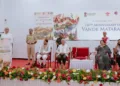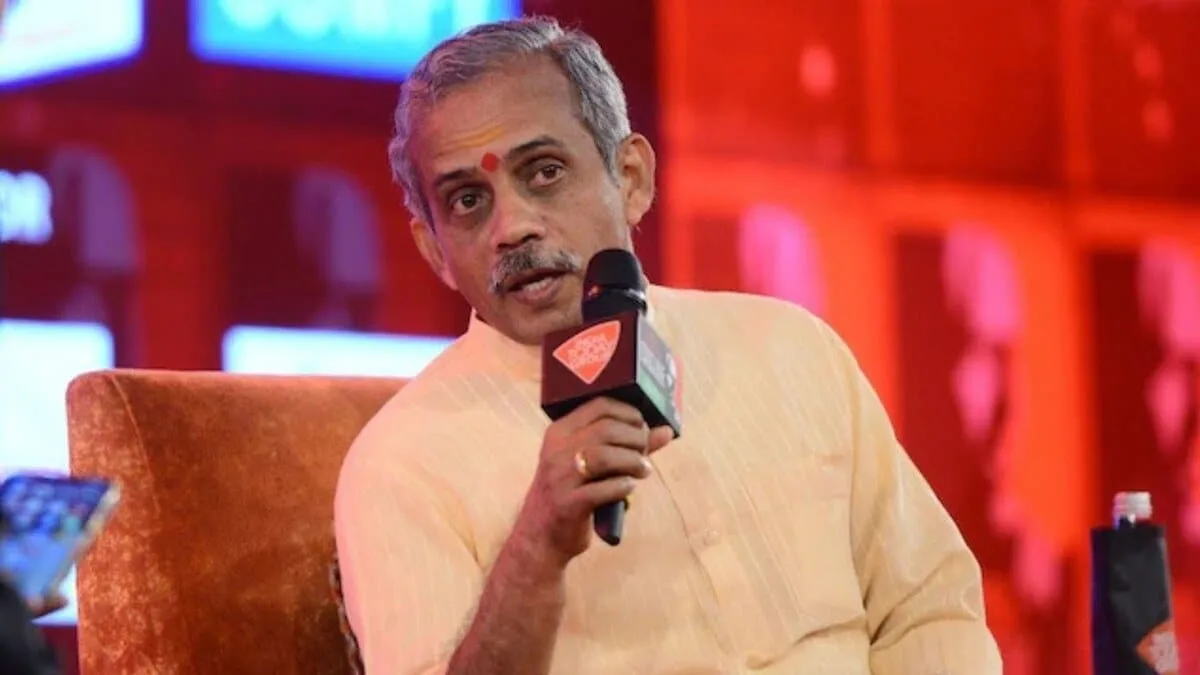
KASARAGOD: The first day of the two-day National Seminar commemorating the 150th anniversary of Vande Mataram was held at the Central University of Kerala, Periya, Kasaragod, on 6 October 2026. The seminar was organised as part of the nationwide observance marking 150 years of Vande Mataram and brought together writers, scholars, academics and cultural practitioners to discuss its historical, literary and cultural significance and its role in India’s national consciousness.
Protest and security situation
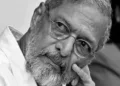
The programme was conducted against the backdrop of protests by SFI, NSUI and MSF over the participation of J Nandakumar, Akhila Bharatheeyan Samyojak, Prajna Pravah, who was scheduled to deliver the keynote address.
The organisations had publicly announced through press conferences that they would oppose his entry into the university campus and prevent his participation in the programme. Following these announcements, students gathered around the venue, raised slogans and displayed organisational flags. The situation became tense as protesters attempted to approach the seminar venue from different directions.
In view of the situation, the organisers adopted precautionary security arrangements. The program has started on time as per schedule, and J Nandakumar delivered the key note address as per the schedule without any hindrance.
Extensive security arrangements were subsequently put in place around the seminar hall. The university administration, police and local authorities deployed personnel at strategic points and maintained a security perimeter to prevent any forcible entry and to ensure the safety of speakers and participants.
The protests continued outside the venue, and the situation witnessed confrontations between protesting students and police personnel. However, the security arrangements ensured that the protesters could not disrupt the proceedings inside the seminar hall.
The Vice-Chancellor of the Central University of Kerala, Prof. Siddu P. Algur, played an important role in coordinating with the organisers and authorities and facilitating the smooth conduct of the programme despite the difficult circumstances prevailing on campus.
Inaugural session and keynote address
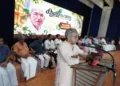
The inaugural session commenced as scheduled, with the invited speakers participating in the programme and J Nandakumar delivering the keynote address. All six stanzas of Vande Mataram were also rendered as part of the inaugural proceedings.
Addressing the gathering, Nandakumar noted that Bankim Chandra Chattopadhyay—like a Rishi—originally envisioned the entire song as a national anthem. However, explaining the historical backdrop, he pointed out that Bankim Chandra strategically utilised terms like “Sapta Koti” (seven crores). According to Nandakumar, Bankim Chandra possessed a deep understanding of the British mindset and their suppressive measures, framing his approach to protect the country from colonial attacks. While tailoring his wording strategically against the British administration, the perspective shifted when addressing the Bharatiya population, specifically invoking the “thirty crores” of Indians.
In his address, Nandakumar focused particularly on the historical context and national vision associated with Vande Mataram, with special reference to Rabindranath Tagore’s understanding of the song. He highlighted Tagore’s vision of Vande Mataram in the context of the entire nation and its collective national consciousness. Nandakumar referred specifically to Tagore’s use of the expressions “Sapta Koti” (seven crores) and “thirty crores”, explaining the historical and political context in which these expressions were used.
According to Nandakumar, Tagore had a deep understanding of the mindset of the British administration and the repressive measures adopted by the colonial authorities. His choice of words and framing of the song, Nandakumar explained, reflected an awareness of the colonial context while simultaneously invoking the larger Indian population and the collective identity of Bharat.
Nandakumar also recalled the historic occasion in 1896, when the young poet and singer Rabindranath Tagore rendered Vande Mataram at the Indian National Congress session. He highlighted this as an important milestone in the song’s evolution as a national symbol.
The address thus sought to place Vande Mataram within its broader historical, political and cultural context, particularly through Tagore’s interpretation and vision of the song as an expression of collective national consciousness.
Governor’s remarks at the valedictory session
The significance of the seminar and the controversy surrounding the previous day’s events was further highlighted during the valedictory session, when Kerala Governor Rajendra Vishwanath Arlekar addressed the gathering.
The Governor called for a comprehensive research study on the history of Vande Mataram, including the circumstances in which Bankim Chandra Chattopadhyay composed it, the background of its composition, its transformation into a slogan of the freedom movement and its influence on the national movement. He emphasised that such a study should go beyond speeches and be scientifically documented and published as an authoritative record for future generations.
Referring to the protests surrounding the seminar, the Governor said the forces and ideas behind opposition to Vande Mataram should be examined and that the previous day’s incident should not be viewed in isolation. He stressed that the issue should not be reduced to a debate over whether two or all six stanzas should be sung, but that the spirit, sentiment and national consciousness associated with the song needed to be understood.
He described Vande Mataram as more than a song, calling it a powerful symbol of the national consciousness that helped unite Indians during the freedom movement. He also emphasised the importance of national unity and urged society to remain vigilant against tendencies that could weaken the country’s institutions, traditions and unity.
The Governor further called for wider public discussion on the history and significance of Vande Mataram, saying that the subject should not remain confined to seminar halls and libraries but should be taken to different sections of society and future generations.
Overall assessment
Despite the protests and the tense atmosphere on the campus, the inaugural session was completed successfully. The keynote address was delivered as scheduled, all six stanzas of Vande Mataram were rendered, and the academic proceedings inside the venue continued without disruption.
The successful conduct of the programme was made possible through coordination among Sahitya Akademi, Akhil Bharatiya Sahitya Parishad, Central University of Kerala, the university administration, district administration, police and security personnel.
The seminar consequently provided a significant platform not only for academic discussion on the 150-year history of Vande Mataram, but also for examining its place in India’s national movement, its historical association with figures such as Bankim Chandra Chattopadhyay and Rabindranath Tagore, and its continuing significance in the country’s national consciousness.