
Indian Standard Timekeeping : Aligning time with the timeless
June 23, 2026
  • Read Ecopy
  • Circulation
  • Advertise
  • Careers
  • About Us
  • Contact Us
Android AppiPhone AppArattai
Organiser
  • ‌
  • Bharat
    • Assam
    • Bihar
    • Chhattisgarh
    • Jharkhand
    • Maharashtra
    • View All States
  • World
    • Asia
    • Europe
    • North America
    • South America
    • Africa
    • Australia
  • Editorial
  • International
  • Opinion
  • RSS @ 100
  • More
    • Op Sindoor
    • Analysis
    • Sports
    • Defence
    • Politics
    • Business
    • Economy
    • Culture
    • Special Report
    • Sci & Tech
    • Entertainment
    • G20
    • Azadi Ka Amrit Mahotsav
    • Vocal4Local
    • Web Stories
    • Education
    • Employment
    • Books
    • Interviews
    • Travel
    • Law
    • Health
    • Obituary
  • Subscribe
    • Subscribe Print Edition
    • Subscribe Ecopy
    • Read Ecopy
  • ‌
  • Bharat
    • Assam
    • Bihar
    • Chhattisgarh
    • Jharkhand
    • Maharashtra
    • View All States
  • World
    • Asia
    • Europe
    • North America
    • South America
    • Africa
    • Australia
  • Editorial
  • International
  • Opinion
  • RSS @ 100
  • More
    • Op Sindoor
    • Analysis
    • Sports
    • Defence
    • Politics
    • Business
    • Economy
    • Culture
    • Special Report
    • Sci & Tech
    • Entertainment
    • G20
    • Azadi Ka Amrit Mahotsav
    • Vocal4Local
    • Web Stories
    • Education
    • Employment
    • Books
    • Interviews
    • Travel
    • Law
    • Health
    • Obituary
  • Subscribe
    • Subscribe Print Edition
    • Subscribe Ecopy
    • Read Ecopy
Organiser
  • Home
  • Bharat
  • World
  • Operation Sindoor
  • Editorial
  • Analysis
  • Opinion
  • Culture
  • Defence
  • International Edition
  • RSS @ 100
  • Magazine
  • Read Ecopy
Home Bharat

Indian Standard Timekeeping : Aligning time with the timeless

As Bharatiya festivals mark the New Year across regions, they revive a deeper understanding of time, one that goes beyond clocks and calendars. Rooted in cosmic rhythms and lived experience, this tradition aligns human life with nature’s order, offering a more holistic way to measure and live time

DK Hari & DK Hema HariDK Hari & DK Hema Hari
Apr 15, 2026, 08:00 pm IST
in Bharat, Analysis, Culture
Follow on Google News
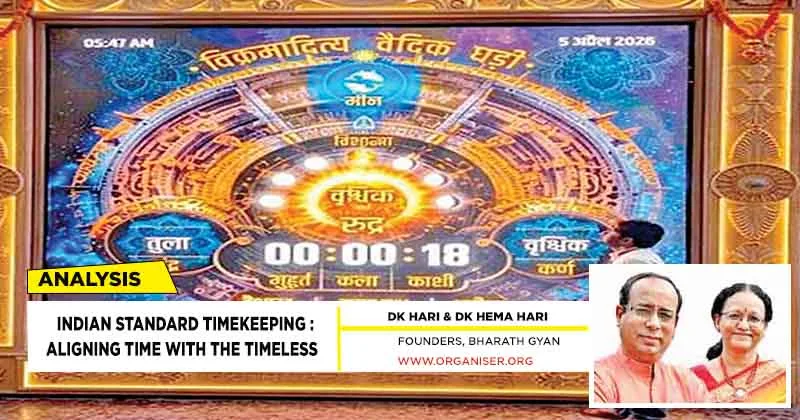
World’s First ‘Vikramaditya Vedic Clock’ Installed at Kashi Vishwanath Temple

World’s First ‘Vikramaditya Vedic Clock’ Installed at Kashi Vishwanath Temple

FacebookTwitterWhatsAppTelegramEmail

With the arrival of the Bharatiya Nav Varsh (New Year) such as Yugadi, Vishu, Bohag Bihu, Baisakhi, Tamil New Year etc, it is the right time to explore time on its own terms.

In the West, the science of time, in the last few centuries, has been called ‘horology’. ‘Logy’ obviously comes from the Greek term ‘Logos’ and Logic to imply Science and hence to denote a branch of study. This has an interesting Bharatiya connect. In Bharat, we recognise that time is a continuum of cycles of day and night. In Sanskrit, night is called ratri. Daylight time is called Aha or Ahan. This continuous cycle of day and night is Ahoratri. This is why, the science of time in traditional Bharatiya literature, is called Hora Shastra in all regional languages.

This same Hora is the word for Hour in Latin, Spanish and Portuguese. In Greek, it is written differently but pronounced the same. We also get the English words Hour and Horoscope from the same. Many other European languages use variations of this Hora as Heure in French, Ora in Italian, Uhr in German etc.

The Bharatiya civilisation has had the capacity to understand the nuances of time, ranging from the miniscule span of time (where it tends to nebulous clouds of sub-atomic charges) such as Anu, Paramanu etc. to the larger expanses of time such as Yuga, Manvantara, Kalpa etc.

Philosophy of Timekeeping

All these time calibrations of Hora Shastra were named and calculated keeping in mind the need for a consonance between the rhythm in our body and the nature around us. We have divided time to be in alignment of yoga, so that, our actions are enabled, rather than hindered by the forces around us.

To measure time using a physical clock, we have traditionally used a pot, (Ghatam). Due to this we also have the terms Ghatika in Sanskrit and Ghadi in Hindi. Time also includes relative motions expressed in the form of relative positions, angles or alignments between objects such as the visible planets of our Solar system.

A day or date is not merely numbers on our calendar or a measure of elapse time, it also includes a quality aspect to the day, which manifests due to the resultant influence of motion of other celestial objects around the Earth and the Earth’s own motion.

A day has therefore been expressed using a minimum of five parts in Bharatiya tradition, called the Panch Ang or
Panchanga, namely:

  • Nakshatra: Star in line with the Moon
  • Tith: Phase of Moon or angular separation of Moon from Sun in the Zodiac belt
  • Vaara: Net resultant influence on Earth each day, by the seven close objects to Earth in Space in order of their speeds repeating every seven days
  • Karana: Halves of the day-night cycle based on light from Sun and reflected light from the Moon as it orbits around the Earth or phase of the Moon
  • Yoga: Sum of the resultant influence of Moon and Sun or Earth motion in the sky.
    These units of time, peg the relative positions and alignments of Sun, Moon and Earth in the overall orbit of the Earth around the Sun, along with the Moon and qualify the day and periods in a day, based on resultant fields and light for that particular location, at that particular moment. This approach being standard across Bharat, it can hence verily be called Indian Standard Timekeeping rather than Indian Standard Time. Besides these, there are other units of Time measure which give a deeper insight into Bharat’s perspective of Time and Timekeeping.

Muhurta – Nature’s Order Now

While Western astronomy divides a day into units of time called hours, minutes and seconds, the typical Bharatiya units of time in a day are called Muhurta. Muhu means instant, moment and Rta is order. Muhurta denotes the predictable order in which each moment unfolds and the quality or potential it bears.

Today, Muhurta is defined as 48 minutes since it is expressed in terms of the 24 hour day-night concept of time in Western astronomy. However, for Bharat, a day-night period was not known as 24 hours. It was 30 Muhurta. It is like imagining a clock dial with 30 units which is covered once during a day-night cycle, rather than a clock with a dial bearing 12 units which have to be covered twice in one 24 hour day or date.

There is an interesting aspect to what these Muhurtas stand for and how they came to be 30 in number. The fixed points in the sky that people can see and relate to include: Eastern horizon where Sun, Moon and stars rise; Western horizon where Sun, Moon and stars set; and Zenith, the sky exactly overhead which the Sun occupies at noon.

Hence Sunrise, Sunset, Mid-day and Midnight mark the four main quarters of time. With the 27 Nakshatra on the Zodiac, the Zenith point called Abhijit and two parts left as Brahma Muhurta, they total to 30 units of time in a span of day-night cycle.

Clubbed with the other aspects of the nature of the day as tracked by the Panchanga, these Muhurta units have been classified into periods that augur and augment nature’s forces on Earth to undertake certain types of activities. While the Muhurta are predominantly used for their ability to point to nature’s quality at that moment, they are also the standard unit of time measure during a day-night cycle.

What is further interesting is that this measure of time, as a quantity of elapse time, has its root in the fundamental unit of time measure called Nimesha — the time taken to blink. 15 blinks per Nimesha make 1 Kashta, 15 Kashta make 1 Laghu, 15 Laghu — 1 Ghatika, 2 Ghatika — 1 Muhurta and 30 Muhurta make a day-night cycle. The day-night cycles then aggregate to form months, days, years and further longer cycles. Thus, the roots of Bharatiya time keeping go way back in time and have been understood and tracked blink by blink.

While the five attributes in a Panchanga denote the Date the Bharatiya way, the Muhurta and its further sub-units help track passage of time during that day and denote the equivalent of Hours, Minutes and seconds, the Bharatiya way. All these have been beautifully brought together in recent installations of the Vikramaditya Vaidik clock at Ujjain and Kashi.


Topics: YogabharatiyaBharatiya Nav Varsh30 Muhurta27 NakshatraBrahma MuhurtaIndian Standard Timekeeping
DK Hari & DK Hema Hari
Founders, Bharath Gyan [Read more]
ShareTweetSendShareSend
✮ Subscribe Organiser YouTube Channel. ✮
✮ Join Organiser's WhatsApp channel for Nationalist views beyond the news. ✮
Previous News

West Bengal Assembly Polls: Bury the Babar’s ghost

Next News

BJP’s April 16 to 18 whip signals big change; Nari shakti breakthrough with women’s reservation bill

Related News

Indian Navy performs yoga underwater

International Yoga Day: From Siachin to Indian Ocean, Dal Lake to Brahmaputra; India celebrated yoga in a unique way!

Delaware Governor Matthew Meyer has officially proclaimed June 21, 2026, as International Day of Yoga in the state

Delaware Governor Matthew Meyer’s Proclamation: A heartening affirmation of yoga’s ancient Indian roots

Yoga Day: From inner balance to global harmony

The wisdom of sattvik food: Nourishing inner balance

Yoga teaches the harmony of body, mind and spirit, the foundation of enduring civilizations and enlightened leadership.

From Self-Mastery to World Harmony: Yoga as the foundation of civilizational survival and progress

Five Ayush hospitals cum medical colleges to come up in Uttar Pradesh (This is an AI generated image)

Uttar Pradesh plans five integrated AYUSH Colleges and Hospitals to expand traditional healthcare and medical education

Load More

Latest News

Dr Mahrang Baloch

Pakistan: Mahrang Baloch gets life sentence, Balochistan erupts in protest; BYC calls for shutdown

Prime Minister Narendra Modi

‘Maoism is breathing its last’: PM Modi highlights crackdown on red terror in last 12 years and growth in tribal areas

(Left) Dr Shyama Prasad Mookerjee (Right) West Bengal CM Suvendu Adhikari

Syama Prasad Mookerjee was instrumental in creation of West Bengal’: CM Suvendu Adhikari

Female recruitment in Jihadist networks emerges as major security concern

Khadija Terror Case: Female recruitment, online radicalisation in Jihadi networks poses major security concern

Outcry grows after Dalits in Theeyathur village carry deceased woman across paddy fields due to lack of burial access

Tamil Nadu: Dalits forced to carry deceased woman through paddy fields as Pudukkottai village lacks road access

ASI transfers Rakhigarhi skeletal remains to Anthropological Survey of India for detailed examination

Rakhigarhi’s ancient secrets to be unveiled as human skeletal remains reach AnSI for advanced scientific analysis

Dr Syama Prasad Mookerjee: A Life That Still Guides Bharat’s National Resolve

(Left) Maoist Arms seized (Right) Security personnel with the seized arms of Maoists

Odisha: Major Maoist arms cache recovered in Koraput, sixth such seizure within two weeks

Delhi Chief Minister Rekha Gupta paid tribute to Bharatiya Jana Sangh founder Syama Prasad Mookerjee on his death anniversary

Article 370 abrogation was the greatest tribute to Syama Prasad Mookerjee: Delhi CM Rekha Gupta

Prime Minister Narendra Modi

Viksit Bharat: PM Modi slams Congress — ‘Blocks development, claims credit’

Load More
  • Privacy
  • Terms
  • Cookie Policy
  • Refund and Cancellation
  • Delivery and Shipping

© Bharat Prakashan (Delhi) Limited.
Tech-enabled by Ananthapuri Technologies

  • Home
  • Search Organiser
  • Bharat
    • Assam
    • Bihar
    • Chhattisgarh
    • Jharkhand
    • Maharashtra
    • View All States
  • World
    • Asia
    • Africa
    • North America
    • South America
    • Europe
    • Australia
  • Editorial
  • Operation Sindoor
  • Opinion
  • Analysis
  • Defence
  • Culture
  • Sports
  • Business
  • RSS @ 100
  • Entertainment
  • More ..
    • Sci & Tech
    • Vocal4Local
    • Special Report
    • Education
    • Employment
    • Books
    • Interviews
    • Travel
    • Health
    • Politics
    • Law
    • Economy
    • Obituary
  • Subscribe Magazine
  • Read Ecopy
  • Advertise
  • Circulation
  • Careers
  • About Us
  • Contact Us
  • Policies & Terms
    • Privacy Policy
    • Cookie Policy
    • Refund and Cancellation
    • Terms of Use

© Bharat Prakashan (Delhi) Limited.
Tech-enabled by Ananthapuri Technologies