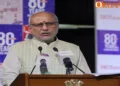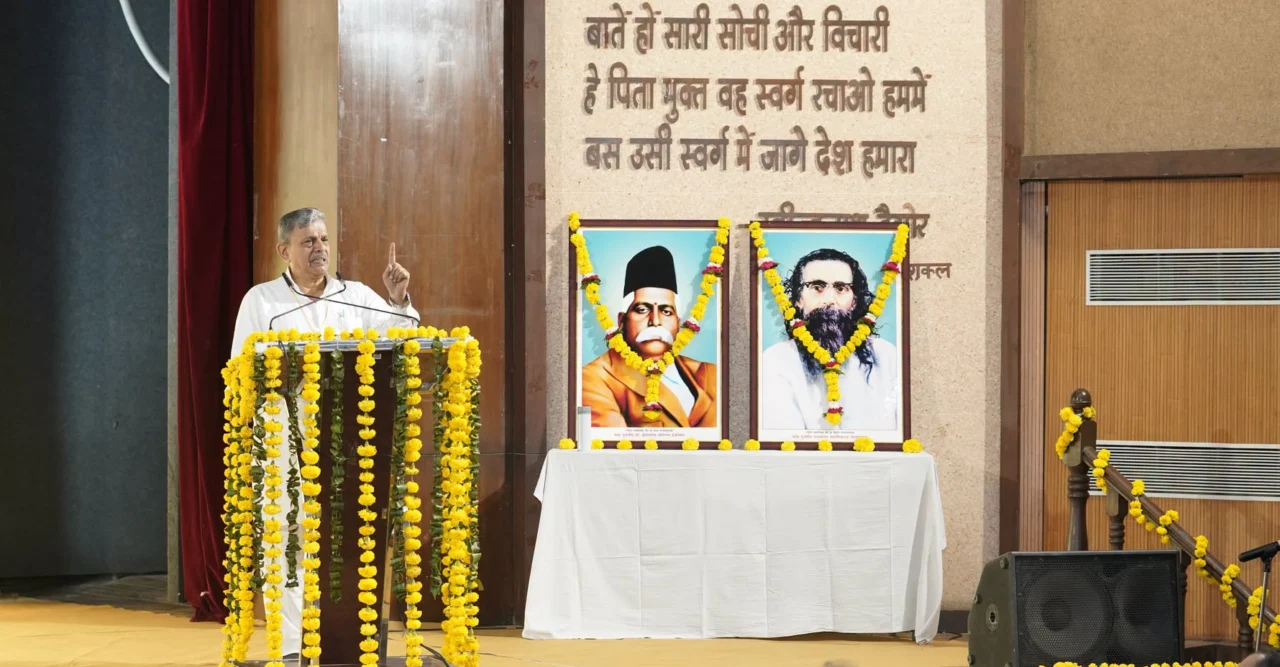
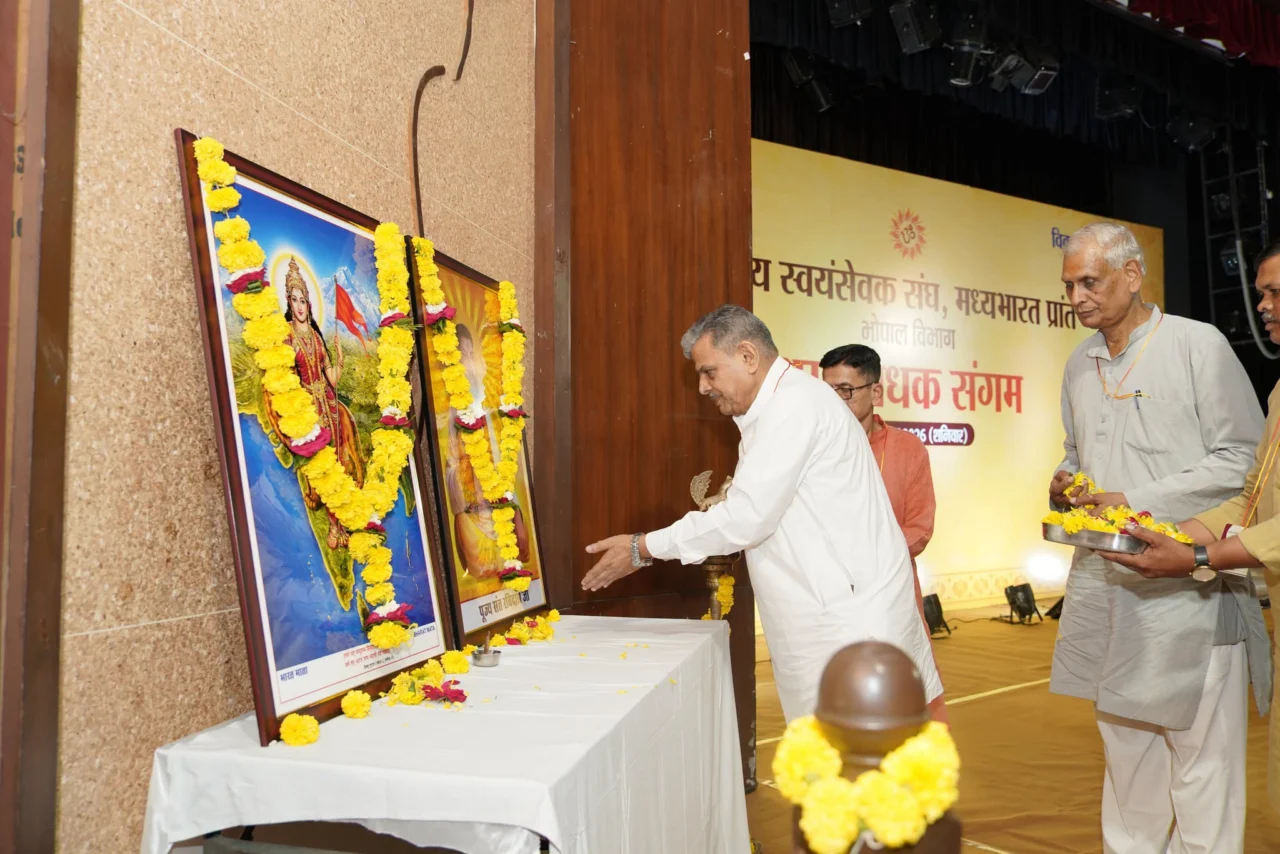
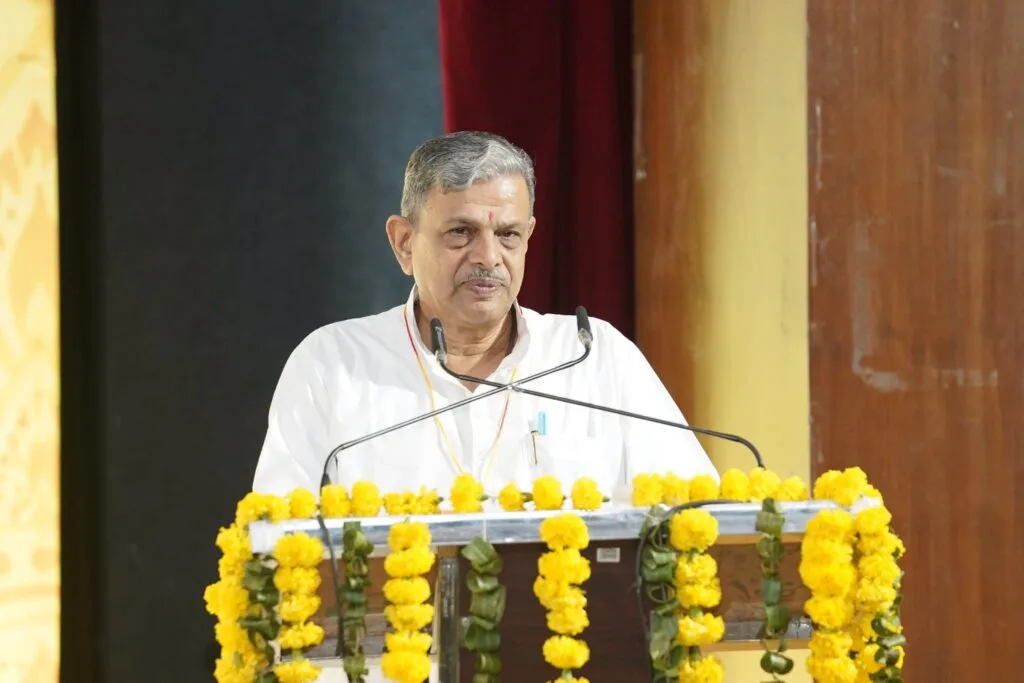
Bhopal: If Shram Sadhaks become strong, both society and the future will become strong, said RSS Sarkaryavah Dattatreya Hosabale while addressing the Shram Sadhak Sangam organised at Ravindra Bhavan, Bhopal, on the 650th birth anniversary of Sant Shiromani Ravidas Ji on September 19, 2026.
He emphasised dignity of labour, social harmony, mutual cooperation and responsibility towards society.
Notably, on the occasion of the 650th birth anniversary of Sant Shiromani Ravidas Ji, a massive Shram Sadhak Sangam was organised at Ravindra Bhavan. More than 1,000 Shram Sadhaks and members of society, who earn their livelihoods through labour in various fields, participated in the programme.
Dattatreya Hosabale said that the real strength of society emerges only when every section receives respect, participation and opportunities to progress.
He said that our saints regarded work as worship. Labour performed through the body is also a form of worship. Worship is not limited to going to a temple and offering flowers before a deity. If a person performs his work with complete dedication, a pure heart and a feeling of worship, that work itself takes the form of worship.
He said, Dharma is not connected only with any particular work or social identity. Performing whatever work a person is engaged in with full sincerity, dedication and a sense of duty is an important form of Dharma.
He said that the greatness of work is not determined by its external form, but by the outlook and dedication of the person performing it. No work in society is small or big. Dedication towards work, purity of mind and excellence in conduct make a person great.
Citing the example of Maharshi Ved Vyas, he said that greatness is not determined by birth or profession. A person born into a fisherman’s family can also become Maharshi Ved Vyas through his work and knowledge. Therefore, considering a person inferior on the basis of his work is a flaw in one’s outlook.
He said that the evil of high and low that has emerged in society must be removed through the right outlook and proper coordination. For this, it is necessary to increase affection among different sections of society. Shram Sadhak Milan is a small but important initiative in this direction.
He said that when a person understands another person’s life, his labour and his circumstances, distance decreases and affection increases. Social harmony cannot be created merely through speeches. For this, people have to connect with each other’s lives.
Giving the example of the structure of creation and society, he said that Brahma Ji created the world, but the provision and creation of resources necessary for living are associated with Vishwakarma Ji. This makes it clear that creation and labour have always been respected in Indian thought.
He said that we are all Rashtrangabhut, meaning that we are parts of the nation. A nation is not merely the name of a geographical area. It is made up of the lives, labour, values, relationships and responsibilities of crores of people. Therefore, every person has a role and responsibility towards the nation.
He said that initiatives such as the Sangh shakha and Milan work to strengthen this feeling of being a part of the nation. When a person considers himself not separate from society and the nation, but an integral part of it, a feeling develops within him to go beyond himself and do something for society.
He said that from this perspective, keeping the body healthy, cooperating with one another, giving values to one’s family and standing with weaker sections of society are the responsibility of every citizen.
He said that Milan is not an end in itself. It is the beginning of meeting. When people meet regularly, acquaintance turns into a relationship and a relationship turns into affection. This affection can subsequently become a means of positive change in society.
He said that coordination is necessary between those who have resources in society and those who lack them. The capable sections of society should cooperate according to their ability, while those in need should also maintain their self-confidence and hard work. This process of cooperation between the two strengthens society.
He narrated the example of service work undertaken by Sangh swayamsevaks during a famine in Gujarat.
He said that service projects were conducted in famine-affected areas and arrangements were made to prepare and deliver sukdi (sweet/snack, generally made from wheat flour) that could remain safe for a long time. Materials were being collected from society for this purpose.
During this period, an elderly woman came to the service centre and left after giving sukdi from what she had. She did not have many resources to give, but understanding her responsibility towards society and the nation, she contributed according to her capacity. This incident shows that responsibility towards society does not belong only to those who have greater resources. Every person can do something for society according to his capacity.
He said that a person’s future cannot be determined by looking at his present situation in society. The child of a labourer can become a scientist and a child born into a family engaged in leather work can become a saint. Therefore, one’s actions, thoughts, speech and conduct should reflect an outlook that recognises the potential of the person before them.
He said that the environment of the family and society should be such that every child gets an opportunity to progress. Economic circumstances should not become a child’s final identity. If society cooperates collectively, children from the families of Shram Sadhaks can progress in education and become professors, scientists and experts in other fields.
He said that people engaged in Shram Sadhana sometimes become socially weak. In such a situation, the question arises as to who will become the strength of the weak. He said, “Nirbal Ke Bal Ram.” Here, Ram means the collective strength of society. Those who are capable in any form should come forward and support the weaker person.
He said that the real test of a society lies in how it treats its weaker sections. The weaker sections of society are the first and most severely affected by many kinds of problems. Therefore, it is necessary to strengthen the weaker sections of society as well.
Shram Sadhaks should not be viewed merely as a section that receives assistance. They themselves are also the strength of society. What is needed is to provide them with opportunities, respect, cooperation and an environment in which they can progress.
Dignity of labour is necessary at every level
Dattatreya Hosabale said that the dignity of labour should increase in society. Every person should engage in physical labour in some form in his life. Physical labour is not merely an economic necessity, but is also necessary for maintaining balance in life and society.
It is not appropriate for any civilisation that a large section of it gradually moves away from labour and labour is considered the work of only a few people. Those who work with their bodies and those who work with their minds are equally important parts of the nation-building process.
Referring to the concept of the Bharatiya nation, he said that this country is like a living Rashtrapurush, which has thousands of eyes and lakhs of hands. Some work with their minds while others work with their hands. Both together run the life system of the nation. Therefore, there is no basis for considering anyone’s work inferior.
He said that in the basic outlook of Bharatiya society, there was no feeling of considering a person engaged in labour inferior. The tendencies of high and low that emerged later in society need to be removed by changing the social outlook.
Referring to divisions such as ‘Nobles’ and ‘Commons’ visible in European social history, he said that Bharat did not have a tradition of viewing society on the basis of such permanent class divisions. In the Indian outlook, the actions, qualities and conduct of an individual have been important.
He said that therefore, there is a need today to once again strengthen the dignity of labour in society and for every person to look at the work of others with respect.
Need for cooperation in education, healthcare and employment
He said that social harmony does not mean merely social contact. Practical arrangements for cooperation will also have to be developed for sections of society that need opportunities in education, healthcare and employment.
He said that in such areas, efforts can be made to provide some healthcare facilities, tuition and educational facilities for children and means of employment. Establishing coordination between those who have resources and capability and those who lack them will increase the collective strength of society.
Responsibility towards society is not determined by economic status
He said that responsibility towards society does not belong only to economically capable people. Whatever the economic situation, every person can contribute to society at his own level.
Referring to examples from the freedom movement, he said that there were many people who themselves did not have many resources, but had a deep commitment to the nation. Giving the example of Ram Prasad Bismil, he said that he was facing financial difficulties and did not even have sufficient money for his mother’s treatment, yet he had a resolve within him to do something for the nation.
He said that along with economic strength, a sense of duty is also necessary to strengthen society. A feeling of responsibility towards society motivates a person to contribute even within his limited capacity.
Eradication of addiction and women’s safety are also social responsibilities
He said that economic cooperation alone is not sufficient in efforts to strengthen society. It must also be ensured that Shram Sadhaks and their families do not fall victim to problems such as addiction. Protecting weaker sections of society from such tendencies is also a collective responsibility.
Linking women’s safety with the strength of society, he said that it is necessary that every section of society should be able to live in a safe and respectful environment. If any weaker section of society faces a crisis, its impact is felt by the entire society. Therefore, strengthening the weaker sections of society is equivalent to strengthening the entire society.
He said that social change begins with the family. It is necessary to give values to families and create an environment conducive to the future of children. Children from the families of Shram Sadhaks can also progress in life through education and talent. A child’s talent is not determined by his family or economic background. With proper opportunities and encouragement, he can establish himself as a professor, scientist or in any other field. Therefore, society should play its role in creating such opportunities.
Sant Ravidas Ji’s life itself is his message
In the context of the 650th birth anniversary of Sant Shiromani Ravidas Ji, Dattatreya Hosabale said that this is a special occasion. In the Bharatiya tradition, Sant Ravidas Ji is remembered not merely as a historical personality, but as an inspiration for social harmony and a life of dedication to work. Sant Ravidas Ji is also remembered every day in the Ekatmata Stotra in the Sangh.
He said that Sant Ravidas Ji did not merely give sermons, but presented through his life an example of unity between words and actions. His message is visible in his life and his life itself is proof of his message. His life reflects a combination of many qualities, because of which he became revered and a source of inspiration for society.
The gathering of Shram Sadhaks on the birth anniversary of Sant Ravidas Ji is also important from the perspective that the relationship between labour and spiritual practice visible in his life remains relevant to society even today.
He reiterated that worship is not limited merely to religious rituals. When a person works with his body and performs that labour with a feeling of worship, it too takes the form of worship.
He said that while performing work, it is our outlook that determines whether that work is merely a livelihood or also a spiritual practice. If a person performs his work with complete dedication, honesty and a feeling of worship, the social value of his labour also increases and dignity also comes into his own life. Therefore, this feeling should develop in society that no work is small. Considering work as small or big is a flaw in one’s outlook. Respect for the person who labours and dignity of labour are essential conditions for any healthy society.
He said that taking the nation towards supreme glory cannot be the work of one individual or one section alone. Every person in society has a role in it. A person can contribute to the nation from wherever he is and in whichever field he works.
The feeling behind the Shram Sadhak Milan is also that people should have dedication towards their work, affection towards society and should perform their work honestly. What work someone does is not the only important thing. What is important is how dedicated he is towards his work and how much importance he gives to the values of Dharma and duty in his life.
Efforts to take different sections of society together, increase mutual respect and strengthen weaker sections should continue constantly. It is through this process that the ground for lasting change in society is prepared.
Presenting a report on the Shram Sadhak work at the programme, Vikram Singh said that the work of contact and dialogue with Shram Sadhaks was initiated with the objective that no section of society should remain deprived. For this purpose, a list of people engaged in different types of labour in society was prepared, in which a total of 52 types of work were identified.
He said that a system of Milan was developed to establish continuous contact with all these Shram Sadhaks. At present, around 40 Shram Sadhak Milans are being conducted in Bhopal. The objective of these Milans is not merely to bring people together at one place, but to develop affectionate relationships among them, participate in each other’s joys and sorrows and strengthen the feeling of responsibility towards society.
The 650th birth anniversary of Sant Shiromani Ravidas Ji has become a special opportunity to present the efforts towards labour and social harmony on a wider scale. The message of labour, spiritual practice, equality and responsibility towards society visible in his life is the basis of inspiration for this entire initiative.
Milan is not merely a means of meeting or entertainment
Shram Sadhak Milan participants Avtar Singh and Ramswaroop shared their experiences. They said that the objective of these Milans is not merely to meet one another or for entertainment. Through the Milan, Shram Sadhaks participate in each other’s joys and sorrows and strengthen their dedication towards their work.
During the Milan, many practical challenges facing society are also discussed. Motivating Shram Sadhaks to stay away from addiction, being concerned about the future of their families and children, and standing by one another in times of need are also important parts of the contact.
According to them, when a relationship of affection develops among people instead of merely formal contact, a genuine feeling of cooperation develops in society. This relationship can subsequently prepare the ground for broader social change.
Madhya Bharat Prant Sanghchalak Ashok Pandey Ji and Bhopal Vibhag Sanghchalak Somkant Umalkar Ji were present on the dais.
The initiative of reaching out to 52 types of labour work began the process of coming together
The programme concluded with the participation of the Shram Sadhaks and members of society present, with a collective feeling towards social harmony, dignity of labour and their responsibility towards the nation. The programme concluded with the Kalyan Mantra.