The contemporary model of global development rests largely on the foundations of the Western Industrial Revolution, materialism and individualism. However, in the twenty-first century, this model is grappling with serious crises such as environmental degradation, mental depression and economic imbalances in social security. In this context, the recent proposition put forward by Swaminathan Gurumurthy, Chairman of the Vivekananda International Foundation (VIF) and a senior thinker, presents an alternative and sustainable global model.
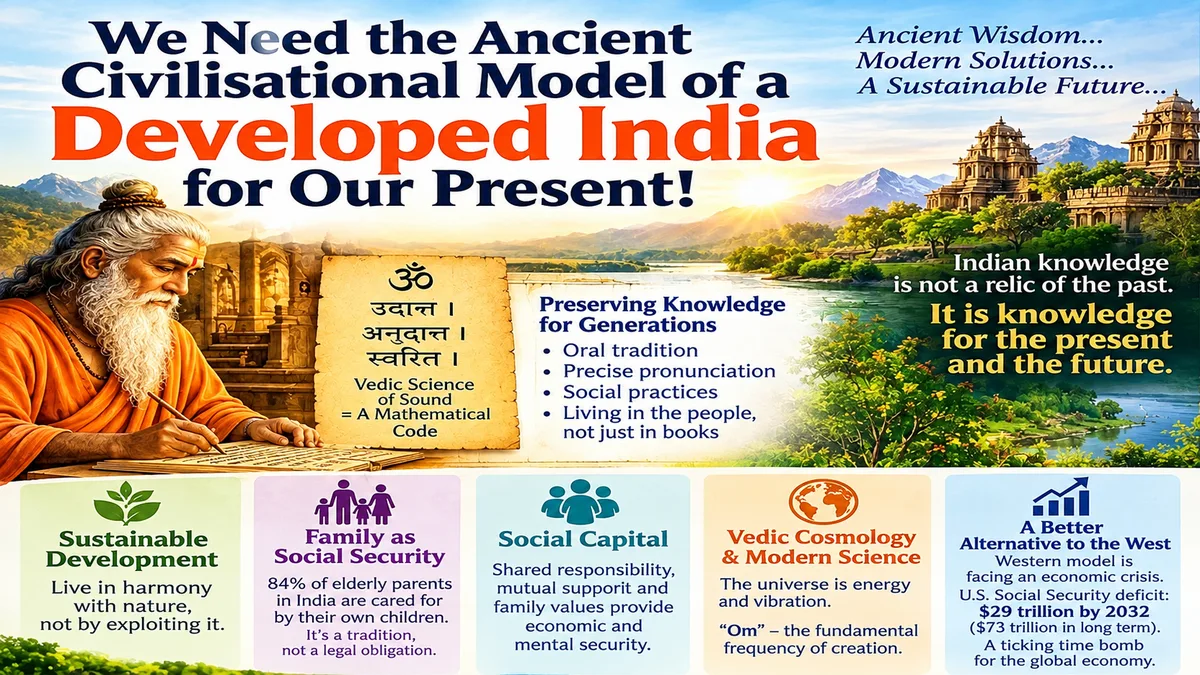
In reality, it would be a grave mistake to regard ancient Indian knowledge merely as a relic of the past. Those who attempt to dismiss it in this manner are, in truth, weakening their own roots. Indian knowledge is, in fact, profoundly contemporary. It is knowledge for the present and the future, capable of guiding the entire world in the fields of science and social security.
The sociological transformation of knowledge and the oral tradition
One of the greatest characteristics of Indian civilisation has been its ability to create knowledge and develop institutional mechanisms to preserve it and carry it to the remotest sections of society. The sages and thinkers transformed abstract scientific understanding into folk culture, oral traditions and everyday social practices, making science an intrinsic part of social life.
In this context, Gurumurthy says that at a time when the entire world is struggling with the adverse effects of Western modernity, individualism and unchecked consumerism, India’s traditional knowledge can truly serve as a sustainable guide for the global future. The first and most important foundation of this intellectual framework lies not merely in the creation of knowledge, but in its social preservation and practical application.
Gurumurthy has explained with considerable logic that the greatness of ancient Indian civilisation did not lie solely in the fact that it generated highly advanced knowledge in philosophy, mathematics and astronomy. Its real distinctiveness lay in transforming that abstract knowledge into the everyday lives of ordinary people, into folk culture, oral traditions and social institutions.
When knowledge remains confined to academic texts or closed rooms, it eventually disappears with the passage of time. The sages of India, however, made scientific understanding an integral part of social practices. As a result, knowledge remained alive in the bloodstream of society from one generation to another, even without formal state patronage. When practices become traditions, they become part of a society’s collective memory. This is the greatest secret behind the continuity of the Indian knowledge system.
Gurumurthy presented perhaps the most compelling evidence of this continuity and scientific precision through the oral tradition of the Vedas and the science of sound embedded within them. Challenging modern linguists and thinkers, he argued that Vedic recitation is not ordinary folklore or poetry, but a highly refined and practical mathematical code. The ancient sages were fully aware of the psychological and historical fact that human memory deteriorates with time and that written languages themselves undergo transformation or distortion over the course of centuries. Therefore, to preserve the purity of the Vedas and their original essence, they developed a rigorous and remarkably precise framework based on phonetic accuracy.
It was through the strict rules governing the variations and pronunciation of tones such as Udatta, Anudatta and Svarita that it became possible to preserve the Vedas for thousands of years, without writing down even a single word, while retaining their original sound and resonance. In this sense, Vedic recitation represents both a precise mathematical code and a science of sound. Gurumurthy particularly emphasised that although this tradition suffered damage in several parts of India because of foreign invasions and periods of cultural upheaval, teachers and scholars in southern India have preserved this oral mathematical code with complete phonetic precision even today. This represents a unique example of linguistic preservation at the global level.
Gurumurthy also highlighted what he regards as the troubling reality underlying Western concepts. According to him, the Western model is based entirely on individualism and a state-driven social contract, in which the government assumes full responsibility for caring for individuals in old age.
Gurumurthy warned that this model is now approaching an economic breaking point. By 2032, the Social Security system in the United States is projected to face a direct deficit of $29 trillion, and, according to this argument, the entire system could cease to be viable over the following 75 years. If the long-term shortfall of the overall Social Security system is assessed in present-value terms, the figure comes to approximately $73 trillion. Gurumurthy has described this, in highly striking terms, as a “ticking time bomb beneath America”, capable of paralysing the global financial system at any time.
In contrast to the impending crisis facing Western countries, India’s traditional family model presents itself to the world as a powerful alternative. Even today, approximately 84 per cent of parents in India are cared for by their own children. It is important to remember that this is neither a legal obligation nor a rule imposed by the state. It is an uninterrupted tradition of partnership, interdependence and family responsibility that has continued from ancient times. What Western economists view through the lens of GDP and the market, India lives as dharma and mutual duty.
The greatest economic advantage of this system is that the Government of India does not have to devote an exceptionally large proportion of its GDP to the social security and pensions of the elderly, because society itself carries this responsibility through its internal social capital, naturally and with dignity. Living together, sharing responsibilities and supporting one another in times of crisis lie at the heart of Indian culture. According to Gurumurthy, this is the true meaning of dharma, which provides society with both economic and psychological security.
In addition, a profound relationship can be explored between modern astrophysics and ancient Vedic cosmology. The conclusions that modern science is reaching today through the Big Bang theory and scientific discoveries made by NASA in recent years are, according to this perspective, truths that were already present in the Indian scriptures thousands of years ago with remarkable clarity. Modern science is increasingly recognising that the fundamental nature of the universe is not simply matter, but waves of energy and vibrations. In the Vedas, this ultimate reality is described as Shabda Brahman, flowing throughout creation like a musical form of divinity.
Gurumurthy has made it clear that the sound of Om is not confined to being merely a religious symbol. It represents, in this interpretation, the fundamental frequency and central principle of the universe. This perspective is presented as evidence that India’s ancient culture and its spiritual traditions are deeply connected with scientific ideas that underpin the modern world. This is also why India’s developmental model is not one that seeks to exploit nature, but one that seeks coexistence with it. It is for this reason that India’s civilisational philosophy offers, in this view, a logical response to the global environmental crisis of the present age.
Seen in this light, Gurumurthy has presented a highly confident and forward-looking conclusion: ancient Indian knowledge represents the future of the world, and there should be no doubt about this. Although the modern world may take some time to accept this proposition, the day is not far away, according to this view, when the global community will understand that the Indian intellectual tradition is not backward or primitive knowledge. It is, rather, knowledge for the future.
India has demonstrated that it is possible for an enormous and diverse population to live together peacefully and harmoniously within a relatively limited geographical space, without internal social fragmentation. India also knows how to embrace modern technology and economic progress while preserving its civilisational self-awareness. In Gurumurthy’s words, “We know how to develop and we will teach the world to develop on our own terms, in harmony with nature”.