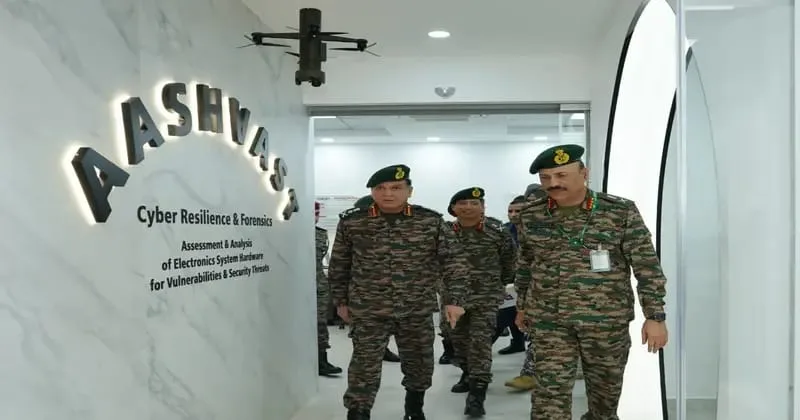
NEW DELHI: The Indian Army has established a specialised laboratory in New Delhi to assess military drones for hidden electronic and software vulnerabilities, including risks associated with components of Chinese origin. Named AASHVAST, the facility aims to strengthen the security and reliability of unmanned systems as drones assume an increasingly critical role in modern warfare.
AASHVAST stands for Assessment and Analysis of Electronic Systems Hardware for Vulnerabilities and Security Threats. The facility operates under the Directorate General of Electronics and Mechanical Engineering (DG EME) and is designed to assess mission-critical military electronics beyond conventional physical inspections. Army Chief General Dhiraj Seth inaugurated the facility on August 14.
The laboratory’s focus goes beyond verifying whether a drone’s visible hardware is genuine. It also examines the software and firmware that govern the functioning of unmanned aircraft. According to The Tribune, technicians can scan systems for hidden passwords, embedded encryption keys, remote-access tools and concealed command pathways that could pose potential security risks.
The facility can further determine whether a drone has been altered from its original configuration and whether its software permits updates exclusively from an authorised manufacturer. It also evaluates how unmanned systems respond to GPS spoofing and jamming—techniques that can disrupt navigation and potentially affect the behaviour of drones during military operations.
Unlike conventional networked computer systems, AASHVAST operates offline within an air-gapped environment, providing an isolated setting for security assessments. Drone software can be extracted directly from the flight controller or camera payload, or analysed using a stored software image. The system follows a read-only approach, allowing the aircraft’s software to be examined for vulnerabilities without altering or modifying the original software during the assessment.
The focus on Chinese-origin components is significant as India continues to address potential vulnerabilities linked to foreign-made electronics in defence systems. The Army had earlier highlighted the need for mechanisms to identify and eliminate Chinese components from drones, particularly after cases involving Indian suppliers using such parts came under scrutiny.
The new facility is also part of India’s broader efforts towards defence indigenisation and strengthening cyber resilience. According to IIT Roorkee’s iHUB DivyaSampark, AASHVAST was inaugurated alongside a Wireless & Security Anti-Drone Laboratory at the DG EME headquarters. Together, the facilities are aimed at enhancing the security, resilience and operational readiness of critical defence systems.
As military drones take on increasingly important roles in surveillance, reconnaissance, logistics and combat operations, protecting their electronic systems is becoming as crucial as safeguarding their airframes. With AASHVAST, the Army has added another layer of security, enabling the digital architecture of a drone to be examined for hidden vulnerabilities before the system is cleared for battlefield deployment.