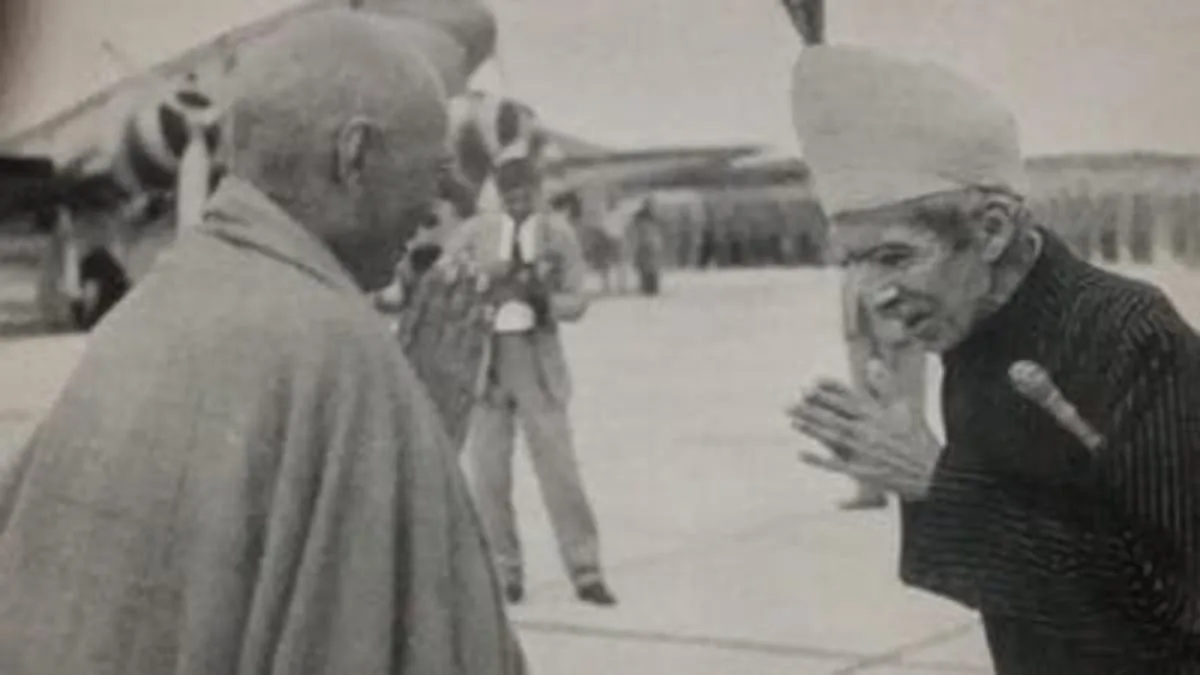
September 17 marks a historic day for independent India, as it was on this day in 1948 that the ruler of the Hyderabad state, 7th Nizam Mir Osman Ali Khan, surrendered before the first Indian Home Minister, Sardar Vallabhai Patel, announcing the merger of his state with the Union of India. The police action under the name ‘Operation Polo’ was necessitated because of the Nizam’s plan to join Pakistan and communists who, in the name of fighting the tyrannical Nizam, were planning to establish a red-flagged separate country with their party dictatorship on the lines of the USSR and China. Sardar Patel, after receiving the information, planned “Operation Polo” and wrapped up the entire operation in less than three days. Till then, the Nizam-sponsored Islamic terror group Razakars were causing havoc with murders, rapes and burning of houses in that area. Razakars, the earlier version of the current AMIM, have fled to Pakistan. Unfortunately, these historic facts of Operation Polo are never taught in schools, and the Congress, in its appeasement policy, has not officially celebrated the victory of the Indian Army over the first generation of religious terrorists.
The struggle for the liberation of the Hyderabad state from the Muslim ruler, while the subjects were largely Hindus, was initiated by the Andhra Maha Sabha, an association of Telugu-speaking people in the Nizam-ruled area. Communist Party, which was strong in the Andhra area, joined the liberation struggle, not with the aim of ending the tyranny of the Nizam but to capture power and establish a Red spot in the Deccan area, with arms and gradually took over the leadership. Communists made it an armed struggle, and country-made rifles were used as weapons. The uneducated, poor men and women supported the Communists’ armed struggle and even joined them by taking up arms, not knowing the intentions of the Reds.
The aim of the communist led armed struggle was to dethrone the Nizam; their armed struggle should have ended on September 17, 1948, the day the ruler received Sardar Patel with folded hands and announced the merger of Hyderabad state with the Indian Union. But the continuation of the Communists’ fight by firing at the Indian Army beyond 17th September 1948 has no convincing explanation. The Communists carried their fight with the Indian Army for the next three years, and it was only at the fag end of 1951 that they announced the ceasefire, that too on the advice of the USSR. Why did Indian Communists fight against the Indian Army and their anti-national motives? remained unresearched by the Indian Marxist historians because the truth hurts them and their ideology badly.
As a diversionary tactic, the Communists commissioned their history group to build a narrative of the Indian Army killing the innocents and committing crimes against the women and farmers and killing many in the countryside. Thus, the communists effectively projected themselves as the victims of state machinery. Unfortunately, many Indians still believe in that manufactured narrative of innocent communists being killed in the Nizam area as well as the Andhra area for their part in liberating the people from a cruel Muslim ruler. The reports and books written by communist sympathisers described many unfounded incidents involving the Indian Army standing as supporters of landlords, zamindars, etc. However, in the book written on the Telangana armed struggle by P. Sundarayya, it was stated that the landlords who fled the countryside to Hyderabad city started returning to the villages only after the armed struggle by Communists was withdrawn in November 1951. In such a scenario, there is no way the Indian Army was standing by landlords and committing atrocities against villagers. As P. Sundarayya wrote, there were deaths of 300 communist cadres during their fight and certainly not all of them at the hands of the Indian military. On the other hand, the Communists and their sympathisers spread the story of the Indian Army standing by the landlords of Telangana and eliminating the communist cadre. They prepared a document listing over 3 thousand cadre being killed by the Indian Army. This is nothing but a falsification of the Indian Army’s character. Indian Army has never had a history of eliminating a surrendered militant or even a foreign enemy.
The question the communists never answered or explained was why they have not celebrated Nizam’s surrender and announced the withdrawal of their armed struggle if their stated objective was eliminating Nizam’s rule. Hyderabad state was liberated through police action. Hiding their intention of establishing a Red conclave in the Deccan they contended that their armed struggle is needed to protect rural farmers who took over the lands from the returning land lords. Such protection is the responsibility of the civilian government established through the constitution and not that of private gun-wielding Communist Dalams. It was the irresponsible act of Communists in not announcing the end of their armed struggle which led to confrontation in some of the villages. The Indian army announced a pardon to the surrendered rebels, and communists refused to utilise that offer. Had communists announced an end to the armed struggle and surrendered their arms to the Indian army, things would certainly have been different, and the burden of settling the land issue would have fallen on the newly taken-over government. But Communists did not do that; they continued their fight with the Indian army. This perhaps was the first anti-national action of Indian Communists.
Their fight against the Indian Army, when coupled with the statements of other communist leaders made elsewhere in the country, exposed their hidden intent of establishing a communist dictatorial Red enclave within India. B.T. Ranadive called “Independence as a jhoot”, and gave a call to throw out the Nehru government through armed rebellion on the lines of Telangana armed struggle.
P. Sundarayya, then a prominent figure in the Communist Party and later general secretary of CPM, has written a book on the Telangana armed struggle and lessons learnt. It was clear that their undeclared intention was to defeat the Nizam through armed struggle and establish their own Red regime in Hyderabad state. It is difficult to expect better behaviour from the Communists, whose sabotage of the 1942 Quit India movement was well documented. The support for the Communist armed struggle, from the local folks, ended the day the Indian Army entered Hyderabad state from the current-day Karnataka, Maharashtra and Andhra side and, fearing for his life, the Nizam surrendered. Even senior local communist leader Ravi Narayana Reddy recognised this fact and presented his view before the party and advised the withdrawal of armed struggle but got dubbed as a revisionist, in the typical communist jargon. Despite the lack of local support, the Communist leadership carried on their armed fight till 1951 October/November, a full three years after the merger of the Nizam with the Indian Union. The reasons for the fight after September 17. 1948 were obvious. It was the communist’s anti-democratic mindset with the Soviet Union-modelled dictatorship in their plans.
After three years of using arms against the Indian military, the Communists were finally compelled to understand their folly in fighting against the Indian Army without the support of local people. The Nizam area people were happy to be with Indian Union and wished to have a peaceful atmosphere rejecting the tensions created by Communist cadre.
Communist party of India is Indian for its namesake and its primary allegiance is with the international communist party, Soviet Union, China in that order, as the then leadership of that party had the established mind set of their party being Indian branch of International Communist Party. Because of the mental servitude and intellectual slavery of the Indian communist party, a delegation was sent to the USSR and sought an audience with Stalin to take his guidance in their future course of action in the armed struggle in Deccan. A delegation of the Communist Party that comprised Chandra Rajeswara Rao, Makineni Basava Punnaiah, Ajay Kumar Ghosh, and S.A. Dange travelled to Moscow secretly and met the USSR communist party delegation, with Stalin, Molotov, Malenkov and Suslov as members. The communist party of India delegation has not disclosed their mode of travel and the discussions they had with a foreign power. It was the internal struggle of the Indian communist party leadership that resulted in the leakage of the deliberations they had in Moscow with Stalin.
The team led by Stalin apparently questioned the continuation of armed struggle after the merger of Hyderabad state with the Indian Union. Such a flawed decision has to be withdrawn immediately was the suggestion from the USSR. With foreign intervention, the communists finally stopped that fight with the Indian Army. Thus, the armed struggle of communists in the state of Hyderabad after the surrender of its ruler, the seventh Nizam, is the first anti-national activity of that party in independent India. Many other anti-national activities followed subsequently.
There were many questions which remained unanswered by the Communists even after 78 years of the Nizam’s surrender to Indian Home Minister Patel.
From where did the communists receive the arms? Who funded that armed rebellion? Who trained them in the use of firearms? Were they in touch with Chinese leadership for these anti-national actions? There needs to be research on these questions to further expose and establish the anti-national mindset of the Indian communists. But it is certain that armed struggle was the foundation for the subsequent violent, mindless killing Naxal actions. Although violent groups have been eliminated successfully, the Dimagi Naxals need to be tackled, and September 17 next year should be set as a target for ending the Dimagi Naxals.