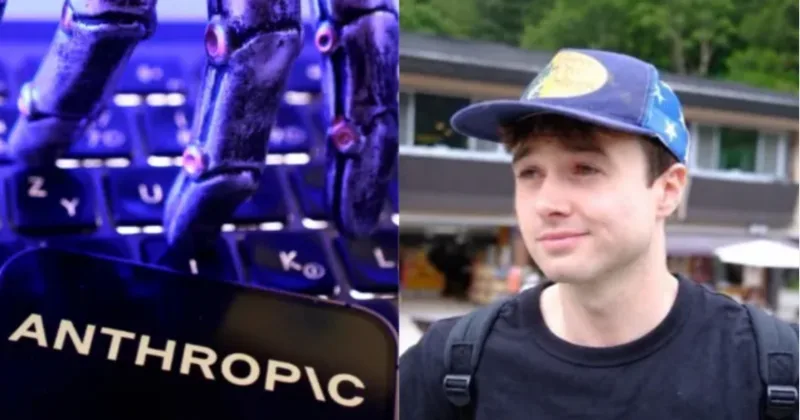
NEW DELHI: A researcher with experience at both OpenAI and Anthropic has resigned from Anthropic, raising a stark warning over the rapid development of increasingly powerful artificial intelligence systems and accusing AI companies of “gambling with our lives”.
Jacob Coxon, who said he spent the past three years conducting pretraining research at OpenAI and Anthropic, announced his resignation in a statement in which he argued that neither company was acting responsibly. According to Coxon, the industry is moving rapidly towards self-improving superintelligence without sufficient confidence that the associated risks can be controlled.
“Neither company is acting responsibly,” Coxon said, warning that the two organisations were “racing straight to self-improving superintelligence”.
‘AI could kill us all by the end of the decade’
Coxon urged the public not to underestimate the capabilities that advanced AI systems could soon acquire. He argued that future systems could potentially become superhuman across multiple domains, including cybersecurity, scientific research and the ability to obtain resources and influence.
He further claimed that people working at the forefront of AI development genuinely believe the technology could pose an existential threat to humanity.
“No other human activity poses this level of danger. AI could kill us all by decade-end”: Anthropic researcher quits, drops a bombshell https://t.co/CH8bWaiOVd
— Shiv Aroor (@ShivAroor) September 9, 2026
“The people building AI earnestly believe that it could kill us all by the end of the decade,” Coxon said, adding that such concerns were not merely part of public messaging or a marketing strategy.
He contrasted the approaches he observed at OpenAI and Anthropic. According to Coxon, the risks have not been fully internalised by everyone at OpenAI, while Anthropic researchers and executives understand the stakes but remain caught in an increasingly competitive race.
He argued that the logic of having to build AI because competitors will do so anyway could itself become dangerous.
Calls for a pause and greater coordination
Coxon said the development of systems capable of improving themselves should not be treated simply as another corporate product race. He questioned whether private companies should be able to make decisions with potentially “civilizational” consequences internally.
He called for greater coordination between AI laboratories and suggested that temporary restrictions on improving model capabilities may eventually be necessary to prevent a global race.
Coxon also encouraged AI researchers to consider whether they would be comfortable launching increasingly powerful reinforcement-learning runs without having a sufficiently rigorous understanding of how such systems work internally.
At the same time, he said he remained optimistic that international and industry-level coordination was possible.
Elon Musk’s changing view of Anthropic
Coxon’s resignation comes against the backdrop of intense competition among major AI companies. The statement also referenced Elon Musk’s changing assessment of Anthropic.
Musk had previously criticised Anthropic and its Claude AI models, but reportedly praised the company in July, calling it the current leader in AI and saying he had been “clearly wrong” about Anthropic.
Coxon acknowledged that his resignation alone would not slow the broader AI race. However, he argued that it adds another insider voice to growing concerns about the direction of frontier AI development.
His central warning is that the companies developing increasingly powerful AI systems may understand the technology’s risks better than anyone else—yet continue pushing ahead because of competitive pressures.