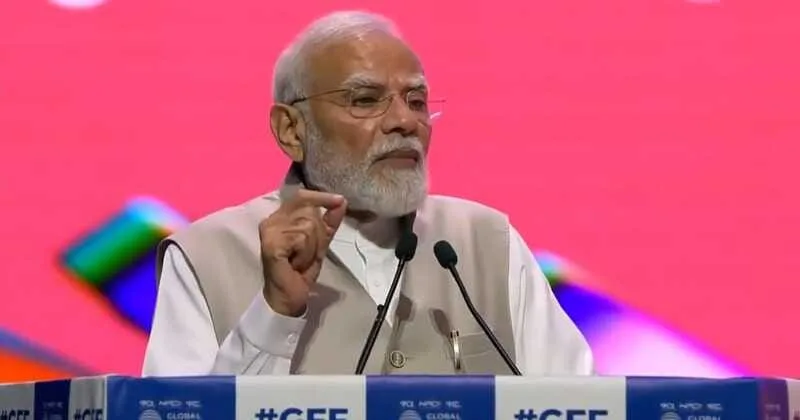
MUMBAI: Prime Minister Narendra Modi on September 8 urged the fintech ecosystem to expand UPI’s global reach, integrate it with local payment systems in other countries, and help the Indian diaspora reduce remittance costs.
India is taking its fintech journey to new heights, with innovation and inclusion at its core. Addressing the Global Fintech Fest 2026 in Mumbai. https://t.co/pMhokoCBjG
— Narendra Modi (@narendramodi) September 8, 2026
Addressing the 7th edition of the Global Fintech Fest after its inauguration, Prime Minister Narendra Modi said India’s 7.8 per cent real GDP growth had boosted global confidence, particularly as the growth came during a challenging quarter when the impact of the West Asia conflict was at its peak.
Urging the fintech ecosystem not to rest on the achievements of the past decade, PM Modi noted that real-time payments through UPI had reached 24.51 billion transactions as of August this year. He said the next goal should be to expand UPI’s global footprint. He emphasised focusing on countries with a large Indian diaspora, strong trade ties with India, or those willing to partner with New Delhi to connect their payment systems.
PM Modi said the initiative was important as a large number of Indians work abroad and the country remains the world’s largest recipient of remittances. He noted that transaction costs account for a portion of these remittances, adding that UPI could help reduce such costs while ensuring that money reaches families faster.
PM Modi said UPI is now operational in 11 countries and has been linked with Singapore’s local payment system, making transactions between the two countries as seamless as payments within local neighbourhoods. He noted that global card payments largely operate through systems developed in other countries, but said India now has its own alternative. “We can set our own rules and standards and connect them with the world,” he said.
Quoting French President Emmanuel Macron, Modi said UPI was “not only a tech story but also a civilisational one.”
Highlighting the fintech sector’s achievements in digital payments over the past several years, Modi said its next phase should focus on non-payment financial services, including access to savings products, pensions, insurance and other financial services.
PM Modi said the PM-SVANidhi scheme, which provides working capital loans to street vendors, was enabled by UPI and helped raise the beneficiaries’ average annual income by 20 per cent. He said technology allows customised financial solutions tailored to individual needs, and urged the fintech sector to make non-payment transactions as simple and seamless as making a payment by scanning a QR code.
Highlighting emerging technologies such as agentic artificial intelligence, tokenisation and quantum technology, Modi said they were opening up new possibilities and called on the fintech sector to pursue them with specific goals. He also stressed the need for robust cybersecurity, ethical data protection standards within the industry and a fintech consumer protection index to transparently rate every company. PM Modi said India also needs to build a strong ecosystem connecting fintech players, regulators, industry and innovation.
On the geopolitical front, he said the world was facing conflicts and uncertainty, with energy and commodity supply chains under pressure and concerns over oil supplies. He said India’s economic performance should be viewed against this challenging global backdrop.
PM Modi also pointed to the Japan Credit Rating Agency’s upgrade of India’s sovereign rating to ‘A-’ from ‘BBB+’ as a reflection of growing global confidence in the country. He noted that the upgrade was the first by the agency in three decades. “This shows that India’s growth momentum, macroeconomic stability and the structural reforms of the last few years are giving the world comfort,” PM said.