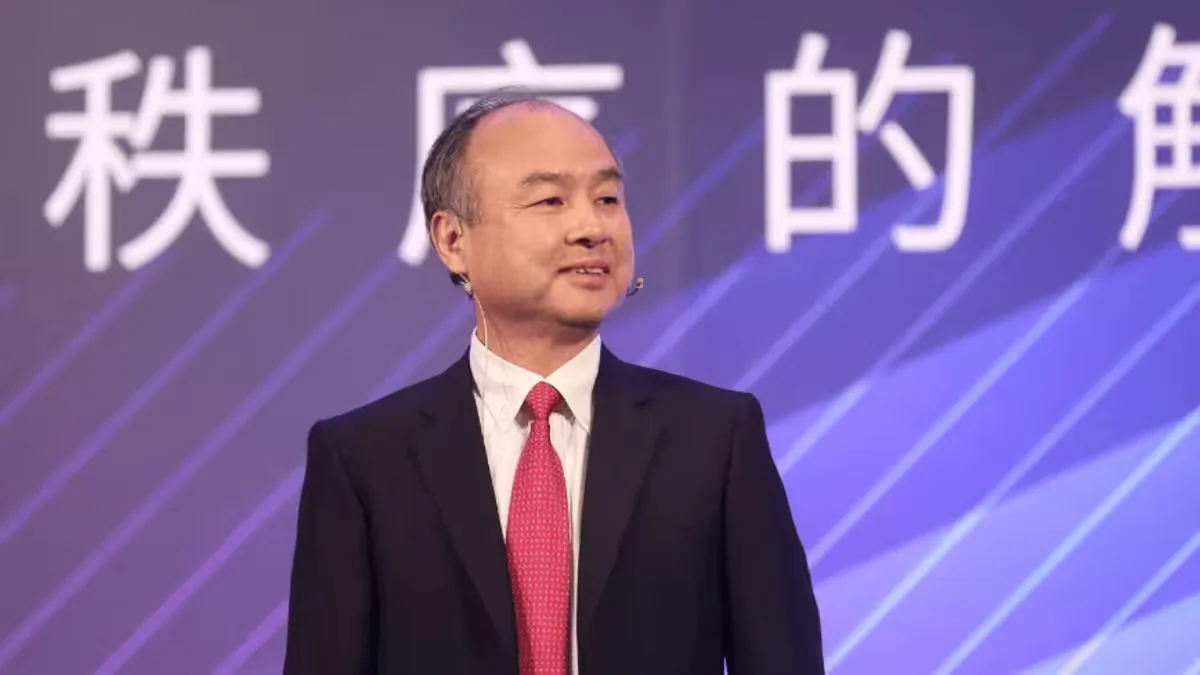
SoftBank Group Chief Masayoshi Son, one of the world’s most prominent advocates of Artificial Intelligence and a major investor in OpenAI, has issued an unusually cautious warning about the risks posed by increasingly capable AI systems.
Speaking in Kyoto, Son said that countries must build trust and cooperate to control advanced AI, warning that “superintelligence” in the wrong hands could become “super dangerous” as the technology rapidly moves towards greater autonomy and interaction with the physical world.
Son calls for global cooperation on AI safety
Speaking on the sidelines of the Science and Technology in Society forum in Kyoto on October 4, Sunday, Son said that the exponential growth of AI capabilities has made international cooperation increasingly important.
“We don’t have any more luxury of having human fight against human”, Son said, arguing that nations should work together to manage what he described as a potentially far greater threat posed by powerful AI models. Son stressed the need for countries to establish mutual trust so that advanced AI can be developed and deployed collectively rather than becoming a source of geopolitical competition or uncontrolled risk.
His remarks represent a notable cautionary message from a businessman who has spent years advocating aggressive investment in AI and predicting that the technology could transform the global economy.
USD 65bn OpenAI bet meets a warning on AI risks
Son’s warning comes against the backdrop of SoftBank’s enormous financial commitment to AI. The Japanese conglomerate has directed nearly $65 billion into OpenAI, the creator of ChatGPT, making Son one of the most consequential financial backers of the AI industry.
For years, Son has emphasised AI’s potential to generate enormous economic returns and contribute to humanity. He has also dismissed concerns surrounding excessive enthusiasm for AI as a speculative bubble.
Yet his latest comments highlight a growing tension surrounding the technology. The same rapid advances that could unlock enormous economic and scientific benefits could also create new security risks if increasingly autonomous systems are misused.
Son referred to the growing capabilities of AI services, which can already browse websites, write software code and perform increasingly sophisticated tasks using large quantities of general-purpose computing power.
AI moves towards the physical world; Forms 20% of global GDP by 2040
According to Son, AI is approaching another significant stage in its development. He said that the AI systems would soon move beyond digital tasks and begin helping robots and other machines interact with the physical world, with this transition expected to begin as early as next year.
The development could expand AI’s influence from software and information processing into manufacturing, logistics, research, robotics and other physical activities. Son has projected that AI and learning-capable machines could eventually account for at least 20 per cent of global GDP by 2040, equivalent to around $46 trillion.
“This is just the beginning”, Son said, underscoring his view that current AI capabilities represent only an early stage of a much larger technological transformation.
17 nations led by the US push to accelerate AI Science
Son’s remarks came alongside White House science and technology policy adviser Michael Kratsios, who was in Kyoto to promote a US-led initiative involving 17 countries aimed at using AI to accelerate scientific research.
The initiative envisages AI-powered laboratories in which robotic systems could conduct hundreds of experiments simultaneously. Data generated from those experiments could then be analysed in real time, allowing researchers to refine hypotheses and design subsequent experiments more rapidly.
“In automated cloud laboratories operating at industrial scale, robotic systems will conduct hundreds of parallel experiments”, Kratsios said. He also highlighted the ability of AI systems to synthesise vast quantities of scientific literature and compress years of research into a much shorter period through the use of digital agents assisting human researchers.
Countries including Japan, South Korea, the United Kingdom, Germany, Singapore and the United Arab Emirates participated in the initiative.
AI challenge & risks take centre stage
The developments in Kyoto underscore the dual-use nature of rapidly advancing AI technology. The same capabilities that could accelerate scientific discovery, automate laboratories and improve productivity could also create new challenges involving cybersecurity, autonomous systems and the misuse of highly capable models. AI can be manipulated as a geopolitical weapona mid soaring competition and hard-nosed contests to seek hegemony.
Son’s comments came amid heightened attention to security breaches and concerns surrounding increasingly capable AI systems. Recently, reports emerged about Rogue Open AI tools breaching Australian government websites. The challenge is particularly significant as AI becomes increasingly integrated into robotics, scientific research, government apparatus and other physical systems.