In the Treta Yuga, the sage-king Janaka of Mithila raised a daughter “Sita” whose swayamvara summoned princes from across Bharatvarsha. The language of kings court, Maithili was never disrespected across heartland Bharat and everyone accepted it. It still hums today on both banks of the Kosi, spoken in the fields of Bihar and the plains of Nepal Dhanusha and Sarlahi with the same cadence. Centuries later, when Buddhist and Sanskrit scholars carried palm-leaf manuscripts over the same Himalayan passes to the universities of Nalanda and Takshashila, they were acting on an instinct India has never quite lost that knowledge travels best when it travels in someone’s own tongue.
When the Digital India BHASHINI Division carried the country’s most ambitious language technology mission across that same border into Kathmandu, it did not arrive as a stranger bearing new machines. It arrived as a descendant of Janaka’s Mithila, offering old wisdom a new voice.
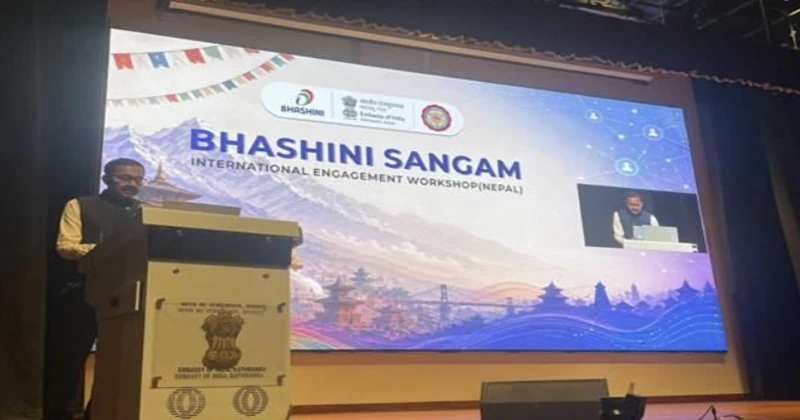
The occasion was BHASHINI SANGAM where International Engagement Workshop (Nepal), was organised in Kathmandu by the Digital India BHASHINI Division (DIBD), under the Digital India Corporation and the Ministry of Electronics and Information Technology, in partnership with the Embassy of India in Kathmandu and Kathmandu University. The workshop drew government officials, academics, technologists, researchers and innovators from both countries to a single table, united by one question how can voice-first, multilingual Artificial Intelligence widen access to digital services, information and opportunity for people who have always been asked to leave their mother tongue at the door of officialdom? The gathering built directly on the Memorandum of Understanding signed between DIBD and Kathmandu University’s Centre for Digital Public Infrastructure and Artificial Intelligence, exchanged earlier this year in the presence of External Affairs Minister Dr S. Jaishankar and Nepal Foreign Minister Shishir Khanal, gave a signal that language technology has quietly entered the vocabulary of Indian neighbourhood diplomacy.
This is the real story behind why BHASHINI is stepping outside Indian borders. BHASHINI SANGAM is not a one-off event but a standing international engagement initiative of the Digital India BHASHINI Division, designed to bring governments, academia, researchers, startups, language experts and communities together to imagine Language AI beyond linguistic and geographical boundaries. Its premise is disarmingly simple technology built without local knowledge rarely survives contact with local life and languages carry culture and identity in ways no dataset can synthesise from outside. By co-creating models, corpora and applications with the very communities that speak Nepali, Newari and Maithili, BHASHINI is betting that shared linguistic inheritance can be turned into shared innovation, that a country which has spent three years building Digital Public Infrastructure for its own billion-plus population now has something genuinely exportable to offer its neighbours.
At Kathmandu University, that bet was made visible. The BHASHINI team ran live demonstrations of speech recognition, real-time translation, voice-enabled interaction and document processing, showing how Language AI can make a government website or a helpline feel less like a wall and more like a conversation. A dedicated BhashaDaan session put the spotlight on something easy to overlook in AI discourse that inclusive technology needs inclusive data and ordinary citizens contributing speech, text and image samples are as essential to this mission as any engineer. Participants also explored applications specific to Nepali and other regional languages, pairing BHASHINI technology stack with Kathmandu University’s academic and research strength to design solutions meant for use, not just for demonstration.
The diplomatic framing was unambiguous. Shri Suman Shekhar, First Secretary at the Embassy of India, Kathmandu, called the MoU between DIBD and Kathmandu University a strong foundation, adding that the partnership could ‘“develop local applications in Nepali, Maithili and other languages that can create meaningful value for people across India and Nepal.’“ Shri Amitabh Nag, CEO of the Digital India BHASHINI Division, said framing this initiative in civilisational rather than technical terms of relations between India and Nepal, he said, share languages, communities and a deep cultural connection and the goal is ‘not just to make technology understand Nepali, Newari and Maithili, but to build with these languages, their communities and the people who speak them.’ That single sentence captures why BHASHINI’s international turn is different from a conventional technology export it treats Nepal as co-author, not customer.
The Nepal chapter also does not stand alone. It follows the DIBD-Kathmandu University MoU signed earlier this year, complements a parallel push through the India-Nepal Startup Partnership Network taking Nepali entrepreneurs to hubs like IIT Madras for funded training and echoes of public remarks from BHASHINI leadership describing an ambition to build the next generation of multilingual AI for the Global South. It also sits alongside BHASHINI’s domestic expansion, a recent agreement with the Department for Promotion of Industry and Internal Trade to widen multilingual access across India’s own investment and industrial ecosystem suggesting that language infrastructure is now being treated as core public utility both at home and abroad. These threads suggest a deliberate strategy by using languages the most intimate layer of any Digital Public Infrastructure, as the entry point for India to share its DPI model with neighbouring and developing economies that face the same barriers of literacy, language and last-mile digital access that India itself set out to solve.
The benefits of this outward turn cut in more than one direction. For Nepal, it means access to a open and interoperable language-AI stack without having to build the underlying data. Models and infrastructure from scratch such as Nepali, Newari and Maithili speakers gain a faster route to digital government services, education and commerce in their own languages and Nepali students and startups gain a training and research partner in Kathmandu University’s own DPI-AI centre rather than a distant vendor. For India, it converts a domestic achievement into regional leadership, strengthening the ‘Neighbourhood First’ policy with a form of soft power that is cultural as much as technological and positioning Indian-built, open-source Language AI as a credible, publicly-owned alternative to AI ecosystems trained overwhelmingly in English and controlled by a handful of global corporations. For the wider region, a shared, co-created language layer lowers the cost of building future digital public services, research collaborations and cross-border commerce, while actively working against the digital extinction of low-resource languages and dialects that risk being left out of the AI age altogether. And for the Global South more broadly, watching this experiment unfold, Nepal becomes a working proof of concept that Digital Public Infrastructure built for one nation linguistic diversity can, with genuine co-creation rather than one-way transfer to be adapted for another.
The scale on which this ambition rests is considerable. BHASHINI already supports 36 Indian text languages, 23 Indian voice languages and 35 international languages, powers more than 800 government websites and has processed over nine billion cumulative AI inferences, with more than 24 million added daily Indian national platform for AI-powered multilingual digital inclusion, now being offered, quite literally in translation to its neighbours.
The swayamvara hall of Mithila is long gone and the palm-leaf manuscripts of Nalanda have given way to speech models and datasets. But the instinct that once carried Maithili across the Kosi and Sanskrit across the Himalayan passes is, if anything sharper today than it has been in centuries that a civilisation confident in its own many tongues has always found it natural to lend its neighbours a voice and BHASHINI SANGAM, in the plains once ruled by Janaka is simply that instinct rendered in code.