Decolonizing Bharat: How India is reclaiming its indigenous identity
August 15, 2026
  • Read Ecopy
  • Circulation
  • Advertise
  • Careers
  • About Us
  • Contact Us
Android AppiPhone AppArattai
Organiser
  • ‌
  • Bharat
    • Assam
    • Bihar
    • Chhattisgarh
    • Jharkhand
    • Maharashtra
    • View All States
  • World
    • Asia
    • Europe
    • North America
    • South America
    • Africa
    • Australia
  • Editorial
  • International
  • Opinion
  • RSS @ 100
  • More
    • Op Sindoor
    • Analysis
    • Sports
    • Defence
    • Politics
    • Business
    • Economy
    • Culture
    • Special Report
    • Sci & Tech
    • Entertainment
    • G20
    • Azadi Ka Amrit Mahotsav
    • Vocal4Local
    • Web Stories
    • Education
    • Employment
    • Books
    • Interviews
    • Travel
    • Law
    • Health
    • Obituary
  • Subscribe
    • Subscribe Print Edition
    • Subscribe Ecopy
    • Read Ecopy
  • ‌
  • Bharat
    • Assam
    • Bihar
    • Chhattisgarh
    • Jharkhand
    • Maharashtra
    • View All States
  • World
    • Asia
    • Europe
    • North America
    • South America
    • Africa
    • Australia
  • Editorial
  • International
  • Opinion
  • RSS @ 100
  • More
    • Op Sindoor
    • Analysis
    • Sports
    • Defence
    • Politics
    • Business
    • Economy
    • Culture
    • Special Report
    • Sci & Tech
    • Entertainment
    • G20
    • Azadi Ka Amrit Mahotsav
    • Vocal4Local
    • Web Stories
    • Education
    • Employment
    • Books
    • Interviews
    • Travel
    • Law
    • Health
    • Obituary
  • Subscribe
    • Subscribe Print Edition
    • Subscribe Ecopy
    • Read Ecopy
Organiser
  • Home
  • Bharat
  • World
  • Operation Sindoor
  • Editorial
  • Analysis
  • Opinion
  • Culture
  • Defence
  • International Edition
  • RSS @ 100
  • Magazine
  • Read Ecopy
Home Bharat

Decolonising Bharat: How legal, educational and cultural reforms are reclaiming India’s indigenous identity

Bharat’s decolonisation journey is unfolding through reforms in governance, education, law and culture, aimed at reclaiming indigenous knowledge and national identity. From legal reforms and NEP 2020 to cultural revival and renaming of colonial-era landmarks, these efforts reflect a broader push towards intellectual and institutional autonomy

WEBDESKWEBDESK
Aug 15, 2026, 04:00 pm IST
inBharat, Culture, Education
Follow on Google News
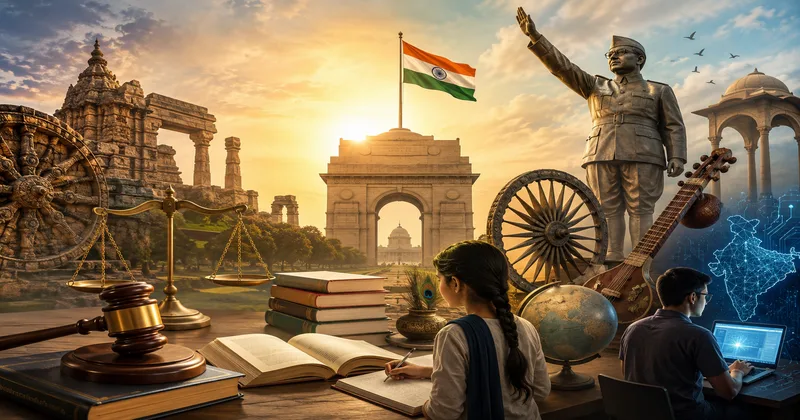
Bharat’s decolonization is reshaping laws, education and culture while reclaiming its civilisational identity (This image is generated by AI)

Bharat’s decolonization is reshaping laws, education and culture while reclaiming its civilisational identity (This image is generated by AI)

Facebook
Twitter
WhatsAppTelegramEmail

Recognising the pervasive nature of the colonial mindset, Bharat has embarked on a deliberate and multi-pronged approach to decolonise its institutions, education, and cultural landscape. This active decolonisation is crucial for achieving absolute freedom (Swatantrata).

Administrative & Legal Reforms: Reforming Governance and Justice

Decolonisation in action is evident in significant administrative and legal reforms aimed at shedding colonial vestiges and fostering a more citizen-centric governance model.

Bharatiya Nyaya Sanhita (BNS): The BNS, which replaced the Indian Penal Code (IPC), represents a significant step towards decolonising Bharat’s legal framework. While retaining most offences from the IPC, the BNS introduces key changes that reflect a shift towards victim-centred justice and contemporary societal needs. Notably, it removes sedition as an offense, replacing it with provisions for acts endangering the sovereignty, unity, and integrity of Bharat.  These reforms aim to make the legal system more relevant to Bharat’s current context and address modern challenges, moving away from laws primarily designed for colonial control.

Digital India Initiatives: Launched in 2015, the Digital India program is a transformative force aimed at creating a digitally empowered society and a knowledge-based economy. It significantly streamlines governance that has always faced challenges of Bureaucratic Red-Tapism by enhancing transparency, efficiency, and citizen participation through tools like e-governance platforms, digital payments, and data analytics.

Education & Knowledge: Reclaiming Philosophical Autonomy

Reclaiming intellectual autonomy is a cornerstone of decolonisation, with significant reforms underway in Bharat’s education and knowledge sectors.

National Education Policy (NEP) 2020: The NEP 2020 is an ambitious policy aimed at transforming Bharat’s education system to be more inclusive, accessible, and equitable, while being rooted in the ethos and values of Bharat. It proposes a new 5+3+3+4 curricular and pedagogical structure and emphasises a multidisciplinary approach, exposing students to a range of subjects including sciences, languages, arts, and humanities to develop well-rounded personalities. A key focus is the promotion of all Bharatiya languages and mother tongues, through the continuation of the three-language formula, development of high-quality bilingual textbooks, and online language courses.

Indian Knowledge Systems (IKS) Division: Established under the Ministry of Education, the Indian Knowledge Systems (IKS) division is an innovative cell dedicated to promoting interdisciplinary research on all aspects of IKS, preserving, and disseminating this traditional knowledge for further research and societal applications. IKS actively engages in spreading Bharat’s rich heritage and traditional knowledge in diverse fields such as arts, literature, agriculture, basic sciences, engineering & technology, architecture, management, and economics. It explores the applicability of ancient wisdom of Bharat in modern contexts, from engineering and science to health, wellness, and public administration.

Cultural Revival: Reasserting National Identity

Cultural revival plays a crucial role in decolonisation, as it involves reasserting national identity and pride by reclaiming historical narratives and symbols.

Renaming of Rajpath to Kartavya Path: Rajpath, formerly known as Kingsway during the British Raj, was renamed “Kartavya Path” (Path of Duty) in September 2022. This renaming signifies a symbolic break from the colonial past and a reassertion of India’s own ideals. Rajpath, connecting Rashtrapati Bhavan to India Gate, was originally renamed from Kingsway in 1947 to symbolise the power and people of an independent, sovereign democratic republic.

Installation of Netaji Subhas Chandra Bose’s Statue: In 2022, a magnificent statue of Netaji Subhas Chandra Bose was installed under the canopy near India Gate, a site that had remained empty for nearly 55 years after the removal of King George V’s statue in 1968. This installation is more than a tribute; it is a powerful statement acknowledging Bose’s unparalleled role in India’s independence movement and correcting a long-standing historical gap in national representation. The statue, depicting Netaji in his iconic Azad Hind Fauj (INA) uniform with a raised arm in salute, symbolises his indomitable spirit and unwavering commitment to Bharat’s freedom.

Symbolic Acts & Shifts: Visible Manifestations of Change

Beyond major cultural landmarks, decolonisation is also manifested through numerous symbolic acts and shifts in everyday life, visibly reflecting India’s evolving ethos.

Decolonisation of Textbooks: Bharat has actively pursued the decolonisation of its education system, which was historically shaped by the colonial model that prioritised the language, pedagogy, and knowledge of the coloniser. This includes rewriting curriculum and syllabi to change “law-breaking insurgents” into “nation’s heroes” in the struggle for independence. The aim is to remove systematic barriers and ensure that education is connected to the child’s social and cultural environment, rather than promoting rote-memorisation of foreign concepts. This process seeks to reconstruct the Bharatiya system of knowledge and challenge Eurocentric epistemologies in knowledge production.

Renaming of Road Names and City Names: A significant trend in decolonisation has been changing established English names of cities to names in local languages. Examples include Chennai (from Madras in 1996), Kolkata (from Calcutta in 2001), and Mumbai (from Bombay in 1995), Ayodhya (from Faizabad in 2018), Prayagraj from (Allahabad in 2018), among many others. Similarly, road names, which were often drawn from the historical and societal contexts of the colonisers, are being decolonised to reflect local languages, cultures, and heritage. This process aims to restore legacies and honour national heroes, embedding local terms and experiential knowledge into urban spaces.
 

Topics: BharatDigital IndiaNEP 2020Kartavya PathdecolonisationIndian Knowledge SystemsBharatiya Nyaya SanhitaCultural Revival
Share
Tweet
SendShareSend
✮ Subscribe Organiser YouTube Channel. ✮
✮ Join Organiser's WhatsApp channel for Nationalist views beyond the news. ✮
Previous News

J&K: LG Manoj Sinha recalls painful partition horrors; Emphasises empowerment of the suppressed voices

Related News

Decolonising Bharat: From the mass movements that won Independence to the challenge of breaking colonial legacies

Pew Research Centre’s 2026 survey highlights Bharat’s growing global goodwill and influence.

Bharat’s rising global stature wins worldwide goodwill, Pew Research Centre’s 2026 survey reveals

Representative Image

Leftist agenda targets emotional Gen Z; Logical thinking crucial for next generation for national well-being

Representative Image

The significance of Shatrubodh: Bharat’s legacy of being a strong and enduring civilization

Representative Image

The Toolkit of Instability: How social media became deep state’s weapon against Bharat

Centre says NEP 2020 strengthens health education, yoga, nutrition and environmental awareness across Indian schools

From PM POSHAN to Eco Clubs: Centre explains how NEP 2020 promotes healthy and environment-friendly schools

Load More

Latest News

Bharat’s decolonization is reshaping laws, education and culture while reclaiming its civilisational identity (This image is generated by AI)

Decolonising Bharat: How legal, educational and cultural reforms are reclaiming India’s indigenous identity

J&K: LG Manoj Sinha recalls painful partition horrors; Emphasises empowerment of the suppressed voices

Uttar Pradesh CM Yogi Adityanath at the 80th Independence day celebrations

Independence Day 2026: CM Yogi urges citizens to fulfill national duties; Highlights 25cr people lifted out of poverty

Decolonising Bharat: From the mass movements that won Independence to the challenge of breaking colonial legacies

AIMIM leader Waris Pathan hoists national flag but refuses to sing Vande Mataram due to religious reasons

Independence Day 2026: AIMIM leader Waris Pathan refuses to sing Vande Mataram while hoisting tricolour in Mumbai

Independence: Reel and Real

RSS Sarsanghchalk Dr Mohan Bhagwat

Youth are Bharat’s demographic dividend, must be properly guided today to build responsible next generation: Dr Bhagwat

Rashtriya Swayamsevak Sangh (RSS) Sarkaryavah Dattatreya Hosabale

Independence Day 2026 | Everyone should pledge to protect the nation’s unity, integrity: RSS Sarkaryavah Dattatreya ji

Video | Full ‘Vande Mataram’ at AICC Irks Sonia Gandhi & Kharge; Caught Asking to Stop National Song After 2nd Stanza

Rashtriya Swayamsevak Sangh Sah Sarkaryawah Shri Krishna Gopal Ji

Independence Day 2026 celebrated at RSS Delhi karyalaya; Dr Krishna Gopal says united Bharat can inspire the world

Load More
  • Privacy
  • Terms
  • Cookie Policy
  • Refund and Cancellation
  • Delivery and Shipping

© Bharat Prakashan (Delhi) Limited.
Tech-enabled by Ananthapuri Technologies

  • Home
  • Search Organiser
  • Bharat
    • Assam
    • Bihar
    • Chhattisgarh
    • Jharkhand
    • Maharashtra
    • View All States
  • World
    • Asia
    • Africa
    • North America
    • South America
    • Europe
    • Australia
  • Editorial
  • Operation Sindoor
  • Opinion
  • Analysis
  • Defence
  • Culture
  • Sports
  • Business
  • RSS @ 100
  • Entertainment
  • More ..
    • Sci & Tech
    • Vocal4Local
    • Special Report
    • Education
    • Employment
    • Books
    • Interviews
    • Travel
    • Health
    • Politics
    • Law
    • Economy
    • Obituary
  • Subscribe Magazine
  • Read Ecopy
  • Advertise
  • Circulation
  • Careers
  • About Us
  • Contact Us
  • Policies & Terms
    • Privacy Policy
    • Cookie Policy
    • Refund and Cancellation
    • Terms of Use

© Bharat Prakashan (Delhi) Limited.
Tech-enabled by Ananthapuri Technologies