NEW DELHI: Twenty-five years in uninterrupted executive power is not merely a political anniversary. It is a record that invites scrutiny, comparison and a reckoning with what has changed.
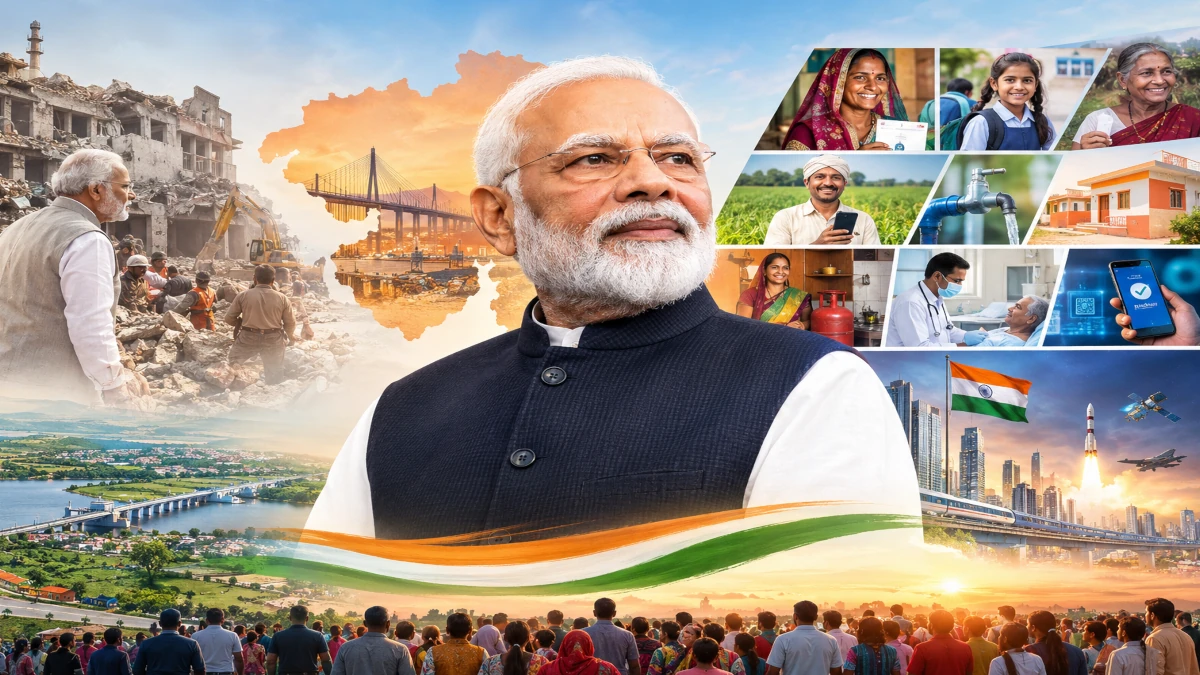
On October 7, 2001, Narendra Modi took oath as Gujarat’s Chief Minister. On May 26, 2014, he moved to the national stage as Prime Minister. Twenty-five years later, his political journey has travelled from earthquake reconstruction in Gujarat to an expansive national agenda encompassing sanitation, banking, healthcare, housing, drinking water, digital payments, infrastructure, defence and India’s global ambitions.
The Seva Sankalp Abhiyan, scheduled nationwide from September 17 to October 17, 2026, is being presented as a month-long celebration of 25 years of public service and, more importantly, as a mobilisation around the next national goal of Viksit Bharat 2047.
The campaign will travel from states and Union Territories to districts, Lok Sabha and Assembly constituencies and down to the booth level, bringing the government’s welfare programmes, development story and larger national resolve directly before citizens.
Twenty-five years have passed. The journey is not over.
From taking the oath in Gujarat in 2001 for the first time to leading India towards a visionary future in 2026, trace 25 years of PM Modi’s unwavering dedication, decisive leadership and transformative governance.
Swipe through pivotal moments of service, from initiatives like… pic.twitter.com/s5koiinSc6
— BJP (@BJP4India) September 13, 2026
From earthquake rubble to the Gujarat model
Modi’s first defining administrative challenge came almost immediately. When he assumed office in Gujarat in 2001, the state was still dealing with the devastation caused by the Bhuj earthquake. Reconstruction became an early test of his administration’s ability to act under pressure.
The years that followed saw a strong emphasis on electricity, irrigation, water conservation, agriculture, infrastructure and investment.
Jyotigram Yojana became associated with efforts to improve rural electricity supply. Water management and agricultural initiatives were pushed aggressively, while the Vibrant Gujarat Summit was developed as a platform to attract investment and project the state as an emerging economic destination.
Supporters began referring to this combination of infrastructure, investment, administrative efficiency and service delivery as the Gujarat model. By 2014, Modi was no longer merely presenting that model to investors and voters in Gujarat.
He was taking it to India.
2014: When governance became a national-scale experiment
The 2014 election marked the decisive transition. As Prime Minister, Modi’s government began rolling out a series of programmes aimed at bringing millions of citizens into formal systems of banking, sanitation, healthcare, housing, digital services and social security.
Jan Dhan. Swachh Bharat. Ujjwala. Ayushman Bharat. Digital India. PM-Kisan. Jal Jeevan Mission. Mudra. Startup India. PM Awas. The list is long, but the underlying philosophy is consistent: identify problems affecting ordinary citizens and build delivery systems capable of reaching the last mile.
That is the foundation on which the Seva Sankalp Abhiyan is building its narrative.
Jan Dhan: Banking the excluded
The Pradhan Mantri Jan Dhan Yojana, launched in 2014, has grown from 14.72 crore accounts in 2015 to 59.09 crore accounts by August 19, 2026, according to the figures cited in the campaign material.
Nearly 46 crore accounts are in rural and semi-urban areas, while women account for more than 32.9 crore of the total accounts. Deposits have risen from Rs 15,670 crore in March 2015 to Rs 3.16 lakh crore in August 2026.
This is not simply a banking statistic. For millions, the significance lies in having an account through which government assistance can be transferred directly, reducing dependence on layers of intermediaries.
Swachh Bharat: From toilets to dignity
Few Modi-era programmes have been as visible as Swachh Bharat. When the programme began in 2014, rural sanitation coverage stood at about 39 per cent. By 2019, the government reported 100 per cent rural sanitation coverage, following the construction of more than 10 crore individual household toilets during the first phase.
By March 2025, according to the figures cited in the campaign material, 5,86,788 villages had been covered, with more than 5.64 lakh villages declaring themselves ODF Plus.
The transformation being claimed is bigger than infrastructure. The argument is that sanitation moved from being treated as a peripheral development issue to becoming a national political priority and, crucially, a question of dignity.
Ayushman Bharat: When illness meets a safety net
Healthcare is where economic vulnerability becomes brutally personal. A medical emergency can wipe out years of household savings. Ayushman Bharat PM-JAY was designed to address precisely that vulnerability by providing cashless hospitalisation to eligible beneficiaries.
The programme’s original coverage of 10.74 crore families was subsequently expanded to 12 crore families, while additional groups were brought under its umbrella. The expansion to all citizens aged 70 and above has further widened its reach, covering around six crore senior citizens from 4.5 crore families.
As of June 30, 2026, the figures cited for the campaign record 29.05 lakh inter-state hospital admissions, involving expenditure of more than Rs 8,383 crore. The larger claim is simple: healthcare protection should not be a privilege reserved for those who can afford it.
Digital India: The middleman meets technology
If Jan Dhan created the account, Aadhaar created an identity layer and mobile connectivity created the channel, India’s digital public infrastructure connected the three. Under Digital India, government services increasingly moved online.
By January 2026, around 2.15 lakh Gram Panchayats had been connected under BharatNet, with nearly seven lakh kilometres of optical fibre laid. India had crossed 106 crore broadband subscribers by March 2026. Aadhaar enrolments had crossed 144 crore, while DigiLocker had more than 70 crore registered users.
And then came UPI.
More than 24,162 crore UPI transactions were recorded during 2025-26, according to the figures supplied in the campaign material. For the ordinary citizen, the revolution is often not ideological. It is practical. A payment that once required cash, a bank visit or paperwork can now be completed in seconds.
That is perhaps the most powerful form of governance: the kind that becomes invisible because it makes everyday life easier.
Water, housing, gas: Governance enters the household
The Modi government’s political vocabulary has increasingly shifted from broad development promises to the basic infrastructure of household life.
- Jal Jeevan Mission seeks to bring piped water to rural homes.
- Ujjwala targeted clean cooking fuel for women from poorer households.
- PM Awas Yojana seeks to provide permanent housing.
- Mudra was designed to provide credit to small entrepreneurs.
- Startup India sought to create an ecosystem in which young Indians could turn ideas into businesses.
Together, these programmes form the backbone of the government’s claim that welfare is no longer simply about subsidies, but about assets, access, infrastructure and opportunity.
Seva Sankalp: Taking the story to the last booth
This is where the Seva Sankalp Abhiyan acquires its real importance. The campaign is not designed merely to display government achievements on posters. It is structured around public participation and is intended to take the 25-year story of PM Modi’s public life directly to citizens.
September 17 will be observed as Seva Diwas, with blood donation drives, hospital outreach and other service activities. Families benefiting from government schemes are encouraged to light lamps at 7 pm.
Schools will host “India of My Dreams” painting programmes, while street theatre under “Namo Seva – Untold Stories” will seek to turn beneficiaries’ experiences into public narratives.
Anganwadi centres will become venues for “Angan Se Milan Seva”, focusing on children, women and communities.
The campaign will also feature Seva Ki Kahani, Seva Jyoti Kalash Yatra, the Vadnagar-to-Varanasi Yatra, Seva Setu, Colors of Seva, the Seva First Innovation Challenge and Good Governance Seva Dialogue. The objective is ambitious, take the 25-year story of Modi’s public life to every corner of the country.
From Seva to Sankalp
The symbolism of the campaign is deliberate.
September 17 is Narendra Modi’s birthday. October 7 marks 25 years since he first assumed the office of Chief Minister. October 17 brings the month-long Seva Sankalp Abhiyan to a close.
Between those dates lies a carefully constructed political narrative: 25 years of service, followed by a pledge for the next national transformation. The destination being projected is Viksit Bharat 2047 an India that seeks to become developed, self-reliant, economically powerful and globally influential by the centenary of independence.
Whether one agrees with every claim surrounding the Modi years is a matter for political debate. But the scale and continuity of his executive journey are difficult to ignore.
From Gujarat to Delhi.
From earthquake reconstruction to national transformation.
From Jan Dhan to UPI.
From Swachh Bharat to Jal Jeevan Mission.
From Ujjwala to Ayushman Bharat.
From state-level administration to global diplomacy.
The narrative begins with Gujarat in 2001, moves through reconstruction and development, reaches the national stage in 2014 and continues through the government’s second decade with programmes involving clean energy, infrastructure, welfare expansion, defence, space and digital public infrastructure.
On September 17, PM Modi turns 76. On October 7, his uninterrupted tenure as Gujarat Chief Minister and Prime Minister reaches the 25-year milestone.
The Seva Sankalp Abhiyan seeks to turn that milestone into a nationwide narrative one that asks citizens not merely to remember 25 years of political leadership, but to examine the changes that have reached their own homes.
Twenty-five years of power may make a political milestone. The real test of 25 years of “Janseva” is whether that power translated into visible change in the lives of the people.