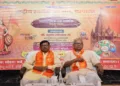
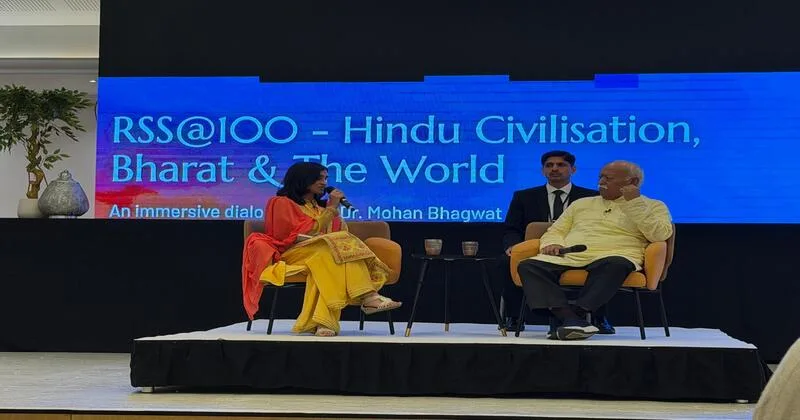
London: Different schools of thought emerged from Bharatvarsha, ranging from atheism to polytheism, while maintaining an attitude that different people may follow different paths said Rashtriya Swayamsevak Sangh (RSS) Sarsanghchalak Dr Mohan Bhagwat while addressing the ‘Celebration of Oneness’ event in London, United Kingdom on September 6, 2026.
The event, organised as an immersive dialogue with RSS Sarsanghchalak Dr Mohan Bhagwat, brought together members of the Hindu community and wider society to reflect on Bharat’s civilisational values, harmony and the message of unity.
The programme began with a moment of silence in memory of those who lost their lives and families displaced by the devastating floods in Nepal, followed by a homage through the chanting of the Shanti Mantra. Sewa UK has raised £100,000 through donations towards relief efforts in Nepal. The Dharma Group performed the melodious ‘Anekta Mein Ekyata’ mantra.
Responding to a question on what single element of the RSS has stood the test of time over the last century, Dr Bhagwat said that if he had to mention one principle, it would be the concept that is rooted in the traditional nature of Hindu thought.
He said Hindu thought is not limited to the individual but encompasses society, humanity and nature. “Hindus love nature, not only worship, they love nature,” he said, adding that this love forms the basis of unity and progress in character and quality.
He further said that this principle has remained the foundation on which the Sangh’s work has continued to stand. According to him, the same principle can be seen in the behaviour and atmosphere of the organisation even after 100 years.
Responding to a question on what Hindu civilisation brings to the world that is essential, particularly in the present turbulent times, Dr Bhagwat said that diversity is the nature of existence. He said Hindu thought accepts diversity while recognising that different forms are expressions of the underlying unity of existence. “One has become many, therefore there are perspectives,” he said, adding that people have to deal with diversity in practical life but should not consider different forms as separate. “We are one, all is one. On this basis, we deal with everything,” Dr Bhagwat said.
He said that this approach also provides a basis for managing conflicts. According to him, conflict can be managed more easily when people think in terms of a “win-win solution” rather than enmity or competition.
He explained that instead of thinking that one person should gain at the expense of another, people should consider what both sides need and work towards the progress of both.
Dr Bhagwat further said that humanity should not seek to conquer nature because human beings are themselves part of nature. Therefore, he said, human progress must contribute to the progress of nature. “Why should development and progress be at loggerheads? There should be complimentary,” he said, explaining that what is now described as “green solutions” seeks to provide solutions for human needs while also protecting nature.
He said the principle should not merely be “live and let live”, but to “let live and make others live”.
Dr Bhagwat said that Hindu thought provides a framework in which the individual, society, humanity and nature can progress together. He said modern thought processes often create a separation between individual rights and the interests of society. According to him, individual and society can instead progress together and contribute to each other’s progress.
He further said that humanity can progress alongside the protection of nature rather than through its destruction. “What is the connecting principle? That is the unity of existence,” he said, adding that Hindu thought uses different expressions for this underlying reality, including Brahma and Shunya.
Dr Bhagwat said that Hindu thought has firmly established this principle and translated it into practical life. “This we have to do. We have in us, we have translated into practical life and given this to the world. Once again, together we have to wake up and give these solutions,” he said.
Responding to a question on Hindu Rashtra and Hindutva, which he described as among the most discussed and least understood concepts, Dr Bhagwat said the basic message was: “Let’s live, let others live.”
He said that people have the ability to connect with others and enable them to live together.
Explaining the meaning of the word “Hindu”, Dr Bhagwat said it cannot be understood merely on the basis of a particular religious practice or lifestyle. He described Hindu as a nature of society that accepts and respects diversity because it holds that different paths can lead to the same goal.
He referred to the famous verse from the Shiv Mahima Stotra, saying that different tastes lead to different paths, but ultimately there is a single destination.
He said diversity is natural and there is no need to make society uniform. “Uniform is not necessary for unity. There is unity in diversity,” he said.
He further explained that diversity itself is diversity within an underlying unity. Therefore, when people recognise that unity, they can respect and accept diversity.
“That thought is Hindu thought. That kind of nature is Hindu nature. That has been history of Hindu society and Bharat,” Dr Bhagwat said.
He said that when the term Hindu is used in this context, it does not refer merely to a religion or a particular form of worship.
He noted that different schools of thought emerged from Bharatvarsha, ranging from atheism to polytheism, while maintaining an attitude that different people may follow different paths. “We need not convert each other. Only we are right, no. We are also right. You are also right. That attitude is Hindu,” he said.
He said this attitude cannot be restricted to a particular community, form of worship, food habits or lifestyle. According to Dr Bhagwat, a person can remain confident in and committed to his or her own path while recognising that another person’s path may also be right for them. “We can go together. We can work together. We can live together. And we should live together. That is the truth,” he said.
Explaining the concept of Rashtra, Dr Bhagwat said that the word “nation” should not be treated as a direct translation of Rashtra because the two represent different concepts.
He said a nation-state is formed when people come together on the basis of similarities such as language, a model of governance or religion and establish rules and institutions for their common good.
According to him, Rashtra is different because the state is not its primary component. “First there is a purpose,” he said.
Explaining the purpose of Hindu Rashtra, Dr Bhagwat said its objective was to share with the world the truth that diversity is natural and unity is the underlying reality.
He said this principle is beneficial for humanity because realisation of the Atman leads to lasting happiness and the experience of the unity of existence.
Dr Bhagwat said the Rishis of Bharat recognised this principle and believed that it should be shared with the world. He said this could not be the work of an individual or a small community, but required the creation and preparation of the entire nation for the larger task.
He referred to the Rishis as benevolent and well-meaning people who undertook rigorous penance and created the strength of the nation through their efforts.
He said that in the initial conception of Rashtra, a state was not necessary because society itself protected and supported its members. With changing circumstances, the state and the ruler became necessary.
Dr Bhagwat said that the people who shared a common purpose constituted society and, when connected with a particular land, became a Janapada. He said the land was an essential component, while other components could change over time.
“We were always there as a nation,” he said, explaining that Bharat had witnessed different forms of political organisation and governance.
At different times, he said, Bharat had a Chakravarti Samrat, Ganarajyas and periods of foreign rule. At other times, people remained engaged in struggles for independence. “Conditions changed. So Janapada, bhoomi is the Rashtra,” Dr Bhagwat said.
He explained that the purpose of the Rashtra was to lead a life that could inspire people in other nations to find ways of fulfilling the purpose of their own societies.
He said the civilisational idea was that Bharat should live in such a manner that people from other nations could look to its experience and derive from it a way to lead their own lives while fulfilling the purpose of their respective nations. “That is what we mean by Rashtra,” Dr Bhagwat said.
He said by noting that because of the historical experience associated with nationalism, there is a degree of apprehension about the concept of nationhood in the world, but the civilisational concept of Rashtra should be understood in its own context.
Responding to a question on what gives him the greatest hope that the present generation will carry forward the work begun by earlier generations, Dr Mohan Bhagwat said he is confident about future generations and their ability to contribute towards making the world a better place.
“I’m more confident about future generations. They have the urge to make world a better place. And they are ready to shed their petty differences of all kinds for this purpose,” he said.
Dr Bhagwat said that younger people are often more honest and willing to act when they believe something is right. He explained that as people grow older, they gain experience and consequently become more cautious about the possible consequences of their actions.
He said the responsibility of the older generation is to provide the younger generation with a clear purpose and the necessary information gained through experience, without imposing methods on them.
“Set the goal. Not the method. And let them do it,” Dr Bhagwat said, adding that the younger generation could achieve the desired objectives in a more beneficial manner and more quickly than previous generations.
Responding to a question on the responsibilities of British Hindus if British and Indian interests were ever to diverge, Dr Bhagwat said there should ordinarily be no conflict between the interests of Britain and Bharat.
“If British Hindus are good and true Hindus, there will never be a conflict between British and Bharat interests,” he said.
He added that if such a situation arose, British Hindus would naturally stand with Britain, which is their Karmabhoomi.
Dr Bhagwat explained that Karmabhoomi is the land where a person lives and where his or her loyalties lie, while Janmabhoomi refers to the land of birth or origin. According to him, the values received from one’s Janmabhoomi or Punyabhoomi should be lived out in one’s Karmabhoomi.
“Hindutva never asks to betray your Karmabhoomi. You are living there, you are earning there, you have to pay,” he said.
He further said that people should live the values they have received from their Janmabhoomi or Punyabhoomi fully and rightly in their Karmabhoomi so that humanity may benefit from them.
Responding to a question on how the Indian diaspora, particularly younger generations in the UK and across the Commonwealth, can translate the values of Vasudhaiva Kutumbakam, service and unity in diversity into practical economic, social and humanitarian partnerships, Dr Bhagwat said that such an approach was already emerging globally.
He said the world had already begun using concepts such as “global” and “one world”, with several initiatives moving in that direction.
Dr Bhagwat said members of the diaspora could remain honest to their Karmabhoomi and strengthen themselves to serve their Karmabhoomi as well as humanity.
“If you have spare means and spare time to serve Bharat, remaining loyal to Britain, nobody prevents you to do that,” he said.
He referred to the contemporary approach of “think globally, act locally”, saying that people can contribute to global service while remaining faithful to the country in which they live.
According to Dr Bhagwat, being faithful to one’s Karmabhoomi while thinking and acting as a global citizen is not a contradiction but a logical evolution of one’s thought.
He explained that an individual’s progress benefits the family, the family’s well-being benefits the locality, and this process continues to expand. “It is expected that if a nation benefits, whole world should benefit from its development,” he said.
Dr Bhagwat said that the older model of development also contained an understanding of the relationship between human beings and nature.
He recalled how children in Bharat were traditionally told not to touch trees after evening because trees were considered to be resting at that time. He noted that while scientific evidence for such practices was not available then, it is available today.
He also referred to festivals in which plants and animals are worshipped, saying that such worship was symbolic and intended to develop concern for the well-being of nature among children.
“The worship was symbolic. It was to develop a concern about wellbeing of the nature among children,” he said. Dr Bhagwat added that similar traditions may exist in different parts of the world and can serve as examples of ways to develop a concern for nature.
Sharing an experience from his work, Dr Bhagwat said that serving society does not require anything except the willingness to serve. “One experience to serve you do not need anything else except your will to serve,” he said.
He recalled an experience involving a hostel run in a forest area. A teenage boy from an interior village had come to a nearby block centre seeking employment. The boy was not literate and had very limited knowledge.
Dr Bhagwat said the boy searched for employment for three days but could not find a job. During this period, he stayed at the hostel with other boys from forest villages. On the third day, the boy approached the person supervising the hostel and explained that he had not been able to find employment but desperately needed work.
Dr Bhagwat recalled the boy telling the supervisor that he was willing to clean the place, bring water and cook, and requested employment there. The boy told the supervisor that he was ready to work without demanding payment. He was told that the hostel depended on donations and that even if they paid him, they would not be able to offer much. The boy, however, said that his needs were very limited and that he was willing to take whatever little amount could be given to him. Accordingly, he was offered Rs 30 per month.
Dr Bhagwat said the boy worked for four months, after which he was given Rs 120 as his four months’ payment. However, the boy returned the money. When he was told that the organisation could not pay him more and that he could leave if he did not wish to continue, he refused and said that he would work there without any payment.
Explaining the reason behind his decision, the boy pointed to a person working there who was called a Pracharak. Dr Bhagwat recalled that the boy said he could only sign his name and had very little education. He asked the Pracharak about his work and how much he was paid. When he was told that the Pracharak received nothing, he asked how he managed his family. The Pracharak replied that he had no family and had not married.
Dr Bhagwat said the boy then asked why the Pracharak was doing such work without receiving any payment. The answer he received was that “we are all society” and that the Pracharak was working for society.
Dr Bhagwat said the boy then began thinking about his own situation. He realised that although the Pracharak was an educated person from a well-to-do family and could serve the country, he too, despite not belonging to a well-to-do family, could serve the country. He therefore decided that he did not need payment and would continue working at the hostel.
Dr Bhagwat said the boy went on to work as a full-time for 15 years. Later, he was trained to drive and was given employment so that he could also take care of his family. “An ignorant boy also says, I can serve. And he serves,” Dr Bhagwat said, recalling the example.
He further narrated that one day, one of the great leaders of the country asked him how he remained inspired when, according to the leader, things around him appeared to be deteriorating and there seemed to be no role models or inspiring examples.
Dr Bhagwat said he responded that while others might see only such circumstances, he saw examples of service everywhere. Recalling the boy’s sacrifice, he said that if a person who had very limited means and was in dire need of livelihood could sacrifice his own desires and serve continuously for 15 years, it became an inspiration for others to do the same. “That is one of the inspirations for you,” Dr Bhagwat said, concluding the story.
Responding to the question on providing a practical model without changing the foundational principles, Dr Bhagwat said that the first principle of Seva should be to regard it as an opportunity to get nearer to God. “Actually, you are not doing something good to those whom you serve. They are doing immense good to you by giving you the chance to serve them,” Dr Bhagwat said, explaining that Seva should be undertaken with this attitude.
He referred to the teaching of Ramakrishna Paramahamsa to Swami Vivekananda and cited the principle, “Shiva bhave Jiva”. Dr Bhagwat recalled that during a discussion, Vivekananda was speaking about the plight of the Indian people and the work that needed to be done for them when Ramakrishna Paramahamsa interrupted him.
According to Dr Bhagwat, Ramakrishna Paramahamsa told Vivekananda that he was speaking as if he was doing something beneficial for the people and was at a higher level than those being served. He said this attitude was wrong and that one should see God in those whom one serves. “God is giving you a chance to wash your sins by serving them. Shiva bhave Jiva,” Dr Bhagwat said.
He further said that Seva should create a cycle of giving and receiving, where the person receiving help eventually becomes a giver himself. Referring to a Marathi poem, he explained the idea that the giver continues to give and the receiver continues to receive, until the receiver also takes from the giver and begins giving to others.
Dr Bhagwat said the idea was that the person to whom Seva is given should also eventually become a giver. “That type of Seva is necessary,” he said.
He further pointed out that there are many other concepts in Hindu thought relating to nature, individual conduct, family and society. These are old concepts, and old models are available, but they cannot simply be reproduced in their old form.
“We have to develop the model in conformity with the times,” Dr Bhagwat said, adding that this is where the younger generation has to take up the responsibility.
He emphasised that merely preaching these principles would not be enough. “We cannot only preach. We have to practise what we preach,” he said.
Dr Bhagwat said there are certain principles that are eternal and cannot be changed, while everything else should evolve according to the changing times. Therefore, there may appear to be a new model, but its basis would remain the same.
He said this approach would have to be applied to individual life, family life, occupations and professions, as well as social life. Such a model of life would then have to be presented to the world.
“That is the challenge Hindus have now. They have to face it and give the old tradition, the much-needed tradition, in a form adapted to modern times,” Dr Bhagwat said.
He said the younger generation, particularly those in their twenties, would have to take up this challenge. “We’ll have to give that challenge in the coming 10 years. They have to do it,” he said.
“We want to create that atmosphere which will propel the nation to the peak of glory,” he said.
He said the RSS is already working in many areas, adding that describing all its activities would require another evening of nearly two hours.
Dr Bhagwat requested that if literature about the RSS in Bharat, particularly regarding its Seva activities, was available, it could be provided to the audience.
He said there was hardly any field of activity where the RSS is not working. “Where reconstruction of that field is required, they are at the reconstruction. Where something additional contribution is required, they are doing that. And wherever whatever service is necessary, they are doing it,” he said.
“It has become their nature. We don’t have to tell them to do it. Whatever is needed, wherever it is needed, swayamsevaks start to work,” he said.
He said the immense spread and wide range of the work made it difficult to describe the activities in a few minutes. Summarising the work, he said that wherever it was necessary, swayamsevaks were working and that nothing had been left out. At the same time, he said, new requirements and new challenges continued to emerge, and the organisation would continue to work for the betterment of society.
Dr Bhagwat further said the RSS also works by networking with everyone, without quarrelling over banners or seeking credit. “Wherever others are doing, we help them. We keep them ahead. We let things happen in their name. Where nobody is doing anything, there we are doing it,” he said.
He said swayamsevaks were working for society across the country, “right from northeast to the west” and “right from Ladakh, Kashmir to Kanyakumari.”
“In every place you will find swayamsevaks working for the society,” Dr Bhagwat said. He added that a person who became a swayamsevak would find that he had relatives in every developmental block in Bharat whom he did not yet know.
Responding to the question, Dr Bhagwat said wisdom was derived from elders and that this tradition had to continue. Speaking about the next 100 years of the Sangh, he said the first thought that came to his mind was that it should not take as long to complete the work of organising society.
Explaining the meaning of organising society, he said it meant consolidating the power of society. People could work together while retaining their individual identities and continuing their respective ways, but they should cooperate with one another and should not become harmful to each other. “If they work in this way, then society will take care of everything else. This atmosphere we have to create,” Dr Bhagwat said.
He said the RSS is now in a position to help create such an atmosphere because it had gained acceptance across society. “Even those who are opposed to us, they know our worth and they know the usefulness of Sangh,” he said, adding that they did not hesitate to call upon the RSS when work was needed and also cooperated with it on crucial matters. That acceptance is there, Dr Bhagwat said.
He said the RSS is working towards bringing about such changes in people’s lives through two important approaches, including the concept of Panch Parivartan.
Explaining this, Dr Bhagwat spoke about social harmony and the role of the family. He said the family is the essence of society and had the responsibility of transmitting Sanskriti and Sanskar. The functions of the family, he said, should be performed properly.
He further emphasised the need to care for the environment, which would require changes in individual habits and restraint in personal conduct. While policies could change, he said, behavioural change among people was equally necessary.
Referring to simple environmental initiatives, Dr Bhagwat said, “Pani Bachao, Plastic Hatao, Ped Lagao.” He said every family and every individual should undertake these simple initiatives.
The next aspect, he said, is Swabodh: an understanding of who we are and taking pride in that identity, while simultaneously respecting who others are. Dr Bhagwat said this should be accompanied by self-sufficiency and a willingness to help one another, because society functions through interdependence.
He said nations today also depend on international trade and that this reality had to be taken into account. At the same time, societies and nations should remain self-sufficient while supporting interdependence and international trade.
Explaining the concept of Swadeshi, Dr Bhagwat said it did not mean keeping everyone else out. Rather, if a situation arose where there was nobody else to depend upon, one should have the capacity to remain self-sufficient. “That is Swadeshi,” he said.
The fifth aspect, he said, was civic discipline. Dr Bhagwat said these five initiatives had been taken up by swayamsevaks in their own lives and families and would now be taken to society.
He cited village development as one such area, saying that everyone was concerned about it and that there was cooperation rather than opposition. Similarly, he referred to Gauraksha in Bharat, saying that it was accepted by people across religions and that everyone could participate in such efforts.
Dr Bhagwat said that anyone who is honest and selflessly working for society, even without knowing the full form of RSS, would be considered cooperative by the organisation.
“This is our idea of uniting the whole society,” he said, adding that the entire society would not necessarily come to the Shakha ground. However, people could move together on the same path without pushing one another out.
“We will hold hands and together we will progress. That is our idea of an organised society,” Dr Bhagwat said.
He said building such an organised society would be the next leg of progress and should not take another 100 years.
600 people representing 326 organisations attended the Celebration of Oneness event in London. Members of the House of Lords, MPs from the House of Commons, Mayors, Councillors and community leaders were among those present at the event.
RSS Sarsanghchalak Dr Mohan Bhagwat’s ongoing three nation visit to USA, Canada and UK is focused on strengthening civilisational and cultural dialogue, fostering people-to-people relations and sharing the Rashtriya Swayamsevak Sangh’s century-long experience with the world.
The visit has generated significant enthusiasm among British Hindus, with several community and social organisations coming together to welcome the RSS Sarsanghchalak and participate in the engagements planned during his stay.
Notably, Dr Mohan Bhagwat’s visit to the United States and Canada witnessed major civilisational and interfaith engagements, with the RSS Sarsanghchalak addressing religious leaders at a Multifaith Leaders Meeting in New York and later more than 6,000 delegates representing over 250 organisations from 853 cities across 39 US states at the Universal Oneness Celebration at Madison Square Garden. In Canada, Dr Bhagwat addressed the ‘Hindu Vishva Bandhu’ gathering, which brought together over 2,000 delegates representing 175 organisations from all 10 Canadian provinces.
Earlier, while addressing the media in London on September 4, 2026, RSS Akhil Bharatiya Prachar Pramukh said, Dr Bhagwat Ji’s message is about uniting the world. He said this dialogue carries India’s larger message of ‘Vasudhaiva Kutumbakam’ – the world is a family.