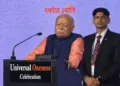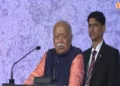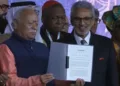
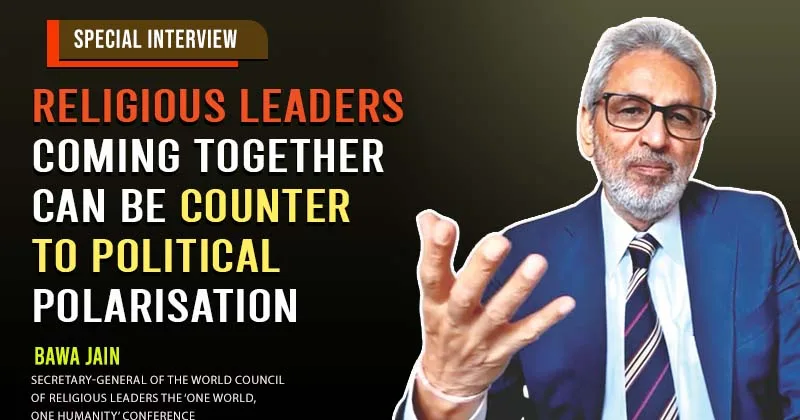
For Bawa Jain, a veteran of global interfaith dialogue, and as Secretary-General of the World Council of Religious Leaders the ‘One World, One Humanity’ conference in New York was different. In conversation with Organiser Editor Prafulla Ketkar, he discusses bringing RSS Sarsanghchalak Dr Mohan Bhagwat and leaders of diverse faiths together, the backlash some participants faced, the Janmabhoomi-Karmabhoomi message, and what must follow the New York declaration. Excerpts:
You founded the World Council of Religious Leaders and have been involved in such initiatives since the 2000s. But this particular event was very special. Why did you think of organising this event, and why do you consider it such a significant step forward?
When we talk about the ‘One World, One Humanity’ event, we are at a critical point in history. There is widespread despair and people have lost hope. It is the religious leaders, the moral conscience of the world, that people are looking up to.
About a year ago, I received a call regarding discussions around the centenary of the Rashtriya Swayamsevak Sangh. I like to work where there are fundamental challenges and differences. We know that over several decades there have been misunderstandings and misperceptions. So, when I was approached, I knew it would be challenging and had to be structured carefully. The motivation was to ask: what could be the direction for the next 100 years of the RSS?
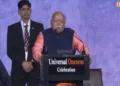
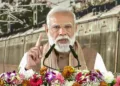
Read every word of his statement at the ‘One World, One Humanity’ conference and listen to what he said at Madison Square Garden. In my mind, he has charted a new way forward—a blueprint or road map for the next 100 years of the RSS.
But this has to be demonstrated through concrete action. That is why we called our document a “Call to Action”. It cannot remain a collection of platitudes. We need on-the-ground evidence of efforts being made.
Hindus, Muslims and Christians together represent billions of people. What could be bigger than bringing these communities into constructive dialogue? We are one world, one humanity and one family. There will be doubters and naysayers, but that only increases our responsibility to demonstrate through action what we declared in New York.
How difficult was it to bring leaders of different faiths onto one platform knowing that Dr Mohan Bhagwat and the RSS would be there? Did Christians, Jews, Muslims and leaders of other faiths have reservations?
We have been fortunate to build trust with communities around the world over a long period. Dr Bhagwat is not a religious leader in the conventional sense, but in terms of influence and dialogue among Hindus, there are very few people or organisations with comparable reach.
There certainly were reservations. That is why I said we stirred up a storm. There were people protesting outside Madison Square Garden. The inter-faith event itself was closed to the media because we wanted an honest conversation. I told the religious leaders: come, have a conversation and see for yourself.
Some who attended subsequently received enormous backlash from their own communities. One leader faced such a backlash that she publicly expressed regret over attending. For me, that itself demonstrates why this work needs to be done. It reinforces my conviction that these leaders need to be brought together and a conversation must begin. The real proof will come when RSS karyakartas translate into action what Sarsanghchalak ji stated. As I said in the Call to Action: unity does not require conformity. Let us start a dialogue.
The idea that everybody has a right to follow his or her own path while pursuing the same Divine is essentially associated with Hindu thought. How did this conversation evolve?
We have to be very careful about words. I would not use the word “accommodate”. We must move from accommodation towards mutual respect—not merely tolerance, but acceptance and respect for different ways of worship. I have to confess that the word “tolerance” irks me. At this stage in human history, is it enough merely to tolerate each other? We have to develop respect and understanding. I think Dr Mohan Bhagwat demonstrated that by coming here. There were threats, and I applaud the courage of the leaders who participated. They wanted to see for themselves whether this initiative was real and genuine. We did not ask anybody to submit a script. We told everyone: speak what you feel. This is an open platform; let us have an honest and difficult conversation. That created trust because people knew we were not trying to censor them or control the narrative.
Sometimes inter-faith dialogue can appear to be a superficial display of harmony. Radical terrorism is a reality. So, when religious leaders say they do not believe in binaries such as believer and non-believer, that God is one for everybody and humanity is one, does that require them to compromise their fundamentals? How can these ideas actually be translated into reality?
We have to be honest and examine our practices and what has happened in the past. At the same time, we must respect the right of every religion to practise its faith honestly. Our allegiance must always be to the country in which we live. That is fundamental to being a citizen. But if wrongs exist within communities, those have to be addressed rather than suppressed.
That is why what Sarsanghchalak ji said about Janmabhoomi and Karmabhoomi was so profound and clear. If I am living in America and I do not have allegiance to America, why should America trust me as its citizen? The same principle applies everywhere.
How did the presence of the RSS Sarsanghchalak at this inter-faith dialogue make this particular event different from your previous efforts?
Initially, it was not even clear whether he would come. I did not know what he would say. But I wanted to explore whether this extending hand for conversation represented the beginning of a new dialogue and direction as the RSS entered its centenary. The RSS is often at the centre of perceptions and challenges. So let us sit down and confront the issue. The potential of what we started here is enormous. The challenge now is to structure it, address the connections between geopolitical questions and religious perceptions or misperceptions, and initiate honest conversations.
The world is facing wars and confrontations on several fronts, sanctions, tariffs and a retreat from the earlier model of globalisation towards new forms of multipolarity. Dr Mohan Bhagwat said that we need to realise the unity of existence while celebrating, accepting and respecting diversity. How can this vision be translated into an institutional framework capable of responding to global challenges?
We are not a political organisation, so I would not like to comment on the political issues. What we need to remember is, religious leaders transcend national boundaries and possess enormous influence. They do not have elected terms of two or four years; their influence transcends political cycles. If we can bring religious and faith leaders together and translate their commitments into action, they can influence society. August 29 was associated with the campaign against nuclear testing. We know the capacity of nuclear weapons to destroy humanity within seconds. But I would argue there is something even more dangerous: the systematic erosion of our humanity.In an environment of political polarisation, what is the counter? Religious leaders coming together and bringing their communities together can be part of that counter.