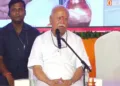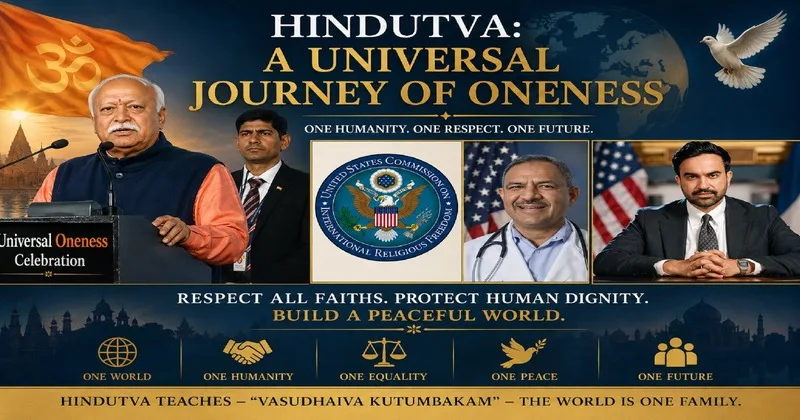
New York Mayor Zohran Mamdani and Asif Mahmood, Chairman of the US Commission on International Religious Freedom, had been vocal in opposing the visit and programme, yet from that very New York, Dr Mohan Rao Bhagwat, Sarsanghchalak of the Rashtriya Swayamsevak Sangh, delivered a message that was not confined to the boundaries of any one religion, sect or community.
Mamdani is the elected Mayor of New York, while Asif Mahmood is Chairman of the US Commission on International Religious Freedom (USCIRF). Along with the two, several organisations and groups had also been raising their voices in opposition to Bhagwat’s visit to the United States. Numerous baseless allegations were made, questions were raised about the RSS ideology and objections were voiced over the programme, but when Bhagwat spoke at Madison Square Garden, his words were “a proclamation of the Indian vision of connecting human beings with one another”.
In fact, the question now is whether those who view ‘Hindutva’ through the lens of division will understand the real message of this ‘Hindutva’ that emerged from New York? Because the very essence of the Hindu principle lies in knowing the inner self, which is all-pervading.
Massive!
People entering in huge numbers to listen to Sarsanghchalak Mohan Bhagwat ji.
Global Hindu Unity in United States of America! pic.twitter.com/hXImQjfWS2
— Pradeep Bhandari(प्रदीप भंडारी)🇮🇳 (@pradip103) August 29, 2026
At the ‘Universal Oneness Celebration’ held at Madison Square Garden, around 180 religious representatives from nearly 30 countries and thousands of Indian Americans were present. From the very platform over which objections had been raised, Bhagwat made ‘oneness’, meaning the unity of existence, the centrepiece of his address. The message was clear: people in the world may be different, their languages may be different, their nationalities may be different, their religions may be different, and their ways of life may be different, but erasing these diversities is not the Indian vision. Nor is it the Indian vision to deny the fundamental bond of humanity because of these differences. In reality, diversity is real, and unity is also real; therefore, carrying both together is India’s message and India’s vision.
Bhagwat first challenged the fundamental misconception in which the Indian concept of ‘dharma’ is equated with ‘religion’ in the Western sense. He said that dharma is not a religion or a matter of worship and rituals. It is far broader than that. It is the principle through which the order of the universe and life is sustained, and through which human beings establish balance amid the contradictions of life.
In fact, religion may represent an individual’s faith, method of worship and religious identity, but in Indian thought the scope of dharma is far broader. Dharma extends from an individual’s conduct to the organisation of society and the relationship with nature. Therefore, Bhagwat’s concept of dharma (Hindutva) does not speak of defeating another religion. It speaks of maintaining a balance between the individual, society and the environment.
Neither suppressing the individual for society, nor crushing society for the individual
Bhagwat also questioned a model of development in which the progress of one side depends upon the suppression of another. His position was that it is not necessary to suppress individuals for the progress of society, nor is it appropriate to weaken society for the success of an individual. The individual, society and environment must all move forward together. On one hand, social responsibility appears to be weakening in the name of individual freedom; on the other, there are attempts to restrict individual freedom in the name of collective identity. Bhagwat presented Indian ‘dharma’ as a principle of balance between these two extremes.
Immerse in the #UniversalOneness . A short video on the #RSS is being shown now. This will be followed by Pujaneeya Sarsanghchalak , Dr. Mohan ji Bhagwat's speech. Watch here: https://t.co/XbB5eXrbnP
— RSS (@RSSorg) August 29, 2026
What does Hindutva mean? The world heard it from New York
For a long time, Western political discourse has been shaped by various perceptions of Hindutva. It is often viewed through the framework of political majoritarianism, religious dominance or identity-based conflict. However, Bhagwat’s speech at Madison Square Garden presented a different ideological reading of Hindutva. Here, the message was not about excluding anyone, but about bringing everyone together. It was not about fearing diversity, but respecting it. It was not about abandoning one’s own faith, but respecting the faith of others. And it was not about imposing uniformity, but recognising the unity that exists within diversity. Bhagwat made it clear that unity does not mean becoming identical. In fact, understanding this distinction is essential.
Look at India, certainly, but in its civilisational role
Dr Bhagwat appeared to convey this very message to those opposed to India and Hindutva, such as New York Mayor Zohran Mamdani and Asif Mahmood, Chairman of the US Commission on International Religious Freedom: India should be viewed beyond merely being a geographical nation, in terms of its civilisational role. Just as every nation has a role, a message, a mission and a destiny, India’s role is to recognise the unity that exists amid the world’s diversities and, from time to time, remind humanity of it.
He also urged all the Indians present in the auditorium to demonstrate through their conduct how India has been fulfilling its civilisational role for centuries. In other words, the claim of Hindutva must be demonstrated not through words, but through conduct.
Swami Vivekananda said that every nation has a message to deliver, a mission to accomplish, and a destiny to fulfil. Bharat is there to realise, and from time to time make the world realise this unity in diversity. – Dr. Mohan ji Bhagwat at #UniversalOneness ;… pic.twitter.com/gwRAImPKgq
— RSS (@RSSorg) August 29, 2026
Life is beyond money, position and convenience
Here, Bhagwat did not reject material comfort and prosperity, but while highlighting their importance, he certainly emphasised the significance of giving artha and kama their place among the four purusharthas in Indian philosophy. His indication was that material achievements are not the ultimate destination of life. How much a person earns is not as important as how much of his earnings and capabilities he uses for others. In other words, the Indian measure of success is not merely accumulation, but sharing, spending for others and acting for the welfare of others. This outlook transforms an individual from a consumer into a responsible citizen.
A clear message to the Indian diaspora as well
Bhagwat told Indians settled in America that America is their karmabhoomi and that they have a responsibility towards it. A person who lives in America, works there and builds their life there should remain honest and committed to America. Their relationship with India is that of their janmabhoomi and the values and संस्कार they have received from it. If they wish to do something for India, they may do so, but the most important thing is to incorporate the values received from India into their own lives. This message is also significant because it speaks not of conflict between nations, but of a balance of responsibilities.
Now the question to Mamdani and Asif Mahmood
This is precisely where questions now arise, because the two, along with some other people and organisations, had been opposing the RSS Sarsanghchalak’s visit to the United States. Therefore, all of them must certainly be asked: if a platform had been used in the name of Hinduism to call for the elimination of another religion, the destruction of a community or the humiliation of another human being, then opposition would have been understandable. But here, what took place was something that humanity needs. So what will they learn from this?
RSS Sarasanghachalak Dr Mohan Bhagwat addressed historic convention of Universal Oneness Celebration at New York, USA. Over 6000 delegates from 39 states , 853 cities, 6000 delegates, 250+ students from various universities, 250 organisations from USA came together to celebrate… pic.twitter.com/q8rR9exnnQ
— Rajesh Padmar (@rajeshpadmar) August 30, 2026
What did Bhagwat say at Madison Square Garden? He said: respect diversity. He said: recognise unity. He said: move forward together with the individual, society and environment. He said: recognise the same existence within another person. He said: the purpose of human life is not merely to live for oneself, but also to serve others. He said: India’s message should reach the world not through preaching, but through one’s conduct. The question, therefore, is whether those who opposed it have truly embraced Bhagwat’s message.
Are they now prepared to accept that, in order to understand “Hindutva”, it is not appropriate to view it merely through a political, selfish and self-centred lens? Should they not accept its universality and its philosophy of the welfare of all?
A message of self-victory emerges from New York amid the challenges
Today, the world is struggling with growing conflicts in the name of religious identity. There are wars, displacement, prejudice, religious extremism, social polarisation and the spread of hatred through digital platforms. Certainly, at such a time, Bhagwat’s message emerges as a challenge to all these crises. This is not a challenge to prove one religion superior to another. It is a challenge to the mindset that confines human beings within their sectarian or religious identity.
India says: identities may be different, but existence is not. Methods of worship may be different, but humanity is not. Languages may be different, but sensitivity is not. Ways of life may be different, but the fundamental truth of being human is not, and this is ‘oneness’. In fact, from Madison Square Garden, Bhagwat placed this very Indian vision before the world. Amid slogans of opposition, he responded to confrontation by placing the idea of unity before division.
‘Bharat’s destiny is to share the message of oneness and dharma with the World’: RSS Sarsanghchalak Dr Mohan Bhagwat in New York
via @eOrganiser https://t.co/4IzM0ir1i1
— Organiser Weekly (@eOrganiser) August 30, 2026
It must be said that this message has now emerged from New York. Whether Mamdani and Asif Mahmood choose to hear it or not may be their choice, but all those who agree with these two should remember that it is not possible to pass judgement on “Hindutva” without understanding Sanatan Hindu Dharma. Because Bhagwat has once again explained in New York, in relation to Hindutva, how “Hindutva” is an Indian vision that connects humanity, and this is the message that needs to be understood today from New York (US) to every capital of the world, every home and the heart of every human being. Certainly, it is within this very thought and philosophy that the welfare of the world lies.