-By Manoranjana Gupta in New York
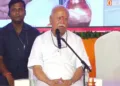
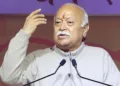
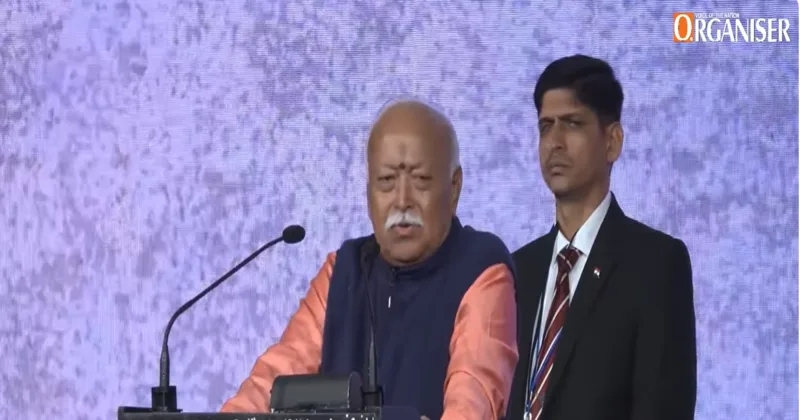
RSS Sarsanghchalak Dr Mohan Bhagwat told the Indian diaspora in America on August 29 that the United States was their “Karma Bhumi” and that their first obligation was to the country in which they lived and worked, making loyalty to America one of the most emphatic messages of his address at the Universal Oneness Celebration at Madison Square Garden in New York.
The declaration was greeted with thundering applause from the roughly 6,000 people gathered at the venue. Cheers and excited cries rose through the auditorium as Dr Bhagwat spoke of the responsibility of Indian Americans not merely to prosper in America, but to give back to the country that had become their Karma Bhumi. The warmth of the response continued after the address, as attendees gathered around to congratulate him and many spoke animatedly of the speech they had just heard.
“We are in America. We live in America. We earn in America. So we are Americans, and we should be true to America,” Dr Bhagwat said.
“The Bharatiya diaspora, they have a duty to their Karma Bhumi. They must fulfil that. They should be loyal to their Karma Bhumi.”
Bharat, he said, remained their Janmabhumi. But the two were not competing allegiances. The country in which the diaspora had built its homes, careers and futures commanded its civic loyalty; the civilisation from which it came asked something different of it.
“Your Janmabhumi expects you to live the values it has imparted on you,” he said.
It was arguably the sharpest news point of an address otherwise framed less in the vocabulary of politics than in the language of civilisation. After days of protests, demands for action against his visit and arguments over what the RSS represents in America, Dr Bhagwat had arrived at Madison Square Garden and told Indian Americans something strikingly unambiguous: be true to America, the land in which you live; carry Bharat through the values by which you live.
In that distinction between Karma Bhumi and Janmabhumi lay something larger than a diaspora homily. It offered an answer to an old immigrant anxiety—the imagined conflict between belonging and inheritance. One could belong completely to the land one had chosen without becoming culturally amnesiac about the civilisation from which one came.
And from there, Dr Bhagwat widened the argument.
“In America one word is discussed—pluralism. For Bharat it is unity in diversity, which is in our DNA,” he said.
Towards the conclusion came an even more distilled formulation:
“Diversity is natural, and unity is truth. That we must understand and shape our life according to this.”
Those two ideas—the duty owed to the land in which one lives and the unity underlying the apparently infinite differences between human beings—became the twin philosophical pillars of the evening.
When the setting became part of the statement
There are occasions when geography becomes argument.
Madison Square Garden is embedded in the mythology of modern America: prize fights and championships, rock concerts and political spectacles, celebrity and commerce, triumph and theatre. It is a place accustomed to noise.
On Saturday, into that unmistakably American space came a Sanskrit proposition several millennia older than the republic in which it was being uttered:
Vasudhaiva Kutumbakam.
The world is one family.
Long before Dr Bhagwat rose to speak, the stage had begun to illustrate the proposition. Performers brought traditions from India, China, Africa, Europe and the Middle East into the programme. Costumes changed, rhythms changed, movements changed. The audience remained one.
The mood was exuberant and, at moments, ecstatic. Phones rose above heads. Applause rolled through the auditorium as cultures separated by oceans and histories occupied the same stage without any one of them being required to disappear into another.
The spectacle supplied the colour. Dr Bhagwat supplied the grammar.
Oneness without sameness
There is a subtle but consequential distinction between celebrating diversity and understanding what lies beneath it.
The modern vocabulary of diversity usually begins by enumerating difference—race, religion, ethnicity, nationality, language and identity. The civilisational vocabulary Dr Bhagwat brought to New York began at the opposite end: with an underlying unity from which difference emerges.
Pluralism tells us that people who are different can live together. Vasudhaiva Kutumbakam goes further. It suggests that the stranger is not merely somebody whose difference must be tolerated, but a member of the same human family.
New York was an unusually appropriate city in which to make such an argument. Few places on earth have been so continuously created and recreated by people who arrived carrying elsewhere within them. Its neighbourhoods are repositories of remembered homelands; its streets speak in the accents of the world.
Dr Bhagwat’s proposition to such a city was therefore not that difference should disappear.
It was that difference need not divide.
“We are one, and due to diversity, that oneness is decorated,” he said.
The choice of words matters because the RSS is frequently interpreted outside Bharat principally through the vocabulary of nationalism, majoritarianism and exclusion. Its Sarsanghchalak chose one of the most visible platforms of his American visit to articulate a proposition that moved in another direction: confidence in one’s identity need not require the diminution of somebody else’s.
The argument was not: become like me.
It was: remain who you are, but recognise what connects us.
Dharma: A word lost in translation
Then Dr Bhagwat turned to a word the English language has spent generations translating inadequately.
Dharma.
“Dharma is not religion. It is not a worship. It is beyond all this,” he said.
He spoke of dharma as that which sustains—the principle that allows apparently competing elements of existence to remain in equilibrium rather than annihilate one another. Beneath it lay what he called the “oneness, unity of existence”.
There was more here than semantics.
For two centuries and more, Bharat has frequently been required to explain itself in categories created elsewhere: religion and secularism, majority and minority, Left and Right, liberal and conservative. These categories are not useless. But they are incomplete instruments with which to measure a civilisation whose intellectual vocabulary evolved through dharma, artha, kama, moksha, seva, samvad and kutumb.
Translation can illuminate. It can also diminish.
Dharma rendered simply as “religion” loses some of the philosophical universe the word carries within it, just as seva is not exhausted by “charity” and Vasudhaiva Kutumbakam says rather more than “global harmony”.
A civilisation of Bharat’s antiquity need not reject the vocabulary of the modern world. Neither need it forget its own.
When the stage became the argument
Some of the programme’s most eloquent moments required no speech at all.
Religious leaders appeared together in their distinctive robes and traditions. They did not pretend to share a theology. Nobody required them to.
That was precisely the point.
Oneness was not being demonstrated by erasing difference. It was being demonstrated by allowing difference to stand visibly within the same frame.
The interfaith component culminated in a call for religious and community leaders to move beyond dialogue towards practical responsibility—building relationships, serving communities and standing alongside one another.
And then came an extraordinarily simple gesture.
Rakhis had been placed for participants. People were encouraged to turn to those around them and tie the sacred thread of protection—sometimes upon the wrist of somebody they knew, sometimes upon that of a stranger.
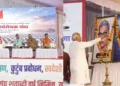
A rakhi was tied on Dr Bhagwat’s wrist on stage.
For a moment, an intimate Hindu ritual escaped the confines of family and familiarity and became a metaphor for something larger: responsibility for another human being.
“When you take the responsibility of others, it liberates you,” Dr Bhagwat said.
An ancient ritual had become a civic proposition.
Kunal Athreya: An American Generation Interprets Bharat
If the speech addressed the dilemmas of a diaspora, some of its most revealing responses came from those for whom America is not an adopted country at all.
Kunal Athreya is 31. He came to New Jersey at the age of four, was raised there and has already participated in American civic life, including contesting a local election.
He does not speak with the nostalgia of an immigrant remembering a homeland left behind. His is the voice of an American interpreting an inheritance.
“Beneath all our differences is one humanity, and we have to recognise the connections that bring us together,” Athreya told Organiser.
“I came to New Jersey at the age of four and was raised here, and for my generation of Hindu Americans, that message has a special meaning. Vasudhaiva Kutumbakam—the world is one family—is not simply an ancient Indian idea; it is something all of us need to follow in the world we live in today.”
There is an entire generational transition contained within those words.
The earliest Indian immigrants to America confronted the practical imperatives of arrival. Study. Work. Establish. Survive. Succeed.
They did so spectacularly.
They entered hospitals and universities, laboratories and boardrooms. They built businesses, professions, temples and homes. Their success is now woven deeply into the American story.
Their children inherit another question: once you no longer have to prove that you belong, what do you choose to remember?
Success is not the end of the story
Dr Bhagwat himself challenged one of the conventional measurements of immigrant accomplishment.
“How much we earn is not important. How much we distribute is important,” he said.
That sentence had particular resonance before an Indian-American audience whose educational, professional and economic achievements have become among the most conspicuous success stories of contemporary America.
He was not rejecting prosperity. Within the Bharatiya understanding of the Purusharthas, Artha and Kama have their legitimate place. The argument was instead about what comes after acquisition.
If the immigrant’s first journey is from insecurity to success, perhaps the next is from success to responsibility.
The farmer grows what somebody else eats. The worker produces what somebody else uses. The physician depends upon institutions others built. The entrepreneur operates within a society sustained by countless people whose names he will never know.
Prosperity, viewed through that prism, ceases to be entirely individual.
It acquires a debt—and therefore an obligation to give back.
Dr Bhagwat returned to the same idea when he told the diaspora that Bharat’s message should be conveyed “by their own example, not by preaching, by practice”.
Civilisational confidence, in that formulation, is not an advertisement for oneself. It is an obligation to make one’s professed values visible in one’s conduct.
Mahesh Kale: When Music Carries Memory
Civilisations do not travel only through organisations or philosophies.
They travel in ragas and recipes, in language and ritual, in gestures repeated without instruction and stories remembered long after their origins have been forgotten.
For acclaimed Hindustani classical vocalist Mahesh Kale, the idea of oneness therefore carries a resonance beyond politics.
“As an artist, I have always believed that music has the power to take us beyond the boundaries of language, geography and even belief, and remind us of the deeper human connection we share,” Kale told Organiser.
“That is why the idea of Vasudhaiva Kutumbakam resonates so strongly with me. For those of us who live in America while remaining deeply connected to India’s cultural and spiritual traditions, this message of universal oneness is especially meaningful. Our heritage gives us roots, but it also teaches us to open our hearts to the world.”
There is something particularly apt about a musician making that argument.
A raga requires no passport. A melody does not present itself at immigration.
It travels because somebody remembers it.
‘AHEAD’ and the Organisations behind the moment
Behind the extraordinary scale and pageantry of the Universal Oneness Celebration at Madison Square Garden stood AHEAD—American Hindus for Engagement and Dialogue—the principal organising body of the programme, supported by nearly 250 community, cultural and religious organisations and an extensive network of volunteers across the United States.
For Sudesh Agrawal of AHEAD, the emotion after the programme was difficult to conceal. Speaking to Organiser, Agrawal said he was ecstatic at the success of the gathering and believed it had created a historic first at precisely a moment when the world needed a renewed message of equality, unity and oneness.
What had been attempted at Madison Square Garden, he said, went beyond bringing thousands of people together beneath one roof. The purpose of the Universal Oneness Celebration was to demonstrate that communities could remain rooted in their own identities and traditions while recognising the deeper human unity that binds them together—a message he believed had acquired particular urgency in an increasingly divided world.
AHEAD did not undertake that effort alone. Nearly 250 organisations supported the initiative, bringing together community institutions, cultural groups, religious organisations and volunteers whose months of work culminated in Saturday’s gathering. Their representatives described not merely the mechanics of mounting an event of this scale, but the emotion within a community that increasingly sees no contradiction between its American citizenship and its Hindu civilisational inheritance.
A representative of the America India Friendship Council, which was actively involved with the gathering, described the mood in the community this way:
“There is a tremendous sense of excitement among Hindu Americans over Dr Mohan Bhagwat’s visit to New York. For many in the community, this is much more than an event—it is a moment of pride and connection with our civilisational roots. Hindu Americans have become an increasingly confident and successful part of American society, and there is a genuine feeling that our heritage, our values and our voice deserve to be celebrated openly and proudly in America.”
A representative of TV Asia placed the significance less in the scale of the gathering than in the symbolism of the setting itself:
“For American Hindus, to see the Sarsanghchalak of the RSS address a gathering at Madison Square Garden is a moment of enormous significance. MSG is one of the great public stages of America, and this moment tells our community that we no longer need to be hesitant about expressing who we are. We can be completely American and, at the same time, proudly Hindu and deeply connected to Bharat and its civilisational values. For generations of Hindus who have built their lives in this country, that is a powerful and emotional affirmation.”
A representative of Americans4Hindus framed the same moment through the language of democratic equality and the right of a community to speak in its own voice:
“Hindu Americans are proud Americans and proud inheritors of one of the world’s oldest civilisations. We seek no special privilege—only the same freedom, dignity and democratic space that America promises every community. Dr Mohan Bhagwat’s presence in New York should be seen in that spirit: the right to speak, the right to be heard, and the right to define our own identity rather than have others define it for us. Dialogue, not demonisation, is the American way.”
Taken together, those reactions captured an important current beneath the evening. Hindu Americans were not asking to occupy a space outside American society. They were asserting their right to participate fully within it without being required to conceal the civilisation from which they came. The demand was not immunity from criticism. It was equality within the conversation.
SANJANAA: Twenty-one, American and deeply rooted
Much later in the story of the evening comes another young voice, and perhaps one of its most affecting.
Sanjanaa is 21.
She was born and raised on America’s East Coast. She is a Bharatanatyam dancer. She learnt Hindi and speaks it fluently. Her parents ensured that the civilisation from which their family came was not reduced to a collection of festivals observed occasionally or rituals performed without understanding.
It became something to know.
Her story unsettles the familiar assumption that cultural inheritance inevitably grows thinner with every generation removed from the homeland.
Sometimes distance produces forgetting.
Sometimes it produces hunger.
“I was born and raised here on the East Coast, but being so far away from Bharat has never made me feel distant from our culture. If anything, it has made me want to understand it more deeply,” Sanjanaa told Organiser.
“I learnt Bharatanatyam, I learnt Hindi and I speak it fluently, and my parents made sure that our traditions were not simply things we observed on special occasions but something we understood and lived. Sometimes I feel that those of us growing up outside India make an even more conscious effort to know where we come from, and perhaps because of that we can end up knowing our traditions as deeply as many young people growing up in India.”
For Sanjanaa, Madison Square Garden brought those strands of identity together.
“Sitting through the programme at Madison Square Garden today, watching so many cultures and faiths come together around the idea of oneness, made me feel incredibly proud and connected,” she said.
“At 21, to be able to experience something like this in the country where I was born and raised, while celebrating a civilisation and culture that are such an important part of who I am, was very special. I was genuinely thrilled to be there and to be part of it.”
Perhaps there, in the words of a 21-year-old American, lies one of the less noticed stories of the Hindu diaspora.
Inheritance does not invariably weaken with distance.
Sometimes distance makes inheritance conscious.
Another conversation, earlier in New York
Before Dr Bhagwat came to Madison Square Garden, another conversation had taken place in New York in the early hours of the day. At an interfaith meeting held ahead of the Universal Oneness Celebration, he addressed more directly a question that has long accompanied arguments over the meaning of Hindu Rashtra and the place of Muslims in Bharat.
It was at that earlier interfaith meeting—not during the Madison Square Garden address—that Dr Bhagwat recalled an exchange in which he had said that if any Hindu believed there should be no Muslims in Bharat, “he will not remain Hindu”.
The distinction of time and venue is important. The remark belonged to the interfaith engagement earlier in the day, before Dr Bhagwat arrived at MSG. But philosophically it formed part of the same continuum that would later run through his address on oneness, dharma and unity in diversity.
If Vasudhaiva Kutumbakam is to possess meaning beyond civilisational ornament, the world-as-family must include those who worship differently, believe differently or do not share the majority’s historical memory.
Confidence is easily proclaimed among one’s own. Its more difficult measure is the space one leaves for the other.
A Sangh entering its second century
There was another historical resonance to Saturday.
The RSS, founded in Nagpur in 1925, is entering its second century.
The world into which it does so bears little resemblance to the world of its birth. Bharat occupies a larger geopolitical and economic space. Its diaspora is no longer transient. Hindu temples have entered the landscape of American suburbs. Sanskrit shlokas are recited by children who speak English in unmistakably American accents.
The Sangh therefore encounters a question that every civilisation eventually confronts when it travels:
Can an idea remain rooted without remaining geographically confined?
For younger Hindu Americans, inherited concepts will endure only if they can speak to the society in which those Americans actually live.
Vasudhaiva Kutumbakam possesses that portability.
It requires no passport.
Nor does Karma Bhumi.
Indeed, Dr Bhagwat’s formulation may ultimately prove the more immediately consequential of the two for the diaspora. It allows an Indian American to say without contradiction: this is the civilisation from which I come, but this is the country to which I owe my civic duty.
Roots need not become chains.
They can become anchors.
Outside Another America Spoke
The argument over the RSS did not disappear at the doors of Madison Square Garden.
Groups opposed to the Sangh demonstrated outside, continuing protests and political objections that had preceded Dr Bhagwat’s appearance.
That, too, was America.
The protesters possessed the right to oppose him. Those inside possessed the right to hear him. The allegations made by groups protesting against the RSS remain allegations and should be reported as such; equally, an organisation as consequential as the RSS cannot reasonably expect exemption from scrutiny.
Its history will be debated. Its politics will be contested. Its influence will be examined.
But something changed on Saturday.
Dr Bhagwat’s own propositions entered the American record.
They may be tested against history. They may be interrogated against practice. They may be challenged politically.
But they cannot fairly be replaced by somebody else’s description of what he believes without reference to what he actually said.
Speech does not end argument.
It makes caricature harder.
Not Less American for being more Hindu
Perhaps this is where the larger significance of the evening resides.
For generations, the immigrant bargain was frequently imagined as subtraction: to become more American was, slowly and imperceptibly, to become less of whatever one had been before.
But mature immigrant societies discover something more complicated.
Identity need not be arithmetic.
The Hindu American does not necessarily become less American by knowing Sanskrit, practising Bharatanatyam, visiting a temple, listening to a raga or regarding Bharat as a civilisational inheritance.
Nor does attachment to Bharat absolve an American citizen from obligations to America.
Dr Bhagwat’s Karma Bhumi formulation placed those propositions alongside each other.
America is where you live. Be true to it.
Bharat is where an inheritance came from. Live its values.
Not divided loyalty.
Layered belonging.
That is a considerably more sophisticated proposition than the binary vocabulary through which diasporas are so often judged.
When the lights came down
Eventually, the dancers left the stage.
The religious leaders departed.
The applause faded.
People spilled back into Manhattan carrying phones filled with photographs and fragments of speeches, greetings exchanged, rakhis tied, memories made.
Madison Square Garden returned to its ordinary American life.
But something of the evening lingered.
Not simply because thousands had gathered beneath one roof. Numbers impress for a day and then surrender to larger numbers.
What mattered more was the conversation that had occurred inside.
An RSS Sarsanghchalak had come to America and told the diaspora that America was its Karma Bhumi and therefore commanded its first obligation.
He had spoken of Bharat not as a competing political allegiance, but as a Janmabhumi whose values should travel in the conduct of its people.
A 31-year-old raised in New Jersey had spoken of one humanity.
A musician had described an inheritance that gives roots while opening the heart to the world.
A 21-year-old Bharatanatyam dancer, born and raised on America’s East Coast and fluent in Hindi, had spoken of choosing consciously to know a civilisation she had inherited across an ocean.
Outside, protesters exercised their freedom to disagree.
Inside, thousands exercised their freedom to listen.
And above the contest of politics and identity remained Dr Bhagwat’s simplest formulation:
“Diversity is natural, and unity is truth.”
Perhaps that was the real journey made on Saturday.
Not merely the journey of an RSS chief from Bharat to New York. Not merely the journey of an Upanishadic phrase across an ocean.
It was the journey of a community from immigrant achievement towards civilisational self-possession—from having established its place in America to becoming sufficiently secure in that place to speak of where it came from.
The world, the sages of the Maha Upanishad declared centuries ago, is one family.
At Madison Square Garden, that ancient proposition encountered a thoroughly modern reality: that one can inherit one civilisation, belong completely to another nation, and diminish neither.
The ocean, after all, separates lands. It need not separate inheritances.