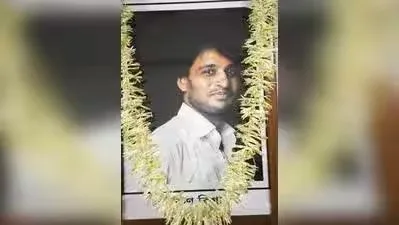
For many Indians, Teachers’ Day is associated with classrooms, lessons and the quiet influence of educators who shape generations. But the story of Barun Biswas offers a very different picture of what a teacher can become when the society around him is gripped by fear.
Biswas was a schoolteacher in West Bengal who stepped beyond the classroom to challenge an organised criminal gang that had turned Sutia, in Gaighata block of North 24 Parganas district, into a place where women lived under constant fear of sexual violence, while residents faced murder, extortion and threats.
The period was the early 2000s, when West Bengal was governed by the Communist Party of India (Marxist)-led Left Front under Chief Minister Buddhadeb Bhattacharjee. According to accounts cited in the supplied material, a criminal network headed by Sushanta Chowdhury operated in and around Sutia and surrounding hamlets.
For years, fear prevented many victims from approaching the authorities. Allegations later documented in court and media reports described a pattern of sexual violence, intimidation and extortion. The supplied material says at least 33 rape cases and 12 murders were officially recorded, while the actual number was believed by local residents and activists to be considerably higher.
The allegations were not limited to individual attacks. The gang was accused of using sexual violence and threats as instruments of control, creating an atmosphere in which families feared that resistance could make them targets.
A village living under fear
The accounts left behind by women from Sutia reveal the extent of the terror they experienced.
One survivor, who was 13 when she was assaulted, recalled how armed men entered her home and raped her while her parents were threatened at gunpoint. Another woman described being sexually assaulted after being taken to an isolated location and subsequently being abducted again by members of the gang.
In another case cited in the source material, a family had refused an alleged extortion demand after beginning construction of a permanent house. The gang subsequently attacked the family, and the daughter was sexually assaulted while her father and siblings were threatened.
Such accounts help explain why residents were reluctant to intervene. Families feared that confronting the perpetrators could expose not just one individual but every woman and girl in the household to retaliation.
The allegations also included the use of photographs and videos to blackmail victims. According to the material, several women were subjected to repeated assaults and intimidation, while some families were forced to leave the area.
The result was a community in which ordinary mechanisms of protection appeared to have broken down.
Sutia eventually acquired the grim description of a “rape village”, a label that reflected the scale of the allegations and the sense of helplessness among residents.
Allegations of political patronage
The criminal gang’s alleged links with political figures became another important part of the Sutia story.
The supplied material states that the gang was believed to have enjoyed political connections and alleged patronage from sections of the local Communist Party of India (Marxist) leadership. Such allegations helped deepen the perception among residents that approaching the authorities would not necessarily result in protection.
The allegations of political patronage are part of the wider history surrounding the Sutia cases and should be distinguished from findings against individual political figures. The source material itself describes the alleged links and subsequent political controversy, rather than establishing collective criminal responsibility of the political party or government.
What is clear from the accounts is that many residents believed the criminals had become powerful enough to operate with impunity.
And that was the environment in which Barun Biswas decided to act.
Barun Biswas refuses to remain silent
Biswas was in his late twenties when he emerged as one of the most prominent voices challenging the gang.
In 2002, he and others established the Sutia Pratibad Mancha, a platform intended to support victims and mobilise residents against the criminal network.
For a community accustomed to silence, the formation of such a platform was significant.
Biswas did not present the issue merely as a political confrontation. He framed it as a question of society’s collective responsibility towards women.
His appeal was simple: if a community could not protect its daughters, sisters, wives and mothers, then it had failed in its most basic duty.
He urged local residents to overcome their fear and stand together against the perpetrators.
The young teacher reportedly carried writings of Ramakrishna Paramahansa during his campaign. His activism gradually helped transform scattered anger and private suffering into a more organised public movement.
The gang begins to lose its grip
The mobilisation around Sutia eventually gathered enough momentum to put pressure on the criminal network.
According to the supplied account, Sushanta Chowdhury and several of his associates eventually surrendered.
Biswas even reportedly handed Chowdhury a copy of Ramakrishna’s writings when he was sent to jail, telling him to read them while incarcerated.
The moment symbolised the unusual character of Biswas’ campaign. He had confronted men accused of brutal crimes, yet his response was not driven solely by revenge. His larger objective was to restore a sense of courage and collective responsibility in a community that had been terrorised for years.
But the victory was not without consequences.
The teacher who became a target
A decade after the formation of the protest movement, Barun Biswas was murdered.
On July 5, 2012, he was returning from school when he was shot dead after exiting a railway station.
His killing sent shockwaves through Sutia.
For the women who had come to regard him as a protector and confidant, the loss was especially devastating. They reportedly called him “Barun Kaku”, an affectionate term that reflected the trust he had earned during his campaign.
The killing also raised immediate questions about whether it was connected to his confrontation with the criminal network.
Investigators arrested several people in connection with the murder. According to the supplied material, one of the accused, Subhankar Biswas alias Fotke, told police that the order to eliminate Barun had come from Sushanta Chowdhury, who was then in Dum Dum Central Jail.
The investigation reportedly led police from Habra, Gaighata and Gopal Nagar to arrest five people, including Fotke.
The account presented in the source material says that the killers had monitored Biswas before carrying out the attack.
A father’s allegation decades later
The controversy surrounding Barun Biswas’ murder did not end with the arrests.
In 2026, his father, Jagadish Biswas, reportedly named former West Bengal minister and former Trinamool Congress leader Jyotipriya Mallick, popularly known as Balu, among those he suspected of having a role in the murder.
The allegation is a serious one and remains an allegation. Biswas’ family has also criticised the investigation, describing it as a “farce in the name of investigation” and maintaining that justice has not been delivered.
Any assessment of the allegation must therefore distinguish between the family’s claims and legally established findings.
What happened to Sushanta Chowdhury?
The criminal cases against Sushanta Chowdhury continued after the gang’s activities came to light.
According to the supplied material, Chowdhury faced dozens of cases involving rape, murder and extortion and received life sentences in at least 16 cases.
He was also charged in connection with Barun Biswas’ murder.
The source material states that Chowdhury and associates including Anish Majumdar and Bireswar Dhali were among the prominent members of the group who remained behind bars.
In another significant case, Judge Debiprasad De reportedly found Chowdhury, Ripon Biswas and Ramesh Majumder guilty of raping 19 women. The men were also accused of photographing victims and subsequently using the material for blackmail.
The first formal complaint in that particular case was reportedly filed by Bijoli Mondal, who accused the three men of sexually assaulting her in a classroom.
Several other accomplices also received prison sentences, while two fugitives were sentenced in absentia.
Chowdhury later developed serious health problems while in custody. He was moved between hospitals after suffering from septicaemia and heart-related complications and died in 2014.
How the Sutia terror finally came to an end
The horror in Sutia had lasted for years before the criminal network was substantially dismantled.
The supplied material notes that local NGOs and volunteer organisations had brought the issue to the attention of the West Bengal State Women’s Commission in September 2001. A commission team headed by its chairperson subsequently visited Sutia on August 15, 2002, and met victims.
The intervention by activists, women’s groups, residents and the legal system eventually brought greater attention to crimes that had remained largely hidden behind fear.
But the story of Sutia is not simply about a criminal gang.
It is also about what happens when victims lose faith in institutions meant to protect them — and about the consequences when ordinary citizens decide that remaining silent is no longer an option.
Barun Biswas’ legacy
A Bengali film, “Proloy”, released in 2013, was inspired by Barun Biswas’ life and struggle.
But his legacy goes beyond a film or a memorial.
Barun Biswas was a teacher who saw that education could not be confined to a classroom when people in his own community were living under terror. He used his position, his voice and his courage to bring victims together and challenge people who appeared to believe that fear would keep them silent forever.
The women of Sutia had lived through some of the most horrific experiences imaginable. Many had been too frightened to speak. Biswas helped give their suffering a public voice.
His murder demonstrated the risks involved in challenging entrenched criminal power. Yet it also ensured that his name became permanently associated with the resistance against the Sutia gang.
The story of Sutia remains a troubling chapter in West Bengal’s political and criminal history. It raises difficult questions about the responsibilities of governments, police forces, political organisations and communities when organised crime begins to operate through fear.
Most importantly, it serves as a reminder that behind every statistic in a criminal case are people whose lives can be permanently altered by violence.
For Sutia’s women, Barun Biswas was not simply a schoolteacher.
He was the man who stood with them when much of the community was afraid to speak and who ultimately paid with his life for refusing to look away.