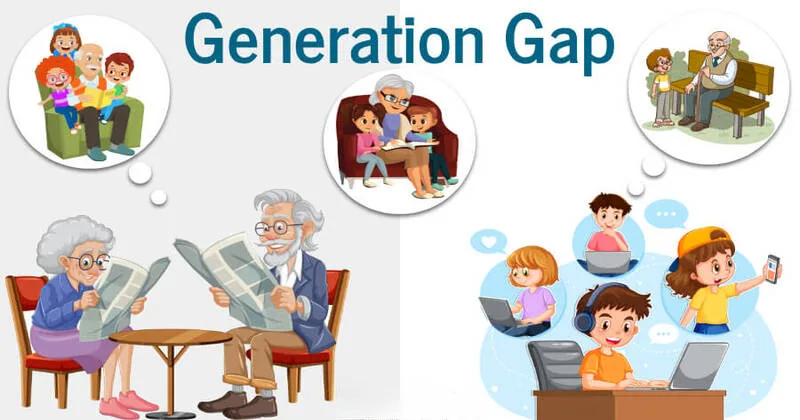
Generation gap is a problem which has become more acute and grave of late. In the current age of electronic and communication devices and in this professedly super age of Artificial Intelligence, human relationships are getting weaker and fragile. Generation gap, that distance between the understanding level of the younger and elder folks is increasing.
We have high-tech educational kits, more algorithms and apps for pedagogy and advanced presentation. But we find it increasingly difficult to convey and convince the younger on a host of subjects drawn from our culture and tradition. For example, we simply fail to drive down in the minds of the youth the age-old concepts of Dharma and joint family virtues, the importance of God and theism, the significance of festivals etc.
We often fail to understand why the younger generation thinks the way it does. We often overlook the fact that we were also quarrelling with our parents when we were young. We forget that we used to get sick of their frequent advisories, instructions or admonitions. We often complained that our parents were too orthodox and rigid.
But past the age of 55 or 60, we remember and recount the above things differently. Now we recall our fathers’ sane advices at the right time that saved us from disaster. Now we fondly remember how our parents’ instructions during those crisis times were so correct but only we failed to heed them and landed into problems. Yes, we now do understand the problems which they could foresee but we couldn’t.
The generation gap is a natural phenomenon. It is a part and parcel of life. Knowledge, understanding and experience are three entirely different things. You can add a fourth item to these—information. Information will come even before knowledge in their sequence because information is just a collection of ideas which could be verified or conjectured. They could be factual or unreal.
The present is the Information Age. Information technology has swamped our mental spaces. Bytes of information stored in computer hardware memory chips are loose strands of ideas based on thoughts, opinions or observations which could be correct or incorrect. They could be factual or fictional. Today, knowledge, understanding and experience stand relegated to background in the face of information blitzkrieg. This situation has increased generation gap and exacerbated problems stemming from it.
Life evolves through experience and it is experiential knowledge which drives the human individual forward on the progress path. Experience is gained through action and results thereof which means experience has time and space as its bases. There is no substitute for experience. It comes the hard way.
The above lines do explain generation gap but also throw light on the importance of bridging it. The erosion of the joint family system over the last few decades is an important reason for the widening generation gap. Reversion to and restoration of the joint family system holds the key to the solution. Grandparents, parents and members living under the same roof make a great mini environment for knowledge sharing based on traditional, familial values and experience of elders.
Information overflow and overload is a great culprit too. Too much information, much of it incoherent and incongruous has left the youth of today a confused lot. The loose and diffused strands of information downloaded from the internet do create loss of clarity in the minds of the impressionable youngsters. Information overflow needs to be drastically reduced. It is becoming almost a scourge of the modern times.
Here it must be stated that some of the elder folks too are biased and out of tune with the reality of the contemporary world where the youngsters are closely belonging. In line with the needs of the times, the younger generation thinks more logically and scientifically. It has grown past casteism, superstition and religious bigotry, while some of their elders are still entrenched in them. Such persons need to change their mindsets and come in sync with the modern age realities.
Last but not the least, acculturation of the youngsters right from the tender age onwards holds importance. Eternal values of family life drawn from the timeless Vedic scriptural texts should be imparted to the children at home and at school. Indoctrination creates enduring impressions that last a lifetime.
Increasing generation gap is a symptom of the rapidly evolving 21st century society. Bridging this gap is the responsibility of those who are in the political, economic, cultural or media domain. Moreover, it needs a realistic and level-headed approach for a more peaceful and progressive future of the global society.