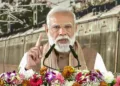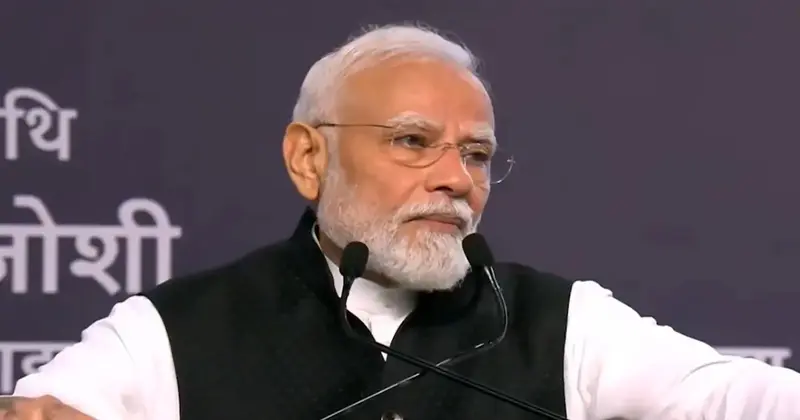
New Delhi: Prime Minister Narendra Modi on September 5, Saturday contrasted India’s economic and security challenges of 2013 and illustrated the country’s transformation over the past 13 years, highlighting 7.8 per cent quarterly GDP growth, expanding domestic manufacturing, near-complete railway electrification and a stronger national security posture.
Addressing students and alumni at the centenary celebrations of Delhi University’s Shri Ram College of Commerce (SRCC), PM Modi said India has moved from being labelled one of the world’s “Fragile Five” economies to becoming the fastest-growing major economy.
Calling SRCC’s 100-year journey “an ocean of inspiration”, PM Modi said that the institution’s centenary was not only significant for the college but also for India’s education sector. He urged students to use the opportunities available in today’s India to set ambitious goals and contribute to the country’s journey towards becoming a developed and self-reliant nation.
From ‘Fragile Five’ to 7.8% GDP: PM Modi presents report card of NDA govt
Revisiting the economic situation in 2013, PM Modi recalled an environment marked by high inflation, a record current account deficit, slowing industrial activity. unsustainable inflation and concerns over “policy paralysis”. He also referred to the negative headlines of the period, including corruption cases, terror attacks and economic uncertainty.
#WATCH | Delhi: At the centenary celebrations of SRCC, PM Narendra Modi says, "Over the past six years, India has faced major crises, including COVID-19, the Russia-Ukraine war and the West Asia crisis. Every time, people said India would not survive. Those who are my biggest… https://t.co/5LnG6Tj06C pic.twitter.com/ul8tyhmkb5
— ANI (@ANI) September 5, 2026
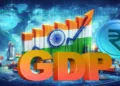
“The world was calling India one of the ‘Fragile Five’,” PM Modi said, contrasting that period with the latest quarterly GDP growth of 7.8 per cent. He said that the present growth figure had strengthened confidence in the Indian economy, particularly as it came amid the ongoing West Asia conflict, trade-related challenges & highly volatile, unpredictable global environment.
PM Modi also referred to a recent upgrade in India’s rating by a Japanese credit rating agency and said that the country’s economic performance was drawing increasing global attention. He said that India’s progress is not restricted to headline GDP numbers but is also reflected in employment generation, entrepreneurship and expanding opportunities for businesses.
Manufacturing Growth: From imports to innovation, exports & Atmanirbharata in defence
Domestic manufacturing emerged as one of the key pillars of PM Modi’s vision for India’s next phase of growth. Recalling 2014, he said India imported more than half of the mobile phones used in the country. Today, he said, India has moved towards manufacturing and exporting mobile phones, with 99 per cent of mobile phones used domestically now manufactured in India.
PM Modi cited the defence sector as another example of the shift towards self-reliance. He said the government worked with the armed forces to identify requirements and encouraged Indian companies to manufacture defence equipment domestically, resulting in what he called a “vibrant defence ecosystem”.
The Prime Minister said India would eventually emerge as a global manufacturing hub and an agricultural export superpower. He also urged Indian professional services firms in areas such as consulting, accounting, law and finance to aspire to become global leaders.
Those spreading terrorism are on the back foot: PM Modi hails India’s strong national security network
PM Modi also drew a sharp contrast between India’s security environment in 2013 and the situation today. Referring to the 2008 Mumbai terror attacks, incidents along the Line of Control and other security challenges, he said the then government had failed to adequately respond to Pakistan despite external pressure.
“Today, those spreading terrorism are on the back foot”, PM Modi said, asserting that India’s armed forces respond strongly whenever Pakistan undertakes a “misadventure”. He said the armed forces were now prepared to cross the border and strike back. The Prime Minister also claimed that peace had expanded from Jammu and Kashmir to the Northeast and that the “back of Maoist terrorism and Naxalism has been broken”.
Linking national security with governance, PM Modi said the world that once discussed India’s “policy paralysis” was now talking about its “policy dynamism”.
Railway electrification, rapid infrastructure & faster decision-making
PM Modi used railway electrification as an example for the acceleration in policymaking and infrastructure development. India’s first electric train ran in 1925, while SRCC was established a year later in 1926. Yet, PM Modi said, less than 30 per cent of India’s railway lines had been electrified by 2014.
“In just 12 years, we have brought railway line electrification to nearly 100 per cent”, he said. According to PM Modi, the pace of decision-making and execution has also strengthened India’s partnerships with other countries. He linked this transformation to the opening of new markets and reduction of tariffs, which he said were creating a “new sky of opportunities” for Indian youth.
#WATCH | Delhi: At the centenary celebrations of Shri Ram College of Commerce (SRCC), Prime Minister Narendra Modi says, "Today, India is moving forward with a different mindset. Work that used to take decades is now being completed in just a few years. Let me give you another… pic.twitter.com/XzXDH2OKMi
— ANI (@ANI) September 5, 2026
‘Naraz Fufa’: PM Modi takes swipe at critics of India’s growth story
Taking a sharp swipe at critics of government initiatives & who spread misinformation, PM Modi introduced the phrase “Naraz Fufa” to describe people who, oppose major projects and repeatedly ask, “What is the need for this?”
#WATCH | Delhi: At the centenary celebrations of Shri Ram College of Commerce (SRCC), PM Narendra Modi says, "You will meet two kinds of people. One kind transforms the strength of society into the strength of the nation. The other becomes 'Naraz Fufa' whenever any work is… https://t.co/f8QqVjsyXk pic.twitter.com/4lz2FNWgFR
— ANI (@ANI) September 5, 2026
He cited the construction of the world’s tallest statue, the high-speed train project, UPI, the new Parliament building and a memorial for military heroes as examples of initiatives that faced criticism. PM Modi said India had repeatedly answered such criticism through its achievements, asserting that “no one can stop India from doing what is necessary for the country”.
#WATCH | Delhi: At the centenary celebrations of Shri Ram College of Commerce (SRCC), Prime Minister Narendra Modi says, "But outside this campus, you will encounter a new world. You will meet two kinds of people. One kind consists of people who positively transform the strength… pic.twitter.com/3Iz0oGvu2W
— ANI (@ANI) September 5, 2026
He also criticised what he called the “mai-baap” culture, saying some people preferred poor and ordinary citizens to remain dependent on intermediaries rather than gain direct access to financial and economic opportunities.
Startups, education & energy: PM Modi outlines expanding India’s opportunity ecosystem
The Prime Minister also highlighted the expansion of India’s education, startup and energy ecosystems. The address noted that higher education enrolment has increased by one crore over the past decade to reach around 4.5 crore students. India’s startup ecosystem, meanwhile, has grown from fewer than 400 startups before 2016 to more than 2.3 lakh.
The speech also highlighted India’s expansion in electricity generation, with total capacity rising from 249 GW in 2014 to 552 GW, while non-fossil capacity has reached 302 GW. Solar power capacity, has surged from 2.6 GW to 165 GW, PM Modi said.
PM Modi said these developments were creating the ecosystem necessary for young Indians to pursue bigger ambitions.
PM Modi’s Message to Youth: Dream big for Viksit Bharat
At the heart of PM Modi’s address was a message to the SRCC students & the youth of the country to think beyond conventional ambitions. “Ambition cannot be taught from any textbook,” he said, adding that ambition emerges from an environment that inspires people to dream big.
#WATCH | Delhi: At the centenary celebrations of SRCC, PM Narendra Modi says, "Now in the 21st century, a new world of opportunities is before us. I am happy that you are ambitious because ambition cannot be taught from any textbook. Ambitions come from an environment that… pic.twitter.com/TO17i3Zo3z
— ANI (@ANI) September 5, 2026
PM Modi said students today have opportunities that their seniors could not have imagined 13 years ago. He urged them to take advantage of India’s expanding markets, technological capabilities and entrepreneurial ecosystem.
Looking ahead, he said India would become a global manufacturing hub, emerge as an agricultural export superpower and establish its own space station. He also reiterated his vision of India hosting an Olympics in 2036 that would leave the world “watching in awe”. Calling on 140 crore Indians to collectively build a “Viksit” and “Aatmanirbhar Bharat”, PM Modi said the dream, resolve and responsibility for India’s transformation must belong to its people.