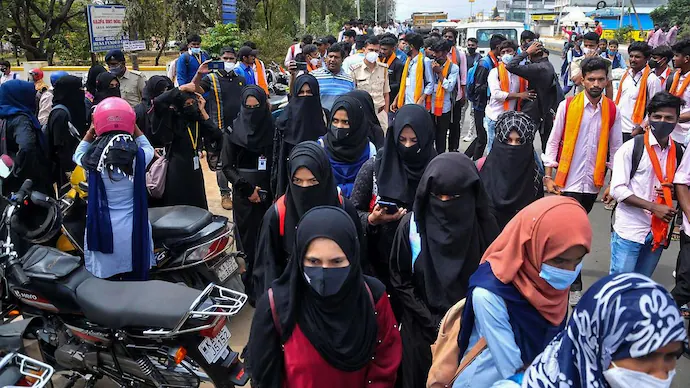
The question of wearing hijab in educational institutions and examination settings has repeatedly come before Indian courts, bringing constitutional rights, religious practices, institutional autonomy and prescribed dress codes into legal focus. Over the years, courts have examined whether wearing a headscarf can be claimed as an Essential Religious Practice under Article 25 of the Constitution and whether educational institutions can enforce uniform and dress-code rules.
The judicial proceedings covered in this report span from 2002 to 2026 and involve the Supreme Court as well as the High Courts of Bombay, Kerala, Karnataka and Allahabad. The cases arose from different circumstances, including school and college dress codes, restrictions on religious identifiers and rules applicable to competitive examinations.
A recurring issue before the courts has been the relationship between the constitutional guarantee of freedom of religion and the authority of educational institutions to prescribe and enforce dress codes. In several cases, courts held that institutions could maintain uniform requirements where the rules were applicable to students generally and were connected with institutional discipline, equality or academic interests.
The Essential Religious Practices doctrine has also played a significant role in some of these proceedings. The Karnataka High Court in 2022 held that wearing hijab was not an Essential Religious Practice of Islam, while the Bombay High Court in 2024 observed that sufficient material had not been placed before it to establish hijab or niqab as an essential religious practice. The Allahabad High Court in 2026 similarly held that wearing a headscarf had not been established as an essential part of Islamic faith.
The Supreme Court’s 2022 proceedings produced a split verdict. Justice Hemant Gupta held that hijab was not an Essential Religious Practice, while Justice Sudhanshu Dhulia considered the question through personal choice, conscience and dignity and held that the ERP doctrine was not necessary to determine the issue. The split verdict resulted in the matter being referred for consideration by a larger Bench.
The cases therefore reflect different judicial approaches to religious dress in educational settings, including questions concerning Article 25, institutional dress codes, academic interests and individual choice. The following seven cases trace the major judicial observations contained in this report.
Religious practices, constitutional law and secularism have been widely examined by courts in India and other countries. In India, courts mainly apply the Essential Religious Practices (ERP) doctrine under Article 25 of the Constitution to determine whether a particular practice forms an essential part of a religion.
Courts may permit the regulation of religious practices that are not considered essential, particularly where issues involving public order, health, morality or other fundamental rights arise.
The detailed 8 Cases Where Indian Courts Stated Hijab Is Not an Essential Religious Practice, are given below.
1. Allahabad High Court Says Hijab Not Proven an Essential Religious Practice, Dismisses Student’s Plea
The Allahabad High Court on August 21, 2026, dismissed a plea filed by Sukaina Rizvi, a minor Muslim student, seeking permission to wear a hijab alongside the prescribed school uniform. She had completed her Class X examinations at Tagore Public School, Attarsuiya, Prayagraj, Uttar Pradesh, and sought admission to Class XI in the same institution.
Sukaina Rizvi approached the High Court through her mother after the school management refused admission over her insistence on wearing the headscarf. The matter was heard by Justice J.J. Munir and Justice Indrajeet Shukla.
The two-judge Bench rejected the argument that wearing a headscarf is an essential Islamic practice. The court observed, “Wherever this issue has arisen, the High Courts have been unanimous in opinion that wearing a headscarf is not an essential part of the Islamic faith for a woman to don in the absence of which faith would be jeopardised.”
The court also stated that as long as a school’s uniform code is fair, non-discriminatory and implemented to maintain institutional discipline and equality, the institution retains full autonomy to enforce its internal discipline and dress code.
2. Bombay High Court Upholds College Dress Code Restricting Hijab, Niqab and Other Religious Identifiers
The Bombay High Court on June 26, 2024, dismissed a plea filed by nine Muslim female students of N.G. Acharya and D.K. Marathe College, Chembur, Mumbai, challenging a dress code that prohibited hijabs, niqabs, burqas and other religious identifiers on the college campus.
The students argued that hijab and niqab were essential Islamic practices and that the restrictions violated Articles 19(1)(a) and 25 of the Constitution. The plea was heard by Justice Atul S. Chandurkar and Justice Rajesh S. Patil.
The Bench rejected the claim, observing that sufficient material had not been produced to establish “donning of a hijab or niqab” as an essential religious practice.
The court held that the dress code was in the “larger academic interest”. It observed that the objective of the dress code was that a student’s dress “should not reveal his/her religion” so that students could focus on education.
The Bombay High Court also expressed “full agreement” with the Karnataka High Court’s 2022 ruling concerning uniform dress codes and dismissed the petition filed by the students.
3. Karnataka High Court Declares Hijab Not an Essential Religious Practice, Upholds Uniform Mandate
The Karnataka High Court on March 15, 2022, dismissed petitions filed after several Muslim female students at government pre-university colleges in Udupi were denied entry to classrooms for wearing hijabs in violation of the prescribed dress codes.
A Full Bench comprising Chief Justice Ritu Raj Awasthi, Justice Krishna S. Dixit and Justice J.M. Khazi held that wearing a hijab is not an Essential Religious Practice in Islam. The court also held that prescribing a uniform is a permissible measure to maintain discipline and constitutional secularism.
The court upheld the Karnataka Government’s authority to prescribe such rules under the Karnataka Education Act. It observed that the uniform requirement did not infringe the students’ rights under Article 25 of the Constitution.
4. Supreme Court Delivers Split Verdict on Hijab in Educational Institutions
The Supreme Court on October 13, 2022, delivered a split verdict on appeals against the Karnataka High Court’s decision upholding restrictions on wearing hijab in government educational institutions.
The case, Aishat Shifa v. State of Karnataka and Others, was heard by Justice Hemant Gupta and Justice Sudhanshu Dhulia.
Justice Hemant Gupta dismissed the appeals, holding that “hijab is not an Essential Religious Practice” and that students cannot claim a right to add religious attire to a prescribed uniform in a secular institution.
Justice Sudhanshu Dhulia allowed the appeals, holding that wearing the hijab is a matter of personal choice, conscience and dignity protected under Articles 19, 21 and 25 of the Constitution. He also held that the Essential Religious Practice doctrine was not required to decide the issue.
As the two judges delivered differing opinions, resulting in a 1:1 split verdict, the matter was referred to the Chief Justice of India for consideration by a larger Bench.
5. Kerala High Court Upholds Private School Uniform Rules Over Hijab Plea
The Kerala High Court on December 4, 2018, dismissed a petition filed by minor Muslim students of St. Mary’s Higher Secondary School seeking permission to wear headscarves and long-sleeved shirts along with the prescribed school uniform.
The case, Fathima Tashneem v. State of Kerala, was heard by Justice A. Muhamed Mustaque.
The court held that the students’ claim under Article 25 of the Constitution had to be balanced against the school management’s right to administer its private educational institution and enforce its uniform policy.
The Kerala High Court therefore upheld the school’s decision, holding that the institution’s right to prescribe and enforce a uniform prevailed over the students’ request for an individual religious-dress exemption.
6. Kerala High Court Upholds Private School Uniform Rules Over Hijab Plea
The Kerala High Court on December 4, 2018, dismissed a petition filed by minor Muslim students of St. Mary’s Higher Secondary School seeking permission to wear headscarves and long-sleeved shirts along with the prescribed school uniform.
The case, Fathima Tashneem v. State of Kerala, was heard by Justice A. Muhamed Mustaque. The court held that the students’ claim under Article 25 of the Constitution had to be balanced against the school management’s right to administer its private educational institution and enforce its uniform policy.
The Kerala High Court therefore upheld the school’s decision, holding that the institution’s right to prescribe and enforce a uniform prevailed over the students’ request for an individual religious-dress exemption.
7. Supreme Court Rejects Plea Seeking Permission to Wear Hijab in AIPMT Examination Hall
The Supreme Court in July 2015 declined to interfere with the CBSE’s dress restrictions for the revised All India Pre-Medical Test (AIPMT), which prohibited items including scarves, headbands and full-sleeved clothing as measures to prevent examination malpractice.
The petition was filed by the Students Islamic Organisation of India and two Muslim female candidates from Kerala, challenging the dress code and seeking permission to wear hijab in the examination hall.
A three-judge Bench comprising Chief Justice H.L. Dattu, Justice Arun Misra and Justice Amitav Roy declined to entertain the challenge.
Chief Justice Dattu observed that “faith was different from insisting on wearing a particular type of cloth to an examination hall” and said, “Examiners cannot conduct inquiry into everyone’s faith. They have to do it (AIPMT) appropriately this time.”
The Bench ultimately dismissed the petition, with the petitioners seeking permission to withdraw it.
8. Bombay High Court Rejects Article 25 Challenge to School Headscarf Rule
The Bombay High Court in 2002 considered a petition filed by a minor Muslim student who was asked by her school principal not to attend classes while wearing a headscarf. The student argued that the restriction violated her fundamental right to freedom of conscience and to profess, practise and propagate Islam under Article 25 of the Constitution.
A Division Bench comprising Justice R.M. Lodha and Justice D.B. Bhosale held that merely requiring the student to follow the school’s prescribed dress code did not violate Article 25.
The court observed, “It is not an obligatory overt act enjoined by Muslim religion that a girl studying in all girl section must wear head-covering.” It further held that the essence of Islam was not affected by directing the student not to wear a headscarf at school.
The seven cases presented in this report show how Indian courts have examined claims concerning hijab and religious dress through constitutional provisions, the Essential Religious Practices doctrine and the authority of educational institutions to prescribe dress codes.
From the Bombay High Court’s 2002 ruling concerning a school headscarf rule to the Allahabad High Court’s 2026 decision, courts have considered whether wearing a headscarf can be established as an essential religious practice and whether educational institutions can enforce prescribed uniforms.
The 2022 Karnataka High Court judgment made a categorical finding that wearing hijab was not an Essential Religious Practice, while the 2024 Bombay High Court found that sufficient material had not been produced to establish hijab or niqab as an essential religious practice. The Allahabad High Court’s 2026 ruling similarly rejected the claim that wearing a headscarf had been established as an essential part of Islamic faith.
The Supreme Court’s 2022 split verdict remains distinct within this set of cases because the two judges adopted different approaches. Justice Hemant Gupta addressed the issue through the Essential Religious Practice question, while Justice Sudhanshu Dhulia focused on personal choice, conscience and dignity without considering the ERP test necessary for deciding the dispute.
Taken together, these judicial proceedings demonstrate the recurring constitutional questions surrounding religious dress in schools, colleges and examination settings. They also show the courts’ consideration of institutional uniform policies, discipline, equality and academic interests alongside claims based on religious freedom.