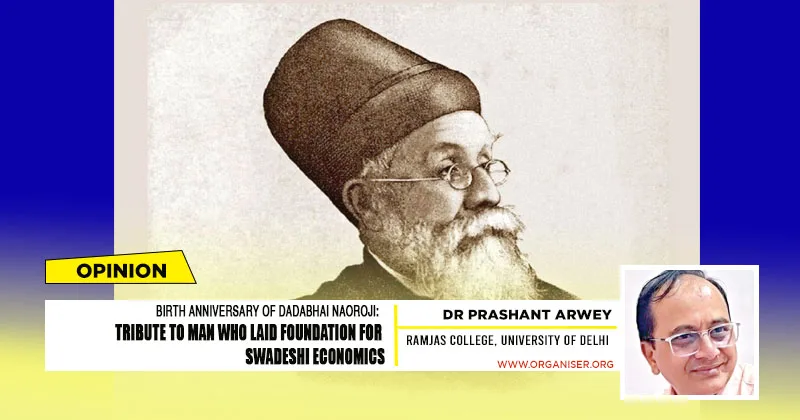
Birth Anniversary of Dadabhai Naoroji:  Tribute to man who laid foundation for swadeshi economics
October 17, 2026
  • Read Ecopy
  • Circulation
  • Advertise
  • Careers
  • About Us
  • Contact Us
Android AppiPhone AppArattai
Organiser
  • ‌
  • Bharat
    • Assam
    • Bihar
    • Chhattisgarh
    • Jharkhand
    • Maharashtra
    • View All States
  • World
    • Asia
    • Europe
    • North America
    • South America
    • Africa
    • Australia
  • Editorial
  • International
  • Opinion
  • RSS @ 100
  • More
    • World Hindu Congress 2026
    • Op Sindoor
    • Analysis
    • Sports
    • Defence
    • Politics
    • Business
    • Economy
    • Culture
    • Special Report
    • Sci & Tech
    • Entertainment
    • G20
    • Azadi Ka Amrit Mahotsav
    • Vocal4Local
    • Web Stories
    • Education
    • Employment
    • Books
    • Interviews
    • Travel
    • Law
    • Health
    • Obituary
  • Subscribe
    • Subscribe Print Copy
    • Subscribe & Read Ecopy
  • ‌
  • Bharat
    • Assam
    • Bihar
    • Chhattisgarh
    • Jharkhand
    • Maharashtra
    • View All States
  • World
    • Asia
    • Europe
    • North America
    • South America
    • Africa
    • Australia
  • Editorial
  • International
  • Opinion
  • RSS @ 100
  • More
    • World Hindu Congress 2026
    • Op Sindoor
    • Analysis
    • Sports
    • Defence
    • Politics
    • Business
    • Economy
    • Culture
    • Special Report
    • Sci & Tech
    • Entertainment
    • G20
    • Azadi Ka Amrit Mahotsav
    • Vocal4Local
    • Web Stories
    • Education
    • Employment
    • Books
    • Interviews
    • Travel
    • Law
    • Health
    • Obituary
  • Subscribe
    • Subscribe Print Copy
    • Subscribe & Read Ecopy
Organiser
  • Home
  • Bharat
  • World
  • Operation Sindoor
  • Editorial
  • Analysis
  • Opinion
  • Culture
  • Defence
  • International Edition
  • RSS @ 100
  • Magazine
  • Read Ecopy
Home Bharat

Birth Anniversary of Dadabhai Naoroji:  Tribute to man who laid foundation for swadeshi economics

Dadabhai Naoroji, born on September 4, 1825, was the first Indian thinker to systematically expose British economic exploitation, laying the foundation of economic nationalism through his pioneering Drain of Wealth theory

Dr Prashant ArweyDr Prashant Arwey
Sep 4, 2026, 08:00 am IST
inBharat, Opinion
Dadabhai Naoroji

Dadabhai Naoroji

Facebook
Twitter
WhatsAppTelegramEmail

In the words of Lord Curzon, “India was the pivot of our empire. If this empire lost any other part of its dominion we could survive, but if we lost India, the sun of our empire would be set.” This statement by Lord Curzon, published in The Times of India in 1898, clearly explains what importance India held for the British. However, this importance was largely economic. India faced economic plunder and its severe consequences. After the Battle of Plassey in 1757, provinces like Bengal, Bihar, and Awadh came under British subjection. The statistics following this subjection make this evident.

Disastrous Famines, Exploitative Policies

During 1769-73, a terrible famine struck Bengal. The matter does not stop here; there was the Chalisa famine of 1783, the Doji Bara famine of 1791, the Agra famine of 1837, the Doab famine of 1860, the Orissa famine of 1866, and the disastrous Bengal famine of 1873. Following this British rule, approximately five million people in this country died of hunger due to a series of consecutive famines. Factually, they did not just die; these innocent people had to lose their lives because of the exploitative policies of the British. It proved to be a horrific massacre during the British Indian regime. There are no mentions of people dying without food in ancient Indian history.

Dadabhai Naoroji, revered for his penance, was the first thinker, intellectual, and politician to bring this fact to the attention of the British. He was a founding member of the Indian National Congress. After that, he remained the President of the Congress three times. At that time, even knowledgeable and sensible people did not understand economic calculations. In that era, Dadabhai read an article titled Poverty of India in 1876 before the Bombay branch of the East India Association of London. He later conducted extensive research on the subject and published the book Poverty and Un-British Rule in India in 1901. He brought the multi-level plunder of India by the British to the world with statistical data.
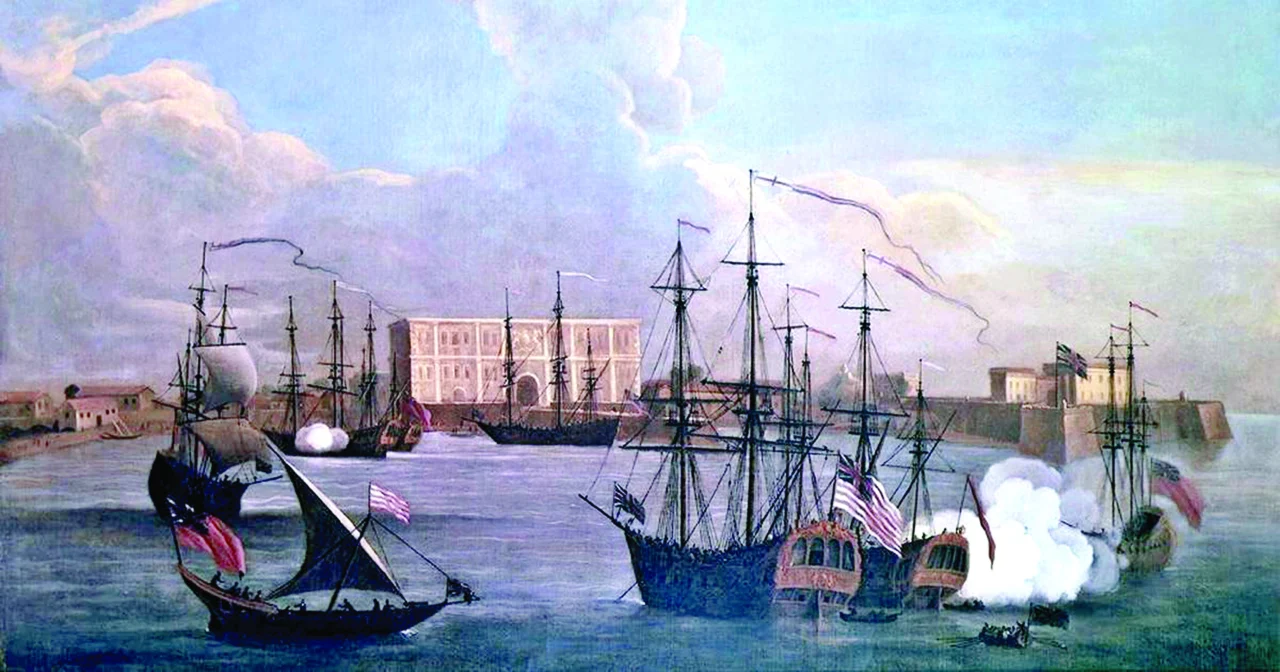
Describing the country’s economic system in a single sentence, Dadabhai said that India is a rich country of poor people. The country being rich meant that the country’s current income was certainly enough to provide full meals and a good life to its citizens, but the effect of the ongoing plunder of the nation was such that not even one-tenth of the wealth reached the public. Dadabhai calls this the  Wealth Drain.

Dadabhai used the term ‘Un-British’ in the title of his book because the Britain he knew or understood believed in democracy and liberalism, but he did not see such a Britain or British governance in India. Hence, he used the word ‘Un-British’. Many Indian leaders among us believed in the conscience of the British. Mahatma Gandhi’s name must be taken foremost among them, but our leaders failed to realise that the exploitation of India during the one hundred and fifty years of British rule was far greater than the exploitation under Islamic rule, which cannot be forgotten.

In the preface of his book, Dadabhai states:

“Mr. Montgomery Martin examined the records of a detailed survey of the conditions of some provinces in Bengal and Bihar at the ‘India House’ between 1807-1814. After that, in 1838, he stated in his book ‘Eastern India’ It is impossible to avoid recording two things as extremely shocking: firstly, the wealth of the surveyed country, and secondly, the poverty of its inhabitants. The amount of this annual plunder of £3,000,000 per year from British India has reached the astronomical sum of £723,000,000 in thirty years, at 12 per cent compound interest. Such a continuous and accumulating drain would leave even England poor. Then how terrible will its consequences be in India, where a labourer’s wages are two to three pence a day? He has also calculated the impact of a plunder of £5,000,000 per year. Certainly, it resulted in famine, plague, poverty and destruction.
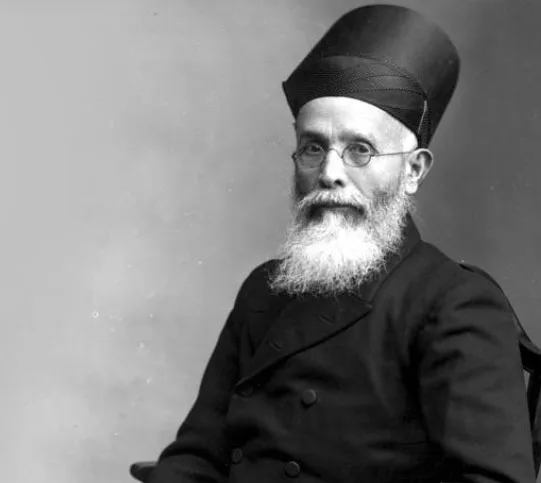
Dadabhai Naoroji

The Gross Domestic Product (GDP) of the country in 1871 was £200 million. However, the per capita income was as low as 27 to 40 shillings. That is why Dadabhai calls it a rich country with poor people. He then details how this wealth moved to Britain through various means, leaving India to beg. For one thing, as the Government was foreign, it inexcusably neglected spending on the development and welfare of the natives. The Government spent enormous sums on administration and practised economic discrimination in jobs. These were some of the primary reasons behind this wealth drain. The salaries of British officers, pensions, instalments on government debts, returns to those who invested money in the East India Company, dividends paid to shareholders, and the massive expenditure on the military were all being paid out of the income generated from India; consequently, the country fell into a state of starvation.

Reassess Its Policies

Dadabhai’s constant research on British exploitative economic policies in India created enormous pressure on the British Government. They constituted a high-level committee to investigate the facts in the claims of Dadabhai. On May 24, 1895, the Welby Commission was constituted with 14 members. Of these, three were particularly influential. Dadabhai Naoroji, W.S. Caine and the third one was William Wedderburn. This trio forced British rule to reassess its economic policies.

Dadabhai Naoroji was a deeply principled gentleman who critics say fundamentally misjudged the true, tactical nature of the British Government. However, any comprehensive analysis of this history must feature the groundbreaking insights of the prominent scholar and Gandhian thinker, Dharampal. In his book, Despoliation and Defaming of India, Dharampal uncovers a crucial ideological dimension behind the economic drain. He demonstrates how the British executed a coordinated propaganda campaign to slander India as a deceitful, primitive, and uncultured society. Driven by colonial figures like James Mill, William Wilberforce, and T.B. Macaulay, this systemic character assassination was explicitly designed to morally justify their systemic plunder and exploitation.

However, Dadabhai’s book omits some facets of British rule, but he was the first in the country to expose the colonial plunder and exploitative nature of British administration. He spent almost thirty years of his life working intensively on this economic drain.

Dadabhai was the first leader to lay the foundation of Indian economic nationalism. Although Dadabhai was elected to the British Parliament, India remained the subject of his contemplation and concern. Therefore, he is called India’s unofficial ambassador. On the occasion of his birth anniversary, it is a duty to pay homage to this selfless, altruistic great man.

Topics: Birth Anniversary of Dadabhai Naorojiswadeshi economics1807-1814Britain or British governance in IndiaAgra famine of 1837Indian National CongressLord Curzon
Dr Prashant Arwey
Dr Prashant Arwey
Ramjas College, University of Delhi [Read more]
Share
Tweet
SendShareSend
✮ Subscribe Organiser YouTube Channel. ✮
✮ Join Organiser's WhatsApp channel for Nationalist views beyond the news. ✮
Previous News

Rajasthan Assembly Speaker Vasudev Devnani extends greetings to the people of the state on Shri Krishna Janmashtami

Next News

Beyond the Flute: Shri Krishna’s actions for Nation First

Related News

Vande Mataram: Pandit Paluskar ji, still alive

AICC General Secretary KC Venugopal and Opposition Leader VD Satheeshan

Keralam: Congress CM row escalates as K.C. Venugopal and V.D. Satheeshan camps clash openly on streets

From Khera to Rahul: The Pathological Trait of Lies & Legacy of Apologies

Keralam BJP President Rajeev Chandrasekhar

Keralam Election 2026: “Muslim League remote-controls Congress, seeks Deputy CM & six ministries,” says Chandrasekhar

BJP State President Rajeev Chandrasekhar

Keralam: “FCRA will not target Christian community, Congress propaganda misleading”, clarifies Rajeev Chandrasekhar

Jammu University drops Jinnah, Sir Syed, Iqbal from Political Science syllabus

Jinnah, Sir Syed, Iqbal dropped from Political Science syllabus: Jammu University panel after ABVP protest

Load More

Latest News

Ex-minister V Abdurahiman (File Photos)

Keralam: UDF govt to register case against ex-minister V Abdurahiman in Messi Gate scandal, awaits Governor’s approval

ABVP organises ‘Stop Anarchy, Embrace Democracy’ protests at Himachal Pradesh University and Varanasi campus

‘Stop Anarchy, Embrace Democracy’: ABVP leads campus rallies in Himachal & Varanasi against anarchist tactics

The Graham Act of US, Russian Oil & Tariff Waiver for Bharat: A thaw where strategic autonomy holds the line

Dr Krishna Gopal Ji, Sah-Sarkaryavah of the RSS, was the key speaker at Spiritual and Religious Leadership Dialogue

Service, good conduct, compassion and self-discipline are at the core of Sanatan: RSS Sah Sarkaryavah Dr Krishna Gopal

Congress Leader and Former Union Minister P. Chidambaram

Fact Check: Congress leader P Chidambaram claims ECI abandoned SIR in 17 states, but the facts tell a different story

Odisha CM Mohan Charan Majhi at the felicitation ceremony honouring India’s gold-winning men’s and women’s hockey teams at the 2026 Asian Games

Odisha Honours Asian Games Hockey Champions; CM Majhi presents Rs 5.61 crore reward for both gold-winning teams

PM Modi speaking at a rally in Meerut in February 2026, video of which is now in circulation with false claim, Image: The Federal

Fact Check: Old video of PM Modi calling Congress a ‘Burden on the country’ goes viral amid SIR protests

Shastra Pujan and Path Sanchalan at the local Narsingh Baba Temple premises in Motihari

Sangh’s founding objective is to organise the entire society: RSS Sah Sarkaryavah Dr Krishna Gopal Ji

Karnataka govt departments owe ESCOMs Rs 12,463 crore in unpaid power bills, deepening the utilities’ financial strain

Karnataka: Government departments owe ESCOMs Rs 12,463 crore in unpaid electricity bills, raising tariff hike concerns

Dr Sunil Mohanty, Assam Kshetra Prachar Pramukh, addressed a Yuva Sammelan organised by the RSS in Assam’s Karbi Anglong district as part of its centenary celebrations

Assam: RSS organises grand Yuva Sammelan in Karbi Anglong; Pays tribute to unsung vanvasi freedom fighters

Load More
  • Privacy
  • Terms
  • Cookie Policy
  • Refund and Cancellation
  • Delivery and Shipping

© Bharat Prakashan (Delhi) Limited.
Tech-enabled by Ananthapuri Technologies

  • Home
  • Search Organiser
  • Bharat
    • Assam
    • Bihar
    • Chhattisgarh
    • Jharkhand
    • Maharashtra
    • View All States
  • World
    • Asia
    • Africa
    • North America
    • South America
    • Europe
    • Australia
  • Editorial
  • Operation Sindoor
  • Opinion
  • Analysis
  • Defence
  • Culture
  • Sports
  • Business
  • RSS @ 100
  • Entertainment
  • More ..
    • Sci & Tech
    • Vocal4Local
    • Special Report
    • Education
    • Employment
    • Books
    • Interviews
    • Travel
    • Health
    • Politics
    • Law
    • Economy
    • Obituary
  • Subscribe Magazine
  • Read Ecopy
  • Advertise
  • Circulation
  • Careers
  • About Us
  • Contact Us
  • Policies & Terms
    • Privacy Policy
    • Cookie Policy
    • Refund and Cancellation
    • Terms of Use

© Bharat Prakashan (Delhi) Limited.
Tech-enabled by Ananthapuri Technologies