
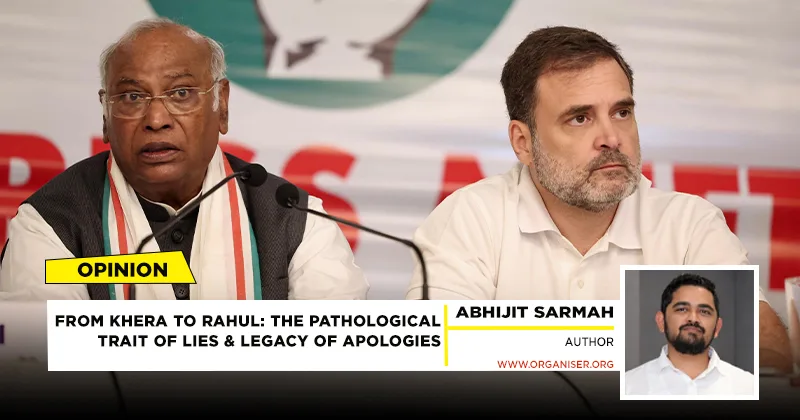
Indian politics has never been a quiet affair. Particularly with Congress leaders, it has followed a clinical pattern, not merely to inform but to provoke and confuse the masses, attempting to corner their opponents and then almost instantly issuing apologies. Yet the modern media ecosystem, especially social media, with its constant recording, instant amplification, and legal scrutiny, has made political jingoism far more accountable. Every remark is preserved, replayed, fact-checked, debated and sometimes litigated. And occasionally, when the dust settles, what remains is not just a controversy but mostly an apology.
The latest political flashpoint to reignite this debate emerged in Assam this week when Congress spokesperson Pawan Khera found himself embroiled in controversy over forged documentary allegations against Riniki Bhuyan Sharma, the wife of Assam Chief Minister Himanta Biswa Sarma. Bhuyan Sharma is not merely a political spouse; she is a prominent businesswoman and media entrepreneur in her own right.
During a press conference, Khera directed a barrage of unverified allegations against the chief minister’s wife, based on material that has now been scientifically established as morphed and forged documents. The comments immediately triggered backlash from the BJP and CM Himanta, who accused the Congress leader of dragging a family member into a political arena for their vested political motives. Himanta Biswa Sarma himself strongly reacted, followed by Sharma filing a police complaint.
Within hours, the controversy had taken on a life of its own. Television debates erupted. Social media clips circulated widely. Political leaders weighed in. The discussion moved beyond Assam and entered the national political conversation. Soon afterwards, Khera clarified that he had not intended to make a personal attack and that his remarks were aimed at political accountability.
The explanation did little to calm the immediate storm, but it followed a pattern that many observers of Indian politics have come to recognise: first, conceive a remark aimed at sparking outrage and confusion among the masses; then, when faced with backlash, rapidly apologise and hide.
For those who closely track political controversies, the episode felt oddly familiar. It echoed an earlier moment involving the same Congress spokesperson who had already captured national attention. For Instance, in February 2023, during a press conference criticising the government over the Adani controversy, Khera referred to Prime Minister Narendra Modi as “Narendra Gautamdas Modi.” The comment was framed as a sarcastic jab, but it quickly spiralled into a legal and political battle.
Multiple complaints were filed in different states, including Assam. In a dramatic development, Khera was removed from a flight at Delhi airport by the Assam Police, an action that triggered a political standoff between the Congress and the BJP. The matter eventually reached the Supreme Court, which granted Khera interim bail and consolidated the FIRs filed across the country.
As the controversy unfolded, Khera stated that he regretted the remark if it had offended anyone, explaining that it had been made during a heated political exchange.
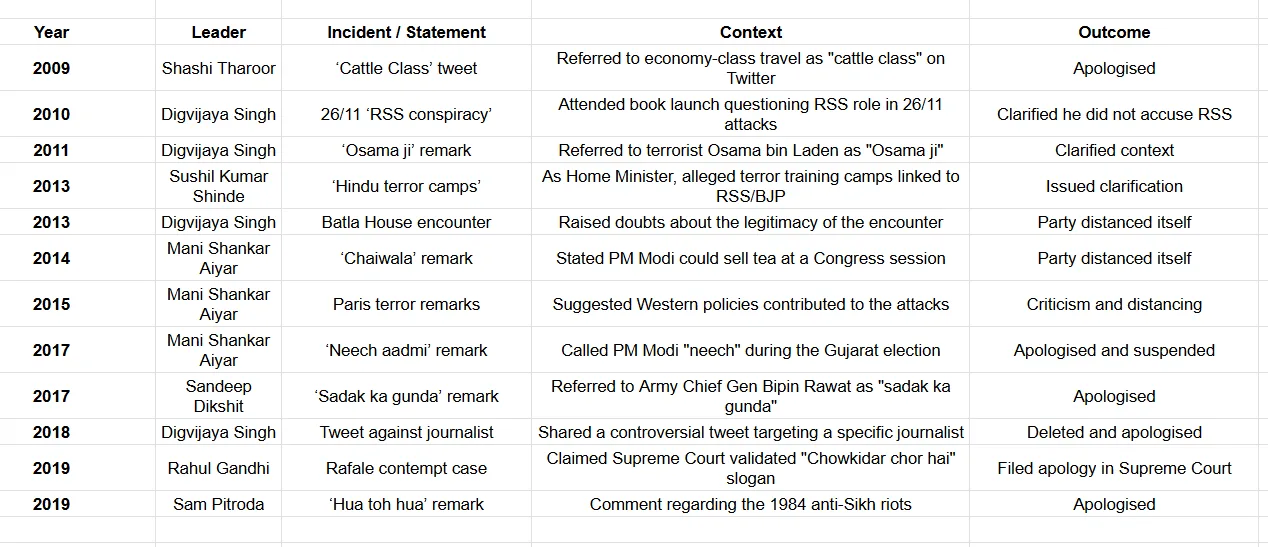
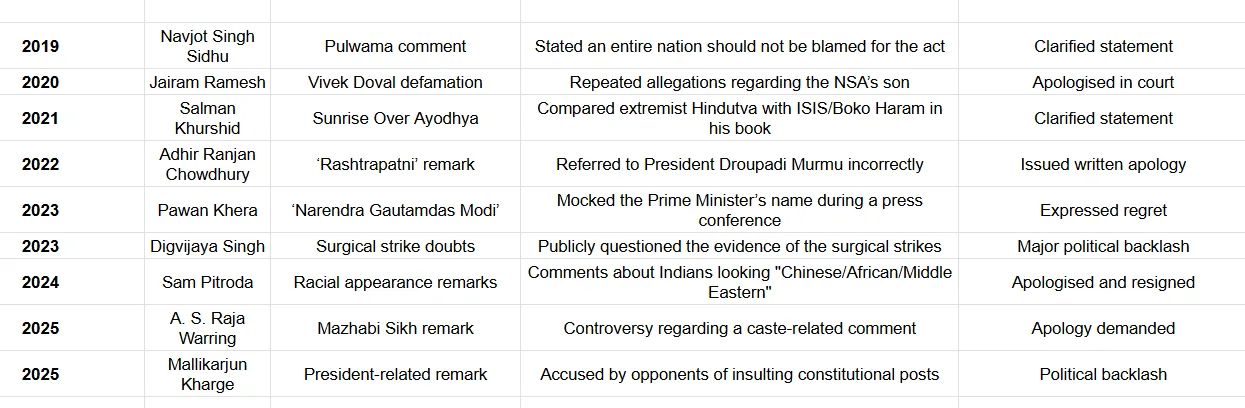
Such episodes might appear isolated if viewed individually. Yet when placed alongside several earlier controversies involving prominent Congress leaders, they reveal a recurring dynamic that has shaped political discourse in India over the past decade. It is a symptom of a deeper, almost pathological trait of the Congress leadership in modern political communication, the Provoke-Viralize-Apologise cycle.
To understand why the Congress, particularly its leaders like Khera, find themselves in these loops, one must look at the environment. In 2026, the political operative is surrounded by a “Digital Panopticon.” The moment Khera made remarks against Mrs Sharma, the wife of Assam CM Himanta Biswa, based on forged and morphed AI-generated passport images, he wasn’t just talking to the press; he was triggering a multi-platform scutinity ecosytem.
Himanta Biswa Sarma’s reaction was indicative of the new BJP playbook: moving beyond verbal rebuttals to seeking legal constitutional remedies. This mirrors the 2023 “Gautamdas” incident, in which Khera’s sarcastic play on the Prime Minister’s name led to a dramatic deplaning at Delhi airport.
The resulting journey to the Supreme Court ended not in a political victory but in expressing the pathological trait of posting a regret, an apology to secure legal relief. It was a clear signal that the judiciary is increasingly weary of political jingoism that crosses the line into personal indignity.
From the “Rashtrapatni” remark to the “sarak ka gunda” remark against the Indian Army Chief, whether a clinical case of tongue Slips or Strategies, remains a subject for public discretion. However, the history of the Indian National Congress is littered with these moments. Take Adhir Ranjan Chowdhury, whose 2022 reference to President Droupadi Murmu as “Rashtrapatni” ignited a national firestorm.
While Chowdhury maintained it was a “slip of the tongue” owing to his Bengali-influenced Hindi, the damage was instantaneous. He was forced to issue a formal written apology to the President.
Then there is Sandeep Dikshit, who in 2017 referred to then-Army Chief Gen Bipin Rawat as a “sarak ka gunda” (roadside thug). The backlash was so severe, extending into the military veteran community, that the party had to distance itself almost immediately. Dikshit’s retraction wasn’t just a correction; it was a reflection of the same trait, which was turning pathological in character.
These aren’t isolated incidents; they are part of a pattern in which the rush to be “bold” or “edgy” in a 24-hour news cycle overrides basic vetting of language.
Even as recently as April 2026, the pattern persisted when Congress President Mallikarjun Kharge, while campaigning in Kerala, sparked a major row by suggesting that voters in Gujarat were “illiterate” and thus easily fooled, whereas Kerala’s voters were too “clever” for such tactics.
The backlash from Gujarat was swift. Within 72 hours, Kharge had to post a formal clarification on X (formerly Twitter), expressing “sincere regret” (aka an apology) and insisting that his words had been misinterpreted.
The DNA of the “Chowkidar” Apology is perhaps the most significant moment in this “legacy of apologies”, which was Rahul Gandhi’s 2019 legal battle. His “Chowkidar chor hai” campaign was the centrepiece of the Rafale narrative. However, when he claimed the Supreme Court had “accepted” this allegation, he moved from political hyperbole to legal misrepresentation.
The resulting contempt petition by Meenakshi Lekhi forced Gandhi into a corner. He eventually had to file a three-page unconditional apology in the Supreme Court. This wasn’t just a political retreat; it was a watershed moment. It proved that while a leader can say almost anything on a stage, they cannot bring the bench into their political theatre without consequences.
Tharoor and Pitroda, allegedly, the Congress party’s most polished voices, are also not immune. Shashi Tharoor’s “cattle class” tweet in 2009 was perhaps the first major “social media scandal” in Indian politics. It showed that even sarcasm, when viewed through the lens of class, can be toxic.
Sam Pitroda, a veteran of the party’s intellectual wing, landed in hot water in 2024 with comments about the physical appearance of Indians in different regions (the “Chinese-looking” and “African-looking” remarks). Pitroda’s resignation and the subsequent distancing by the party showed that in a globalised India, the “old school” way of talking about race and identity is a political death sentence.
In February 2026, a Guwahati court issued a gag order against Congress leaders such as Gaurav Gogoi and Bhupesh Baghel following a ₹500 crore defamation suit filed by the Assam CM.
The Pathological Question remains, is this a “pathological trait” unique to one party? Critics argue that Congress has a “Messaging Discipline” problem. Unlike the BJP, which often uses a centralised, highly vetted communication funnel, Congress leaders often operate as rogue entities, lacking discipline and, especially, the ethics of genuineness and academic fellowship.
Congress supporters, however, argue that this is simply the cost of being an aggressive opposition. They point out that in a democracy, the right to criticise, even harshly, is vital.
In 2026, the microphone is a permanent witness. The journey from Mani Shankar Aiyar’s “neech” remark in 2017 to Pawan Khera’s current legal battles in Assam shows a clear evolution. The price of political jingoism has gone up. Now, the news cycle doesn’t end; it archives and becomes a permanent footnote in a leader’s biography.
As the camera never stops recording, the social media never stops archiving, the political jingoism travels around the world in seconds, and the pathological trait becomes etched on the DNA of the countries oldest political party.
Congress Party: Chronology of Controversial Statements (2009–2026)