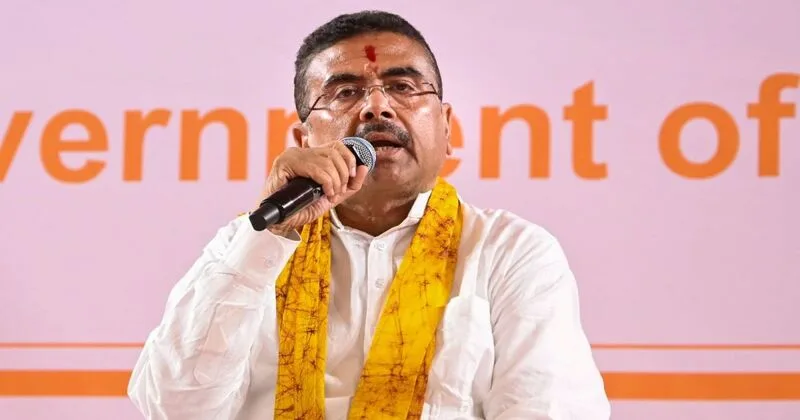
West Bengal Chief Minister Suvendu Adhikari on August 28, launched a sharp criticism of slogans and symbols that he said were contrary to patriotism and national unity, specifically questioning the “Lal Salam Kishenji” mural at Jadavpur University and slogans demanding “Azadi”.
Speaking at a Raksha Bandhan programme in his Bhawanipur Assembly constituency in south Kolkata, Adhikari spoke about the significance of the festival, India’s freedom struggle and the sacrifices made by freedom fighters before turning his attention to political slogans and activities at educational institutions.
His remarks focused particularly on the slogans being raised in Kolkata and the political messaging visible on university campuses.
‘Azadi’ slogans pain me, says Adhikari
Adhikari said seeing “Azadi” slogans on the streets of Kolkata caused him pain and questioned the meaning of such slogans in independent India.
“When I see ‘Azadi’ slogans on the streets of Kolkata, it pains me. What is this freedom for?” he said.
He invoked the sacrifices made during India’s freedom movement and referred to personalities such as Netaji Subhas Chandra Bose and Matangini Hazra.
Adhikari said India had achieved Independence in 1947 after a long struggle and argued that the sacrifices of those who fought for freedom should not be forgotten.
His comments came a day after he had also warned that people raising certain “Azadi” slogans could face police action.
Adhikari had said slogans such as “Inquilab Zindabad” could be raised but claimed that people raising “Azadi” slogans would face cases. He had also referred specifically to slogans such as “Kashmir demands freedom” while speaking about possible police action.
Questions Kashmir slogans in Kolkata
Adhikari also questioned why slogans concerning Kashmir were being written on the streets of Kolkata and at Jadavpur University.
He described Jadavpur University as a centre of excellence but questioned the presence of slogans such as “Kashmir demands freedom” on its premises.
“Kashmir has been the subject of several wars and considerable conflict between India and Pakistan. Then why should ‘Kashmir demands freedom’ be written on the streets of Kolkata?” he said.
His comments were directed at what he described as political slogans that question India’s position on Kashmir.
The Chief Minister’s remarks placed Kashmir-related slogans within the larger issue he was raising about patriotism and national unity.
‘What are you teaching the new generation?’
Adhikari also specifically questioned the “Lal Salam Kishenji” mural on the walls of Jadavpur University’s arts department.
He said he felt sad when he saw the mural and questioned the message being conveyed to young people.
“I feel sad seeing ‘Lal Salam Kishenji’ written on the walls of Jadavpur. What are you teaching the new generation? Who is Kishenji?” he said.
Kishenji, whose real name was Koteshwar Rao, was a senior Maoist leader who was killed in a police encounter in West Bengal in November 2011.
Adhikari questioned the glorification of Kishenji and the presence of such a mural on a university campus.
His comments specifically focused on what students might learn or understand from seeing a Maoist leader being honoured through a mural.
‘No more Lal Salaam to Kishenji’
Expanding his criticism, Adhikari called for an end to slogans honouring Kishenji.
He said there should be “no more Lal Salaam to Kishenji”, linking the slogan to his criticism of the mural at Jadavpur University.
He also objected to slogans related to Palestine.
Adhikari said there should be “no more Free Palestine” slogans and instead called for people to raise the issue of Pakistan-occupied Jammu and Kashmir (PoJK).
He also said there should be no siding with what he described as forces seeking to “break India”.
The remarks brought together his objections to the Kishenji mural, Kashmir-related slogans and Palestine-related slogans under his broader argument about national unity.
Patriotism and Raksha Bandhan
At the Raksha Bandhan programme, Adhikari also spoke about the relationship between the festival and patriotism.
He said Raksha Bandhan has religious significance as it celebrates the bond between brothers and sisters, but added that patriotism has also become associated with the festival.
He referred to the country’s armed forces and said they were responsible for dealing with threats from outside India.
At the same time, he spoke about people within the country whom he accused of acting against national interests.
According to Adhikari, India had demonstrated its strength against external enemies and would continue to do so. He argued that a similar resolve was required against people whom he accused of attacking patriotism, nationalism, Vande Mataram and the national anthem from within the country.
He said forces working to divide the country should be dealt with firmly.
Questions objections to Vande Mataram
Adhikari also raised the issue of Vande Mataram, questioning objections to the complete version of the national song.
“Vande Mataram was not written by any political leader. It was written by Bankim Chandra Chattopadhyay. What is there to object to?” he said.
He referred to the song’s author, Bankim Chandra Chattopadhyay, while questioning why there should be opposition to the song.
His remarks formed part of his wider comments on patriotism, national symbols and the way such symbols are viewed in public and educational spaces.
Raises issue of drugs on campuses
Adhikari also raised the issue of drug use, calling for an end to drugs on educational campuses.
He included the issue among several concerns that he said needed attention in relation to educational institutions.
Along with drugs, he questioned the presence of former students in hostels that are meant for current students.
He asked why ex-students were living in hostels intended for those currently enrolled, raising questions about the use of student accommodation.
These remarks broadened his comments from political slogans and murals to issues concerning campus administration and student facilities.
NCC in schools and colleges
Adhikari also announced efforts to introduce the National Cadet Corps (NCC) in all schools and colleges across West Bengal.
He said the move would help promote discipline and patriotism among young people.
The proposed expansion of NCC participation formed part of his emphasis on youth, national institutions and patriotic values during the Raksha Bandhan programme.
Bengal’s freedom struggle and cultural heritage
During his address, Adhikari also referred to Bengal’s contribution to India’s cultural and freedom heritage.
He mentioned personalities including Chaitanya Mahaprabhu, Ramakrishna Paramahamsa and Rani Rashmoni while speaking about Bengal’s spiritual and cultural identity.
He said efforts were being made to restore aspects of Bengal’s cultural identity that, according to him, had been lost over time.
His references to Bengal’s historical and cultural figures came alongside his discussion of India’s freedom struggle and patriotism.
Jadavpur University at the centre of controversy
Adhikari’s remarks have brought the “Lal Salam Kishenji” mural at Jadavpur University into renewed focus.
His criticism centres on the message conveyed by the mural and whether a Maoist leader should be commemorated on the walls of an educational institution.
The issue has also been linked by Adhikari to the broader question of slogans being raised on university campuses, including “Azadi” and “Kashmir demands freedom”.
His comments reflect his stated concern that educational institutions should not become spaces for messages that he believes challenge India’s national unity.
The remarks come against the backdrop of continuing political debate in West Bengal over campus politics, nationalism and freedom of expression.
Adhikari’s wider message
Across his address, Adhikari repeatedly returned to the themes of patriotism, national unity and the country’s freedom struggle.
His criticism covered the “Lal Salam Kishenji” mural, “Azadi” slogans, Kashmir-related slogans and “Free Palestine” messaging. He also questioned objections to Vande Mataram and raised concerns about drugs and hostel accommodation.
His call for “no more Lal Salaam to Kishenji” was directly linked to the mural at Jadavpur University, while his opposition to “Free Palestine” slogans was accompanied by his call to raise the issue of Pakistan-occupied Kashmir.
He also reiterated his opposition to what he described as forces seeking to “break India”.
The comments have placed Jadavpur University, political expression and nationalism at the centre of a fresh debate in West Bengal.