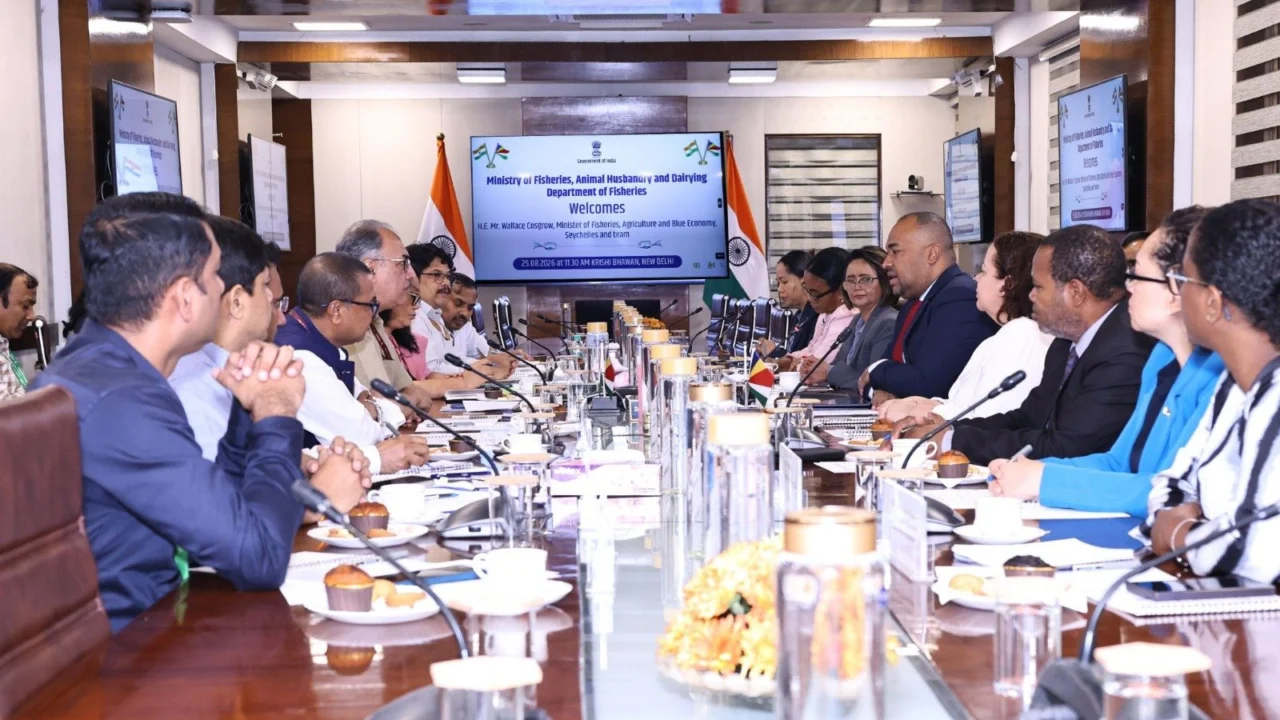
India and Seychelles are set to strengthen their cooperation in fisheries, aquaculture and the blue economy, with both countries identifying sustainable management of marine resources as an important area of their bilateral partnership.
The agreement was reached during a high-level bilateral meeting hosted by the Department of Fisheries under the Ministry of Fisheries, Animal Husbandry and Dairying in New Delhi on August 25.
The Seychelles delegation was led by Minister of Fisheries, Agriculture and Blue Economy Wallace Cosgrow, while the Indian delegation was headed by Secretary, Department of Fisheries, Dr Abhilaksh Likhi.
The meeting reviewed existing cooperation mechanisms and explored new areas in which the two countries can work together to promote sustainable use of marine resources, strengthen technical capabilities and support economic development linked to the ocean.
Focus on sustainable marine resources
At the meeting, India reiterated its commitment to expanding technical cooperation with Seychelles across fisheries, aquaculture, scientific research and capacity building.
Both sides recognised that these areas have importance beyond the fisheries sector, particularly for food and nutritional security, employment and socio-economic stability in the Indian Ocean Region.
The discussions highlighted fisheries and the broader blue economy as potential drivers of sustainable economic growth.
For Seychelles, an island nation with a strong dependence on marine resources, fisheries and the blue economy are closely linked to livelihoods and economic activity. For India, strengthening cooperation in the Indian Ocean also provides an opportunity to share its expanding technical expertise, infrastructure and experience in fisheries management.
The two sides therefore explored ways to move beyond broad cooperation and develop specific programmes, technical exchanges and joint projects.
India highlights growth of fisheries sector
During the discussions, India shared the scale and growth of its domestic fisheries sector.
India’s fish production has reached 19.7 million tonnes, while seafood exports are valued at USD 8.46 billion.
The Indian delegation also highlighted initiatives undertaken in areas such as sustainable fisheries management, responsible harvesting and technology-driven infrastructure development.
These experiences could provide opportunities for knowledge sharing with Seychelles, particularly in areas where modern technology and scientific approaches can contribute to better marine resource management.
The discussions also focused on the importance of ensuring that increasing economic activity in fisheries does not undermine the sustainability of marine ecosystems.
Responsible harvesting, scientific assessment of fish stocks and improved monitoring were therefore among the areas identified for closer cooperation.
Tuna fisheries emerge as key area
Tuna fisheries were among the important areas discussed by the two sides.
Both countries explored potential cooperation in tuna fisheries, including fish stock assessment, processing and value-chain development.
Tuna is an important component of the Indian Ocean’s fisheries economy, making scientific management and sustainable harvesting important for the long-term health of the sector.
The two sides also discussed opportunities for strengthening tuna processing and encouraging product diversification.
Developing stronger value chains could allow greater value to be generated from marine resources while creating opportunities in processing and related activities.
The discussions also examined ways to ensure more sustainable management of fish waste, making waste reduction and utilisation part of a broader effort to improve resource efficiency.
Cooperation in aquaculture and hatcheries
Aquaculture was another major component of the discussions.
India and Seychelles explored potential collaboration in marine aquaculture and modern hatchery systems, with technology and knowledge transfer forming an important part of the proposed cooperation.
Modern hatcheries can support the development of aquaculture by improving production systems and providing reliable supplies of quality fish seed.
The two countries discussed opportunities for technical studies, institutional training and exchange of expertise to strengthen capabilities in this area.
Such cooperation could also include exposure to best practices and technical approaches being used by institutions in both countries.
Science and technology at the centre
Scientific research is expected to play a significant role in the proposed cooperation.
The two sides discussed fish stock assessment, marine conservation and fisheries research, recognising the importance of scientific evidence in managing marine resources sustainably.
Better information about fish stocks can help governments make informed decisions about harvesting and conservation.
The countries also explored opportunities for faster commercialisation of joint scientific research, suggesting a focus not only on generating research but also on translating scientific findings into practical applications.
Reciprocal access to laboratories was another area discussed as part of efforts to encourage greater institutional cooperation.
The proposed approach could allow researchers and technical experts from both countries to work more closely and benefit from specialised facilities and expertise.
Digital transformation and artificial intelligence
Technology was another important part of the discussions.
India and Seychelles explored cooperation in fisheries data systems and monitoring, control and surveillance infrastructure.
Digital systems can play an important role in improving the collection and management of fisheries information and strengthening oversight of marine activities.
The two countries also examined the potential use of artificial intelligence in harvest management.
The use of emerging technologies could help improve decision-making by combining fisheries data, monitoring systems and scientific information.
The discussions indicate that future cooperation will not be limited to traditional fisheries practices but could also involve digital tools and technology-driven management systems.
Strengthening fisheries value chains
Beyond catching and producing fish, the two sides also examined the wider fisheries value chain.
Particular attention was given to tuna processing and product diversification.
The objective is to explore ways of generating greater economic value from fisheries while creating opportunities for employment and investment.
Post-harvest technology was also discussed, reflecting the importance of reducing losses and maintaining the quality of fish and seafood products after harvesting.
Improved post-harvest systems can strengthen the connection between production and markets while supporting the development of a more efficient fisheries sector.
The management of fish waste was also included in the discussions, with both sides looking at ways to promote more sustainable use of marine resources throughout the value chain.
Capacity building and institutional exchanges
India and Seychelles also placed emphasis on capacity building.
The two sides discussed technical studies, fisheries extension services and institutional training programmes as potential mechanisms for transferring knowledge and strengthening expertise.
They also explored mutual exposure visits and specialised technical exchanges.
An important proposal was to make greater use of national Centres of Excellence in both countries for institutional capacity building and the sharing of best practices.
Such exchanges could bring together government officials, researchers, academics and technical specialists, allowing both countries to learn from each other’s experiences.
The Seychelles side stressed the importance of institutionalising engagement between administrative authorities, academic institutions, researchers and technical experts.
Regular interaction would help ensure that cooperation continues beyond individual meetings and develops into sustained programmes.
Push for a bilateral fisheries and aquaculture MoU
The Seychelles delegation expressed interest in expediting the implementation of a bilateral Memorandum of Understanding focused specifically on fisheries and aquaculture.
The proposed MoU would be supported by an advanced work plan, providing a structured framework for cooperation.
Both sides also stressed the importance of having a structured annual work plan to ensure that discussions translate into measurable activities.
Regulatory alignment, joint pilot projects and faster implementation of scientific research were identified as important elements for sustaining cooperation.
The emphasis on annual planning reflects an effort to make bilateral engagement more systematic, with clear areas of work and continued institutional follow-up.
Deepening India’s maritime partnership with Seychelles
The fisheries discussions also form part of the broader maritime relationship between India and Seychelles.
As two countries with strong interests in the Indian Ocean, cooperation in marine resources provides an avenue for combining economic development with environmental sustainability.
Fisheries, aquaculture and the blue economy have the potential to support employment, food security and coastal livelihoods, while scientific cooperation can help ensure that marine resources are managed responsibly.
The discussions in New Delhi therefore focused on building practical cooperation around shared interests rather than limiting engagement to policy-level dialogue.
The proposed technical exchanges, joint research, pilot projects and institutional programmes could provide a framework for sustained engagement between the two countries.
From diplomatic partnership to practical cooperation
The meeting concluded with India and Seychelles reaffirming their commitment to converting their existing diplomatic partnership into practical and result-oriented initiatives.
The focus will be on sustainable fisheries, stronger aquaculture capabilities, scientific research, technology adoption and the development of the blue economy.
The discussions also highlighted the importance of creating stronger fisheries value chains, improving post-harvest systems and developing modern approaches to monitoring and management.
For Seychelles, closer cooperation with India can provide access to technical expertise, research capabilities and institutional knowledge. For India, the partnership offers another avenue to deepen its engagement with an important Indian Ocean partner while contributing to sustainable marine resource management.
The proposed fisheries and aquaculture MoU, annual work plans, joint pilot projects and institutional exchanges could give the cooperation a more structured foundation in the coming period.
The broader objective remains to ensure that the economic potential of the ocean is harnessed without compromising its sustainability.
As India and Seychelles move towards greater cooperation in fisheries, aquaculture and the blue economy, the partnership is expected to increasingly focus on technology, science, skills and practical projects that can contribute to long-term maritime prosperity and sustainable development in the Indian Ocean Region.