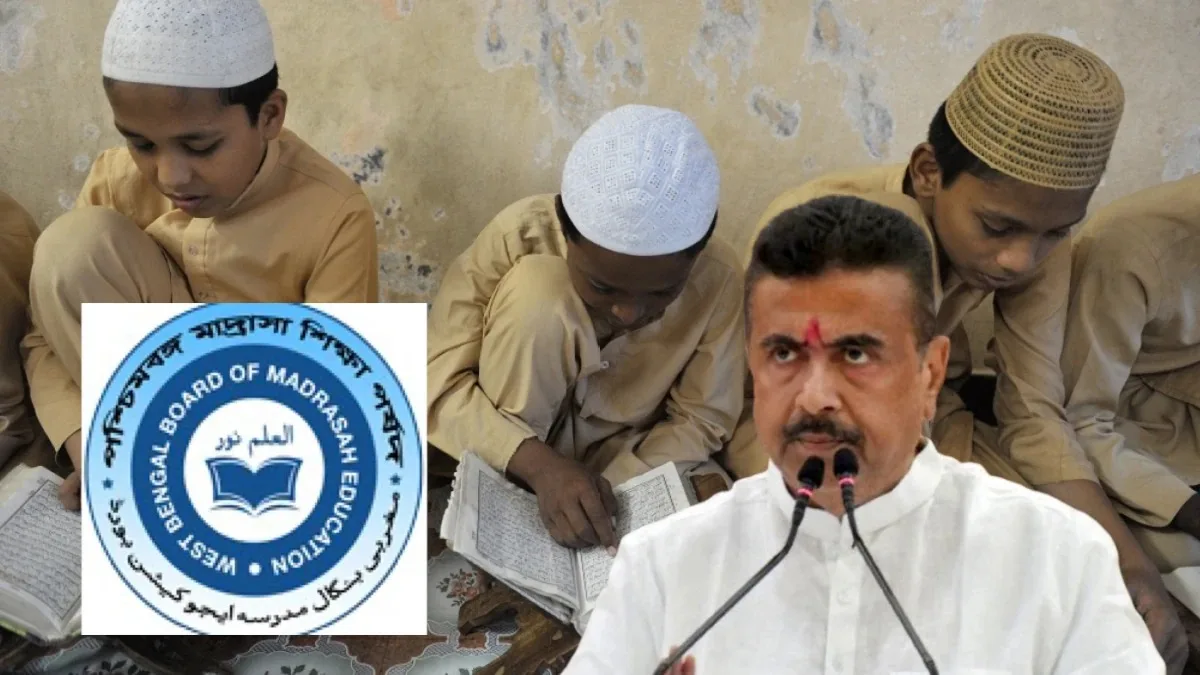
KOLKATA: In a major administrative reform aimed at bringing greater uniformity and transparency to teacher recruitment, the BJP-led West Bengal government under Chief Minister Suvendu Adhikari has abolished the separate Madrasa Service Commission and merged madrasa teacher recruitment with the West Bengal School Service Commission (WBSSC).
Announcing the decision, Chief Minister Suvendu Adhikari said the Madrasa Service Commission had been revoked and merged with the School Service Commission, meaning that recruitment to state-aided madrasas will now take place through the common school recruitment framework.
The move marks a significant shift away from a parallel recruitment structure. Instead of maintaining a separate commission for madrasa appointments, the government is seeking to bring recruitment under a single institutional framework, with the stated objective of making the process faster, more uniform and less vulnerable to irregularities.
🚨 BIG: SURGICAL STRIKE BY CM SUVENDU AS WEST BENGAL GOVT ABOLISHES MADRASA SERVICE COMMISSION! 🔥
The WB govt has dissolved the separate Madrasa Service Commission, merging madrasa teacher recruitment with the West Bengal School Service Commission (WBSSC).
➡️ One commission.…
— Megh Updates 🚨™ (@MeghUpdates) October 6, 2026
One State, One Recruitment Framework
The decision fits into the Adhikari government’s broader effort to overhaul recruitment mechanisms in West Bengal. The Chief Minister has previously stated that major government recruitments should be handled through independent recruitment bodies to reduce the scope for political interference.
For the BJP government, the abolition of the separate madrasa recruitment body represents a move towards a common recruitment architecture rather than maintaining parallel systems for different categories of institutions.
The government has also taken steps to restructure education-related bodies after taking office. In May, the new administration terminated the tenure of several office-bearers and members appointed by the previous government to education boards and recruitment bodies, including the School Service Commission.
Tougher Scrutiny of Madrasas
The recruitment overhaul comes alongside a wider verification drive ordered by the Suvendu Adhikari government.
A state-wide survey covering all 22 districts and Kolkata reportedly found 2,132 madrasas operating with proper approval, while 2,396 were functioning without the required government or board authorisation.
Following the verification exercise, the government ordered the closure of 252 madrasas and issued show-cause notices to around 100 others, with further action dependent on the responses submitted by those institutions. Officials said the action was linked to deficiencies including lack of requisite approvals and basic infrastructure.
The government has maintained that madrasas operating with the necessary approvals will continue to function, framing the exercise as an administrative and regulatory crackdown on unauthorised or non-compliant institutions rather than a blanket action against madrasas.
From Separate Structures to Common Standards
The latest decision therefore forms part of a larger policy direction: government recognition, administrative accountability and recruitment standards are to be applied through a more unified system.
The government argues that the objective is not to target legitimate educational institutions, but to ensure that institutions receiving state support operate within the law and that appointments are conducted through a transparent recruitment mechanism.
The abolition of the Madrasa Service Commission could consequently become one of the most consequential education-administration decisions of the new BJP government, signalling a departure from the separate recruitment architecture that had existed for madrasa institutions.