
National Security Advisor Ajit Doval’s arrival in Beijing and his scheduled 25th round of Special Representatives talks with Chinese Foreign Minister Wang Yi on August 25 are not just another diplomatic engagement. They are the decisive checkpoint that will determine whether the fragile thaw in India-China relations can hold — or whether it remains hostage to the unresolved border. The timing is deliberate.
The meeting comes just weeks before India hosts the BRICS Summit on September 12-13, where Chinese President Xi Jinping is widely expected to travel. A successful Modi-Xi interaction on the sidelines could project an image of Asian giants managing their differences maturely. But both sides know the truth: without tangible progress or at least credible assurances on the border, any high-level optics will ring hollow.
This marks the second high-level engagement between India and China in just a few weeks. On August 6, the two countries held talks under the Working Mechanism for Consultation and Coordination (WMCC), focusing on boundary delimitation, border management, institutional mechanisms, and trans-border cooperation.
These developments come as India has gradually smoothed ties with China over the past two years through partial disengagement in eastern Ladakh, the creation of buffer zones along the Line of Actual Control (LAC), and reciprocal limited patrolling arrangements along the de facto India-China border. But the situation along the border has not returned to its pre-2020 state.
Border remains the non-negotiable core
India has been consistent and blunt. External Affairs Minister S. Jaishankar has repeatedly stressed that peace and tranquillity along the Line of Actual Control (LAC) is the prerequisite for normal bilateral ties. New Delhi’s position is clear — trade, people-to-people contact, multilateral cooperation and summit-level meetings can expand only if the frontier stays quiet and mechanisms to prevent friction are strengthened.
China, for its part, speaks of “in-depth communication” on the boundary question and “jointly safeguarding peace and tranquillity.” The Chinese Foreign Ministry has framed the Special Representatives mechanism as the main channel for negotiations. Yet the underlying reality has not changed: the 3,488-km disputed border, the legacy of the 2020 Galwan clash, incomplete disengagement in some sectors, and recurring reports of activity in areas such as Arunachal Pradesh continue to cast a long shadow.
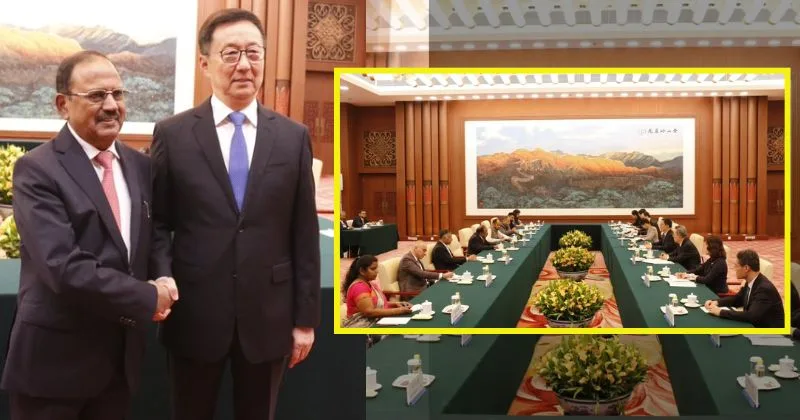
On 25 August, NSA and Special Representative on the India-China Boundary Question, Shri Ajit Doval called on H.E. Han Zheng, Vice President of the People's Republic of China. Prior to the 25th Round of the SR Talks today, NSA and VP Han discussed ways to strengthen peace &… pic.twitter.com/Mm34aOiAp6
— India in China (@EOIBeijing) August 25, 2026
India-China Meet – What is really being tested?
Doval and Wang will review the status of earlier disengagement agreements, discuss confidence-building measures, border management protocols, and explore the possibility of “early harvest” steps on delimitation in less contentious sectors. They will also take stock of the broader relationship — flights, visas, trade, and multilateral coordination. But the real test is simpler and more brutal.
Can the two sides move beyond managing incidents to creating conditions that allow the relationship to breathe? Or will the talks produce yet another carefully worded statement that papers over the fundamental trust deficit? A positive outcome — clearer protocols, reduced troop presence in sensitive areas, or concrete forward movement on expert groups for boundary delimitation — would give both capitals the political space to expand engagement ahead of BRICS. A stalemate or mere reiteration of known positions would signal that the border continues to dictate the ceiling of the relationship.
India is not seeking confrontation. It is insisting on reciprocity and predictability. The decision to send Doval to Beijing at this juncture reflects New Delhi’s willingness to engage, but only on terms that prioritise security on the frontier. China, hosting the talks and preparing for Xi’s possible India visit, faces its own calculus: whether limited concessions on the border are worth the strategic and political gains of a smoother BRICS outing and improved optics with India. For now, the equation remains unchanged.
Everything else — trade volumes, summit handshakes, multilateral statements — is secondary. Border first. Everything later. That is why these talks matter far more than the formal agenda suggests. They are the real stress test of whether the post-2020 stabilisation is sustainable, or whether it is still one incident away from unravelling.