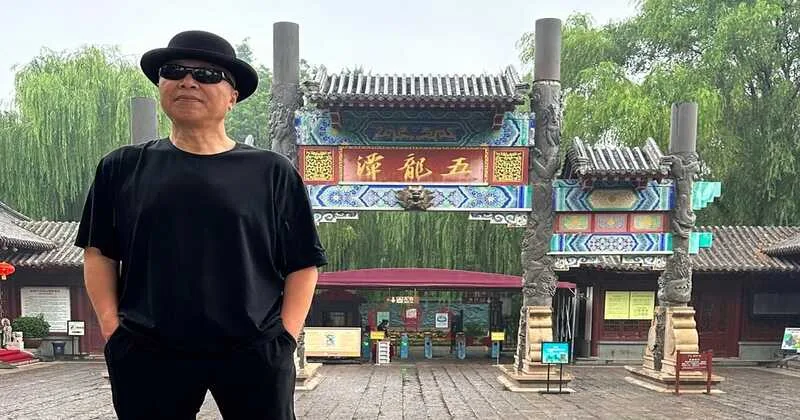
Beijing has sentenced Chinese artist Gao Zhen to three years in prison over artworks he created nearly two decades ago, highlighting growing concerns that the Chinese Communist Party (CCP) is increasingly turning criticism of China’s leaders into a criminal offence. The prosecution of the 70-year-old artist has drawn attention to Beijing’s expanding crackdown on political expression, criticism of Communist Party leaders and artistic depictions considered offensive to the Chinese regime.
Gao Zhen was sentenced on August 25 by a court in Sanhe, a city in China’s Hebei Province, after being convicted of insulting “heroes and martyrs.” Chinese police arrested the artist in August 2024 when he returned from New York to visit his family in China. Gao, a U.S. permanent resident who moved to the United States in 2022, has remained in Chinese custody since his arrest.
The case against the Chinese artist centres on artworks he created in China between 2005 and 2009, including Mao’s Guilt, a statue depicting former Chinese Communist Party leader Mao Zedong kneeling. The prosecution has raised concerns that the CCP is using newer criminal provisions to investigate and punish artistic and political expression that took place years before the relevant laws existed. According to human rights groups, Gao Zhen has decided to appeal his conviction and three-year prison sentence.
China’s retroactive prosecution raises concerns
The case of Gao Zhen has also sparked fresh concerns over China’s use of exit bans. The Chinese artist’s wife, who is also a U.S. permanent resident, and their young son, a U.S. citizen, have reportedly been barred from leaving China since mid-2024. Gao Zhen’s family situation has added an international dimension to the Chinese Communist Party’s prosecution of the artist.
The prosecution appears intended not only to punish Gao Zhen for his earlier artwork but also to send a broader warning that criticism, mockery or artistic depictions involving China’s Communist Party leaders can increasingly be treated as political matters. The case sends a warning to people living outside China that returning to China could expose them to legal action for conduct or expression dating back many years.
China adopted the Law on the Protection of Heroes and Martyrs in 2018. Three years later, China amended its Criminal Code to create the offence of insulting “heroes and martyrs,” making such conduct punishable by up to three years in prison.
However, these legal provisions did not exist when Gao Zhen created the artworks at the centre of his prosecution between 2005 and 2009. The case has therefore generated concerns about what human rights groups describe as a form of retroactive criminal investigation by the Chinese Communist Party.
Such cases involving older artistic or political expression were relatively uncommon in China in the past. However, the CCP is increasingly investigating conduct dating back as far as two decades, particularly in cases involving alleged insults against Communist Party leaders and figures associated with the history of the Chinese regime.
Xi Jinping and the tightening control over political speech
The environment surrounding criticism of current Chinese leader Xi Jinping is considered even more sensitive. Cases involving alleged insults directed at Xi Jinping could potentially result in longer sentences and may require local procuratorates in China to report such cases to higher-level authorities.
Public servants in China have also been repeatedly warned in recent years to be careful about what they say regarding Xi Jinping, the Chinese Communist Party and the CCP leadership. For CCP members and government employees, remarks involving Xi Jinping or other top Chinese Communist Party leaders can be treated as political violations and could potentially lead to expulsion from the Communist Party or dismissal from government employment.
The central message increasingly conveyed by the Chinese political system is that criticism of Xi Jinping can be directly characterised as a political problem. The discussion surrounding Xi Jinping has reportedly moved beyond online communities and public criticism into private conversations among people working within the CCP and China’s wider state apparatus.
The Chinese Communist Party regime has become increasingly attentive to expressions of dissatisfaction within the government and has used offences involving alleged insults against national heroes or state leaders to punish some individuals. The tightening restrictions on political speech in China have coincided with a broader consolidation of political authority under Xi Jinping and the Chinese Communist Party.
In 2018, China amended its Constitution to remove the two-term limit on the presidency, allowing Xi Jinping to remain in power beyond the previous 10-year norm. Since then, the CCP and the Chinese regime have continued to emphasise political loyalty to the Chinese Communist Party and its leadership.
Against this backdrop, the prosecution of Chinese artist Gao Zhen has become more than a case involving an artwork created nearly two decades ago. The three-year prison sentence highlights growing concerns that China and the CCP are expanding the boundaries of criminal liability for criticism of Communist Party leaders, while reinforcing the message that political expression considered unacceptable by the Chinese regime may carry consequences even many years after it was created.