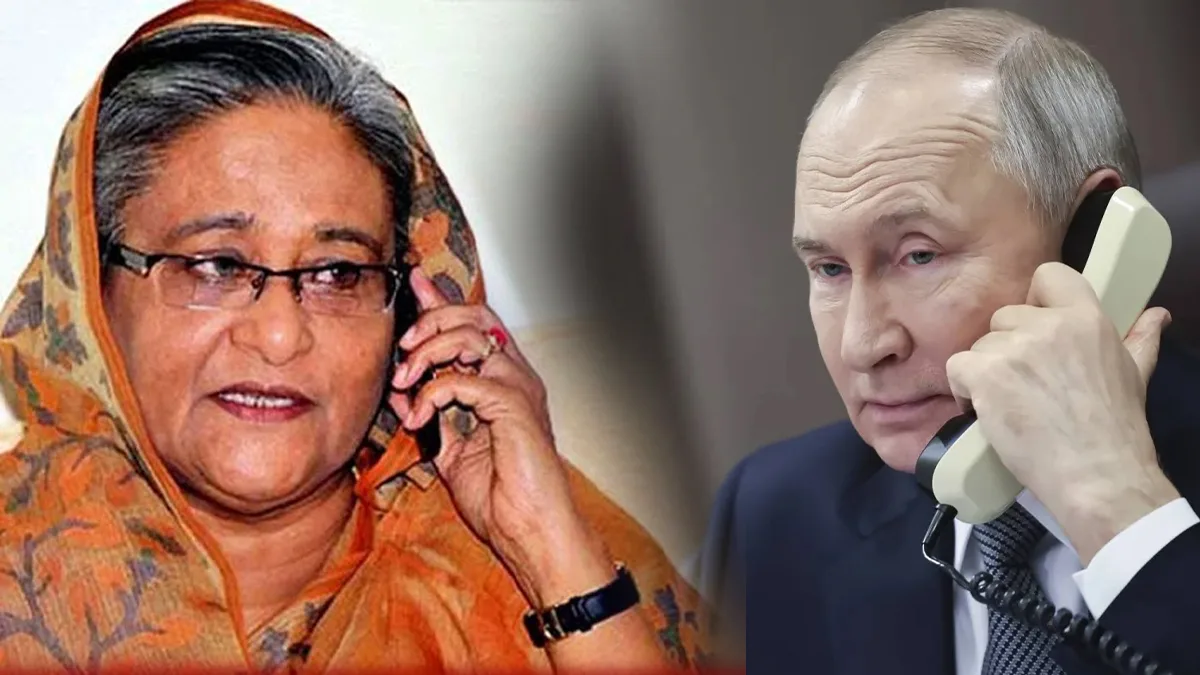
NEW DELHI: Bangladesh’s sudden move to seek a “reset” in relations with India, coming immediately after Dhaka declined to participate in the BRICS Summit in New Delhi, has triggered fresh attention to the changing diplomatic equations surrounding the country. The development comes amid unconfirmed reports circulating on social media and in diplomatic circles that Russian President Vladimir Putin spoke with former Bangladesh Prime Minister Sheikh Hasina during his stay in New Delhi.
According to the reports circulating online, Putin spoke to Sheikh Hasina for nearly 20 minutes during the BRICS Summit. The reported interaction has attracted attention because of the political circumstances surrounding former Prime Minister Hasina, her current presence in India and Russia’s longstanding relationship with her government. As per unconfirmed reports, NSA Ajit Doval was also present in the room during the phone call.
The reported call has not been confirmed by the Government of India, the Russian government or the Kremlin nor by Sheikh Hasina’s side. No official transcript or detailed readout of the reported conversation has been made public.
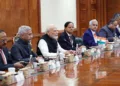
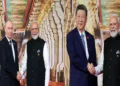
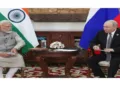
Putin was in New Delhi for the BRICS Summit held on September 12 and 13, where Russia and India discussed their broad strategic partnership and a range of bilateral and international issues. Against that backdrop, the reported Putin-Hasina conversation has added another dimension to the rapidly changing geopolitical environment in South Asia.
The political transition in Bangladesh began in August 2024, when Sheikh Hasina left the country following weeks of student-led protests and a wider uprising against her government. After her departure, Nobel laureate and Grameen Bank founder Muhammad Yunus, who was in Paris at the time, returned to Bangladesh and was appointed Chief Adviser of the interim government on August 8, 2024, following consultations between President Mohammed Shahabuddin, student protest leaders and other stakeholders.
Yunus subsequently headed the interim administration through the political transition and preparations for a national election. The interim period ended after the February 2026 parliamentary election, in which the Bangladesh Nationalist Party secured a decisive victory, paving the way for BNP leader Tarique Rahman to become Prime Minister on February 17, 2026.
Russia, Hasina and the Rooppur connection
The reports suggest that Putin expressed appreciation to Hasina and assured her of Russia’s support regarding the political situation in Bangladesh. The reported conversation assumes significance because Russia has maintained close economic and strategic engagement with Bangladesh, particularly during Hasina’s tenure.
One of the most important pillars of that relationship is the Rooppur Nuclear Power Plant, Bangladesh’s first nuclear power project, being developed with Russian assistance through Rosatom. The project, estimated at around $12 billion, has faced difficulties over payments following the disruption of conventional financial channels involving Russia.
Russia has subsequently explored alternative payment arrangements, including the possibility of settling payments through Indian rupees. The issue has acquired wider significance because India is simultaneously a major economic and strategic partner of both Russia and Bangladesh.
For Moscow, Rooppur is therefore more than a major infrastructure project. It represents an important long-term Russian economic and technological presence in South Asia. Russia has faced growing pressure on some of its overseas strategic and commercial interests following political changes and Western sanctions in other countries.
In Syria, the fall of Bashar al-Assad created uncertainty around Russia’s military presence at the Tartus naval facility and Hmeimim airbase, while Russian commercial interests also came under pressure. In Venezuela, US sanctions have similarly affected Russian energy interests and companies operating in the country. Against this wider backdrop, maintaining its role in Rooppur is important for Russia as it seeks to preserve major overseas projects, economic partnerships and strategic influence.
The reported phone call between Putin and Hasina creates an important convergence around Russia’s interests in protecting its major investment in Bangladesh and maintaining its long-standing economic and strategic relationship with Dhaka.
Dhaka’s sudden call for an India reset
The timing becomes particularly significant because Bangladesh chose not to participate in the BRICS Summit hosted by India on September 12 and 13. Dhaka maintained that the invitation extended to Prime Minister Tarique Rahman was in his capacity as chair of BIMSTEC, rather than specifically as Bangladesh’s Prime Minister.
However, immediately after the summit, Bangladesh signalled a distinctly different approach towards New Delhi.
On September 13, Bangladesh State Minister for Foreign Affairs Humaiun Kobir said Dhaka wanted to “reset” relations with India and establish a new phase of bilateral engagement. He said Bangladesh wanted a “good working bilateral relationship” with India based on mutual interests and direct bilateral discussions. “We want to move towards a new relationship, which should be done through bilateral discussions, not through a multilateral forum,” he said.
His remarks come at a significant moment in India-Bangladesh relations. The relationship has undergone considerable strain following the political upheaval in Bangladesh and Sheikh Hasina’s departure from the country in August 2024. India has nevertheless continued to keep diplomatic channels open with Dhaka.
The proposed reset could open a new phase in India-Bangladesh relations, particularly in areas such as trade, connectivity, energy, border management and regional cooperation. Both countries share extensive geographical, economic and people-to-people links and remain important participants in BIMSTEC and other regional mechanisms.
At the same time, the sudden sequence of events has raised questions about what may have prompted Dhaka’s new diplomatic approach.
The reported Putin-Hasina call, the Russian interest in Bangladesh and the Rooppur project, India’s role in facilitating regional economic links, Bangladesh’s decision to stay away from the BRICS Summit and Kobir’s September 13 call for a reset have all emerged within a remarkably short period.
Whether these reported developments are connected remains an open question. But the sequence has placed Russia, Putin, Hasina, Ajit Doval and the future of India-Bangladesh relations within the same emerging diplomatic conversation.