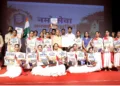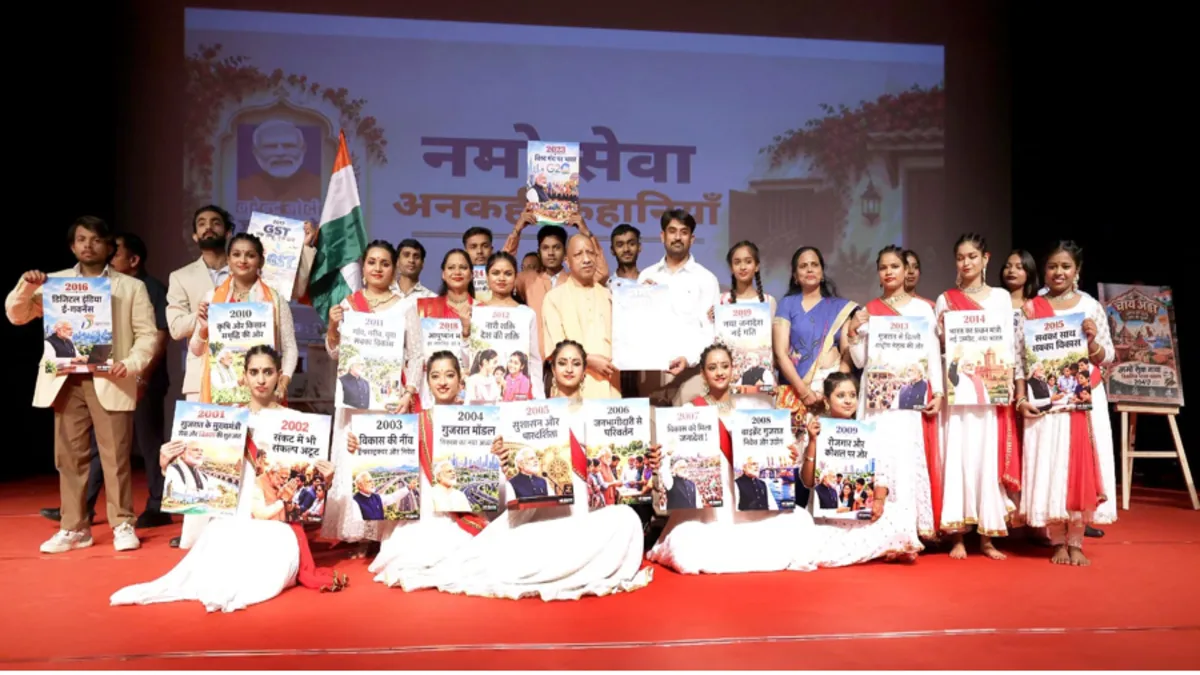
Chief Minister Yogi Adityanath joined the audience at Lucknow Lok Bhavan auditorium for Namo Seva: Ankahi Kahaniyan. Staged by artists of the Bharatendu Natya Akademi under the Seva Sankalp Abhiyan, which is running from 17 September to 17 October, the play marks a milestone few democracies have witnessed, twenty-five years of uninterrupted public service by one leader as the head of an elected government.
Prime Minister Narendra Modi first took oath as Chief Minister of Gujarat on 7 October 2001. Expressing his gratitude after the performance, the Chief Minister described this journey as a remarkable union of Indian heritage and development.
As a commendable effort to carry welfare to every section of society without discrimination. With the production set to travel across all 403 assembly constituencies of Uttar Pradesh, it is a timely reminder that numbers tell only part of a milestone.
Anniversaries in public life usually arrive with predictable rituals: a press release, a few speeches, a round of television debate and then the news cycle moves on. Marking this one through theatre is significant.
Indian civilisation has always relied on performance to carry ideas from one generation to the next. Ramlila, Nautanki, Yakshagana and folk theatre have long done more than entertain. They have carried values, debated ethics and made public memory accessible to ordinary people. Choosing that medium to reflect on a political journey suggests something deeper. Service when understood properly is a cultural value as much as an administrative duty.
A rare continuity in democratic life
Long tenures in power are not unusual in authoritarian systems, but they are remarkable in a democracy, where every five years the voter decides whether a leader stays or goes. In India, with its diversity of languages, castes, regions and interests, winning repeatedly is anything but routine.
It requires a sustained connection with people, earned again in every election. The twenty-five-year journey moves through two distinct phases. The first, in Gujarat that began after the devastating earthquake, at a time when the state needed rebuilding of both infrastructure and confidence.
The second is at the national level from 2014 onwards, carried the lessons of state administration onto a far larger stage. What links the two phases is a consistent approach. Governance is treated as a mission rather than a privilege and delivery is valued over declaration.
Critics may debate individual policies and in a democracy they must. Yet even sceptics concede that this period has redefined voter expectations. Citizens now ask whether a programme reached them, not merely whether it was announced. That shift in public expectation may prove to be one of the most lasting legacies of this era.
Heritage and development; Not rivals but partners
For decades Indian public discourse assumed a false choice. Development was seen as Western-style modernisation, while heritage was treated as a sentimental remnant of the past. Leaders who spoke of civilisational pride were labelled backward-looking.
Those who championed growth were expected to keep their distance from tradition. The past twenty-five years have challenged this binary in a decisive way. The phrase “Vikas bhi, Virasat bhi” captures a philosophy that has shaped policy on the ground.
Restoration and redevelopment of major pilgrimage centres, from Kashi Vishwanath Dham to Kedarnath to the Mahakal Lok in Ujjain, have gone hand in hand with expressways, airports, digital public infrastructure and modern railway networks. The consecration of the Shri Ram Janmabhoomi temple in Ayodhya stands beside semiconductor ambitions and space missions. A nation can be confident about its roots while building for the future.
Heritage-led development has revived local economies, created livelihoods for artisans and small traders. It placed Indian culture back at the centre of how the country sees itself. Yoga global recognition, the return of stolen antiquities and the renewed respect for Indian languages all point in the same direction. A civilisation that had been taught to apologise for itself has started speaking in its own voice again.
Welfare without discrimination
Perhaps the most consequential feature of these twenty-five years lies in how welfare has been delivered. Independent India record on schemes was rarely a record of intention failing. It was a record of delivery failing. Benefits were lost to intermediaries, captured by local power structures, or distributed along lines of caste, community and political loyalty.
The governance model that has emerged turns on a simple principle: saturation without discrimination. If a household qualifies for a scheme, it receives the benefit, whatever its religion, caste, region or voting preference.
Bank accounts under Jan Dhan, clean cooking fuel through Ujjwala, housing under the Pradhan Mantri Awas Yojana, health cover under Ayushman Bharat, tap water under the Jal Jeevan Mission and free food grains for the poor rest on that foundation.
Direct Benefit Transfer, linked to digital identity and mobile connectivity, has cut out layers of leakage that once seemed permanent features of Indian administration.
This is where “Sabka Saath, Sabka Vikas, Sabka Vishwas” moves beyond a slogan. Welfare designed to reach every eligible citizen weakens the old politics of appeasement and vote banks. It treats the citizen as a rightful beneficiary rather than a client of patronage. For a society that has long struggled with exclusion, this is a quiet revolution, measured less in headlines than in kitchens, bank passbooks and hospital admissions.
Uttar Pradesh, where the Lucknow programme was held, is a state once synonymous with administrative inertia now finds itself among the leading implementers of several national schemes. The convergence of central and state efforts has shown that political will, backed by technology and accountability, can transform even the most challenging governance environments.
Seva as a philosophy of power
The name of the campaign itself, Seva Sankalp, deserves attention. In Indian thought, power has never been regarded as an end in itself. The ideal ruler in our traditions is the one who serves, the king is bound by dharma, the administrator who sees the people as the true sovereign. The Prime Minister’s description of himself as a “pradhan sevak” draws directly from this tradition.
Such language can easily be dismissed as rhetoric. It becomes meaningful only when it shapes conduct. Over twenty-five years, a few traits have remained notably consistent with a relentless work schedule, a habit of personally reviewing the progress of projects, an insistence on timelines, and a willingness to take on issues earlier governments considered too politically risky.
Sanitation, toilets in rural homes and the dignity of the poor had never been subjects of prime ministerial priority before. Bringing them into national conversation was itself an act of seva.
The theatre presented in Lucknow reflected exactly this point. The untold stories are not only about one leader. They are about the transformation of what Indians expect from those who govern them.
Leadership for a new India
The idea of ‘New India’ is sometimes treated as a political catchphrase, but it describes a real change in national temperament. India today engages with the world with greater confidence.
It has handled a pandemic, produced and distributed vaccines at scale, built world-class digital payment systems and taken positions on the global stage that reflect its own interests rather than borrowed ideological frameworks. Its G20 presidency placed the concerns of the Global South at the centre of international dialogue.
At home, the vision of Viksit Bharat by 2047 gives a long-term horizon to policymaking that was often missing in the past. The challenge is to sustain momentum. Employment for a young population, agricultural resilience, quality of education and urban planning remain areas where much work lies ahead.
A milestone is a moment for gratitude, but it is equally a moment for resolve. Twenty-five years of service create expectations of the next twenty-five.
Culture as a carrier of seva
The artists who brought the Lucknow presentation to the stage deserve sincere appreciation. Art that engages with public life humanises governance, invites reflection and allows ordinary citizens to connect with ideas that might otherwise feel distant.
If the spirit of seva is to outlast any single leader, it must become a shared social value, carried by volunteers, institutions and communities. Programmes that invite citizens to reflect on service, rather than merely celebrate power, help build that culture.
A milestone that belongs to the people
Ultimately, twenty-five years of uninterrupted public service is not a personal achievement alone. It reflects repeated mandates from millions of voters who chose continuity because they saw delivery. It belongs to the farmers, women, youth, workers and entrepreneurs whose lives became the measure of governance.
‘Namo Seva: Ankahi Kahaniyan’ captured this essence well. It looked beyond the arithmetic of years in office to their meaning, where a governance model brings heritage and development together, that delivers welfare without discrimination and that treats power as a responsibility to serve.
As India moves towards its centenary of independence, the lesson of this milestone is clear. Nations are built not by announcements but by sustained, honest work, carried out year after year, is the most important untold story of all.