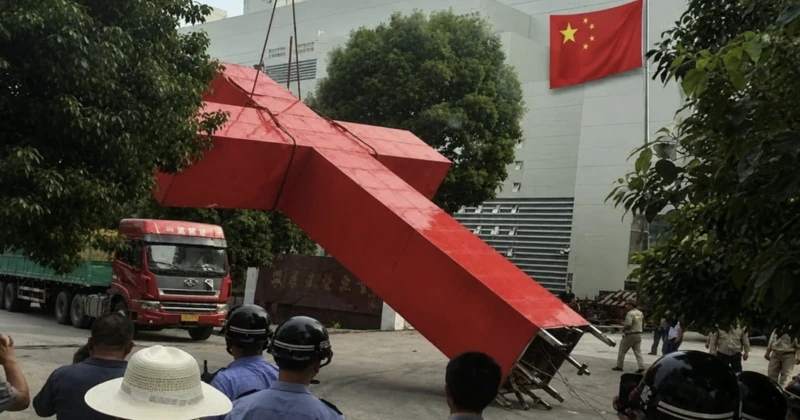
New Delhi: China’s Communist regime is tightening its grip on Catholic religious life, with believers reporting a widening campaign of restrictions affecting Bibles and theology books, pilgrimages, church access, online prayer and even Catholic funeral rites.
Accounts emerging from Catholics in Shanghai and Beijing suggest that the crackdown is increasingly reaching beyond churches and religious institutions into the everyday practice of faith.
The latest reported measure came on August 18, when funeral homes across Shanghai were reportedly ordered to stop conducting Catholic funeral rites from this month. The development, documented by a Shanghai Catholic and posted on X on August 19 by prominent overseas Chinese dissident and citizen-journalism account @whyyoutouzhele, has raised concerns that Communist authorities are extending controls over Catholic worship from the beginning of believers’ religious lives to their final rites.
Religious books disappear as Churches face tighter controls
At Shanghai’s St. Ignatius Cathedral, one of the city’s best-known Catholic churches, local Catholics say the religious goods store has stopped selling Bibles, prayer books and theology-related materials. Theology books reportedly began disappearing from the shelves last year.
According to accounts from believers, staff at the store warned fellow Catholics at the time: “If there is anything you want to buy, hurry up and buy it. After a while, they will all be gone.” Not long afterwards, theology books and other religious materials reportedly disappeared from sale.
The restrictions have also affected access to churches themselves. Reports say that St. Ignatius Cathedral stopped admitting visitors for sightseeing this year. Its main entrance has reportedly been closed, forcing worshippers to use another entrance. It is reported that apart from fellow believers, other people are no longer allowed to enter.
Surveillance, pressure, church closures, and even property seizures how is China using technology and government control to restrict Christianity? And what happens when that technology spreads beyond its borders?#Christianity #ReligiousFreedom #China #Faith pic.twitter.com/DsArp5WBD2
— Billy Hallowell 🙏 (@BillyHallowell) August 20, 2026
Similar restrictions have reportedly appeared in Beijing. Some Catholic churches in the capital have stopped selling Bibles after a notice was reportedly issued by the Religious Affairs Bureau. According to reports, religious materials were removed from shelves in June.
The pattern suggests that the Communist authorities are seeking not merely to regulate formal religious ceremonies but also to control the circulation of Catholic literature and access to religious spaces. For believers, such measures can severely restrict the ability to study theology, obtain Scripture and practise their faith outside tightly controlled settings.
Pilgrimages, online prayer and Catholic funerals targeted
The reported crackdown also extends to organised religious travel. According to the August 19 account, a Catholic attending Mass at a church on the outskirts of Beijing was told by a priest in June that a planned pilgrimage scheduled for July could not proceed.
The priests reveals that the new policies require official approval for such pilgrimages and that obtaining permission has become extremely difficult. They subsequently told parishioners that some religious activities that had previously been possible as group events could no longer continue under the prevailing restrictions, while encouraging them to maintain their faith.
Online religious activities have also come under pressure. Chinese Catholic platforms previously livestreamed the Rosary every evening from the Sanctuary of Our Lady of Lourdes in France, accompanied by Chinese-language translation. Catholics reportedly said the livestream suddenly disappeared in December last year, along with information connected to the broadcasts.
Younger Catholics may still be able to use virtual private networks and other tools to access religious material on platforms such as YouTube, but older believers often lack the technical knowledge required to circumvent China’s extensive internet censorship. The disappearance of Chinese-language religious content therefore risks cutting older Catholics off from an important avenue of participation in religious life.
The latest reported restrictions on Catholic funeral rites mark an especially significant escalation. According to the same August 19 account, all funeral homes in Shanghai may no longer conduct Catholic rites from this month. Catholic funerals traditionally include religious prayers and rites associated with death, memorial services and burial.
Taken together, the accounts from Shanghai and Beijing portray an increasingly restrictive environment for Catholics under China’s Communist system. What began with controls over religious literature and church activities appears to have expanded into pilgrimages, digital religious expression and rites surrounding death.