
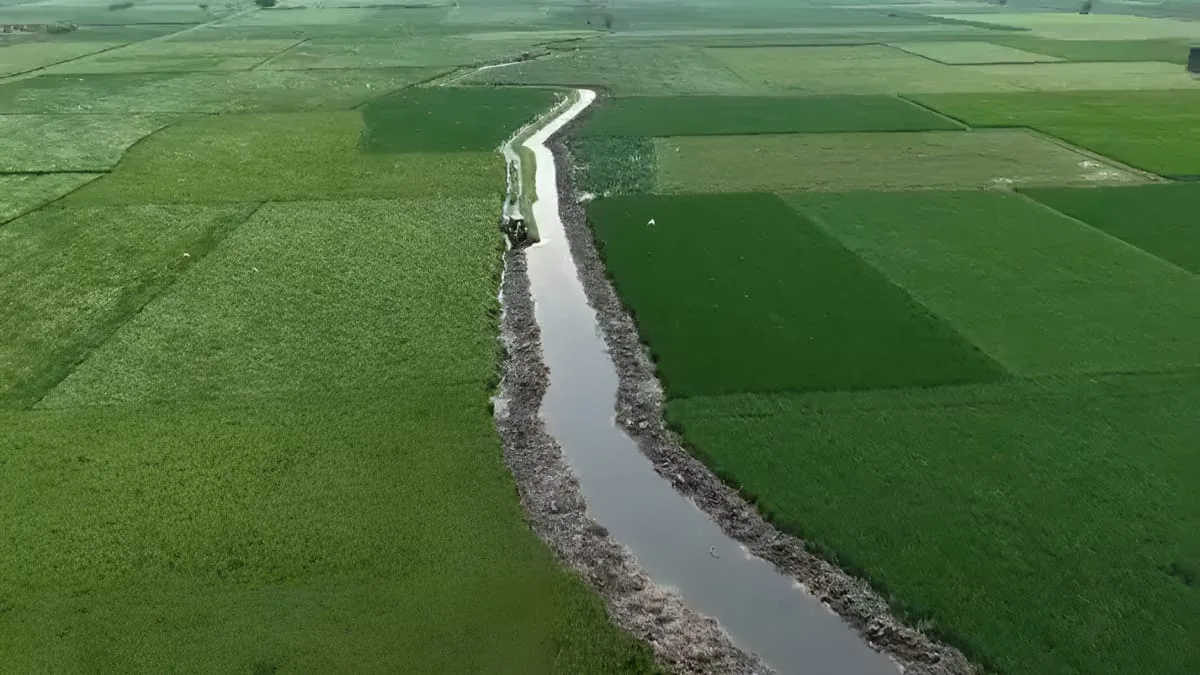
SAMBHAL: A forgotten chapter of Sambhal’s water and cultural heritage is being brought back to life as the historic Mahishmati River, which had disappeared from much of its original course, has been revived through a sustained river-restoration drive. After years of encroachment, siltation and neglect, natural water flow has now returned to the riverbed, marking a significant step in restoring one of the district’s historically important water channels.
This is Mahishmati River in Sambhal.
An ancient, culturally significant river which was lost, has been revived under the One District, One River initiative of UP Govt.
Almost 18 kms of stretch within the district has been successfully reclaimed, excavated, cleared and revived.… pic.twitter.com/bihzm4cDGb
— The Uttar Pradesh Index (@theupindex) September 29, 2026
The revival of Mahishmati is part of Uttar Pradesh’s wider focus on restoring small and seasonal rivers and strengthening traditional water systems. In Sambhal, the administration has undertaken the rejuvenation of five rivers under the district’s river-revival programme, with Mahishmati among the important water channels identified for restoration. Officials have said the 18-kilometre-long Mahishmati is a seasonal river that plays an important role in groundwater recharge and the movement of excess monsoon water.
A river that had almost disappeared
For years, Mahishmati had ceased to resemble a functioning river. Sections of its traditional course had been encroached upon, while other portions had deteriorated into a drain-like channel. Reports from Sambhal have documented the administration’s efforts to identify the original riverbed, conduct surveys, remove encroachments and restore the waterway to its natural form.
The restoration drive formally moved into an active phase in August 2026, when revenue officials began removing encroachments and undertaking excavation work along the river’s identified course. Work began in areas including Rasoolpur Sarai, with excavation and restoration extending towards other parts of the historic channel.
The objective was not merely to clear a drain, but to recreate a functioning natural water channel by recovering its original width, depth and flow path.
18 kilometres of water heritage
Mahishmati is reported to stretch for approximately 18 kilometres within Sambhal district. It is one of the seasonal rivers being restored as part of the district’s broader river-rejuvenation programme.
The restoration involves several interconnected steps: identifying the original river course, measuring its land, freeing the riverbed from encroachments, excavating accumulated earth and restoring the channel so that rainwater and natural runoff can once again move through it.
This approach is significant because a river’s revival is not limited to making water visible. Restoring the channel itself allows the landscape to once again perform the ecological functions associated with a natural waterway.
Water returns where the riverbed had gone dry
The most visible sign of the transformation is the return of water to portions of the restored riverbed. For residents who had seen Mahishmati disappear over the decades, the sight of water moving through its revived course represents more than an infrastructure project. It is the physical return of a water system that had largely survived only in official records, local memory and historical references. Recent reports have also documented visible water in the revived river after the restoration and removal of encroachments.
The return of water can have wider implications for the surrounding landscape. Seasonal rivers help carry excess rainwater during the monsoon and contribute to groundwater recharge. The Sambhal administration has also linked its river-revival programme with rainwater-harvesting measures, including the creation of trenches in barren areas.
Reconnecting Sambhal with its heritage
Mahishmati’s revival carries a cultural dimension as well. Local and administrative accounts describe the river as having historical and religious significance in Sambhal. A 2025 report noted that the river is associated with the district’s network of traditional religious sites and that officials intended to restore its identity alongside its physical water channel.
This makes the project different from a conventional desilting exercise. The effort seeks to restore a landscape feature that formed part of Sambhal’s older geographical and cultural identity.
The administration had earlier conducted surveys with river experts and other officials to understand the condition of the waterway from its upstream to downstream sections.
Part of a larger water-conservation push
The Mahishmati revival is also part of a broader movement to bring neglected small rivers back into the water cycle. Uttar Pradesh’s river-restoration programme has focused on cleaning waterways, removing obstructions, restoring disappearing streams and improving their ecological and economic functions. The state has reported restoration work on rivers including the Gomti, Neem, Karwan, Kali and Sot, alongside efforts involving rainwater harvesting, plantation and community participation.
In Sambhal itself, the administration has been working on five rivers, including the much larger Sot, Mahawa, Vardha Mar and Mahishmati. Officials reported in June 2025 that around 60 per cent of the work across the five-river programme had been completed at that stage. The approach reflects a simple but important principle: protecting water resources does not always require creating new waterways. In many cases, the task is to identify and restore the natural systems that already existed.
A new beginning for an old river
The revival of Mahishmati demonstrates how a river that had almost vanished from the landscape can begin to reclaim its natural identity when its course is mapped, its land is protected and its channel is restored.
What was once remembered as a lost waterway is now showing visible signs of life again. For Sambhal, the return of Mahishmati represents the convergence of water conservation, groundwater recharge, environmental restoration and cultural heritage preservation. The challenge ahead will be to maintain the restored riverbed, prevent fresh encroachments and ensure that the revived channel continues to receive and carry natural flows.
After decades in which the river had largely disappeared from public view, the return of water to Mahishmati offers a striking reminder that restoring India’s traditional water systems can also mean restoring a piece of its living heritage.